Support

Barbacena

About the Airport

Barbacena Airport, bearing the name of Major-Brigadier Doorgal Borges, is not merely an air gateway but a significant part of the aviation history of Brazil. Located in the picturesque state of Minas Gerais, it plays a dual role: serving regional needs and acting as the home for the prestigious Preparatory School for Air Cadets (EPCAr). For the traveller, this means a touch of the world of Brazilian military aviation, even if your journey here does not lie on a scheduled flight.

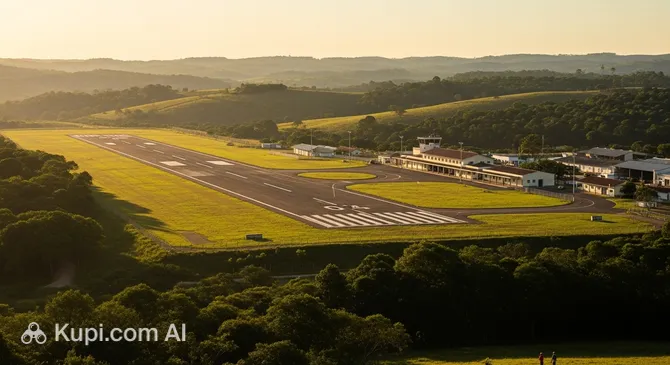
Barbacena. Illustration.
Source: Kupi.com AI
PropertyValue
IATA CodeQAK
ICAO CodeSBBQ
CityBarbacena
CountryBrazil
TimezoneAmerica/Sao_Paulo
ScheduleOnline Timetable

The main feature of Barbacena Airport is its status. It is an active Brazilian Air Force base where future officer-aviators are trained. Due to this, the airport does not serve regular commercial flights. The infrastructure is primarily oriented towards military, training, and private (by special permission) flights. For most tourists planning to visit Barbacena, the main points of arrival will be major international airports, such as Tancredo Neves in Belo Horizonte (CNF) or the airports of Rio de Janeiro (GIG, SDU), from where the city can be reached by bus or car.

Despite the lack of commercial traffic, the airport has an important advantage — it is located just a few kilometres from the city centre. This makes it convenient for government and business aviation needs. Observing the take-offs and landings of training aircraft can be an interesting addition to the impressions of visiting this historic city, known as the "City of Roses".

Contact Information

  • Official Website: At the moment, Barbacena Airport (QAK) does not have an official website intended for passengers, as it mainly serves military and private aviation.
  • Information Desk Phone: There is no unified enquiry service for passengers. For questions related to private or charter flights, it is recommended to contact your air carrier directly.
  • Airport Address: Praça Major-Brigadeiro Doorgal Borges, s/n - Bairro São José, Barbacena, State of Minas Gerais, 36205-018, Brazil.
  • Email: A public email address for general enquiries is not provided.
  • Social Media: The airport does not maintain official pages on social networks for passenger information.
  • Lost Luggage Information: There is no centralised lost luggage service at the airport. All issues related to lost items should be resolved directly with the airline operating the flight.
  • Passenger Support Contacts: Passenger support is provided by representatives of the specific airlines organising flights to Barbacena Airport.

How to Get to the Airport

Barbacena Airport (Aeroporto de Barbacena — Major-Brigadeiro Doorgal Borges) is located very close to the city limits, making the trip there quick and untiring. The distance from the city centre is only about 6–8 kilometres, so the journey usually takes no more than 15–20 minutes if there is no traffic. Since this is a small regional airport, transfer options here are fewer than in major metropolises, but they sufficiently cover the needs of travellers.

Taxi and Transfer are the most popular and reliable way to get to the terminal. You can use the services of local taxi companies or mobile driver-hailing apps popular in Brazil. This is especially convenient if you are travelling with luggage. The cost of a trip from the centre is usually quite reasonable, but it is better to clarify the approximate price with the driver before boarding or check the fare in the app.

Public Transport in Barbacena is represented by buses. There is no special airport express, metro, or trains connecting the city to the airport here. City bus routes pass in the vicinity of the airport; however, this option is suitable only for tourists travelling light who are well-oriented in the area, as walking from the bus stop may be required. This is the most budget-friendly method, but it loses out in terms of comfort and speed.

For those who prefer freedom of movement, car rental is available. You can rent a car in the city centre and drive to the airport yourself. This is an excellent option for exploring the picturesque state of Minas Gerais. You can leave the car in the parking lot at the airport. Usually, the parking zone is located in the immediate vicinity of the terminal, allowing for quick access to check-in.

Given that Barbacena Airport accepts a limited number of flights, many travellers use it as a starting point for private aviation or choose alternative routes through larger transport hubs. If you are planning a complex route, pay attention to neighbouring airports reachable by intercity bus or rented car:

The nearest major alternative is Zona da Mata Airport, located approximately 67 km from the city. It offers more regular flights. For long-haul and international flights, it is more convenient to use major hubs such as Tancredo Neves International Airport in Belo Horizonte (about 182 km) or Rio de Janeiro/Galeão–Antonio Carlos Jobim International Airport in Rio de Janeiro (approximately 178 km).

Also within a radius of 200 km are Santos Dumont Airport, convenient for domestic flights within Brazil, and the airport in the resort city of Angra dos Reis. Plan your journey in advance, considering the transfer time to your chosen departure airport.

Terminals and Map

Barbacena Airport (Major-Brigadeiro Doorgal Borges) is a small regional air hub characterised by an intimate atmosphere and an extremely simple structure. Travellers will not have to study complex maps or use intra-airport transport: the entire complex is designed to ensure maximum speed of service for a small flow of passengers.

There is one passenger terminal operating here, located in a single-storey building. It serves exclusively domestic flights and general aviation. Thanks to its compact size, getting lost here is impossible: all key zones are in direct line of sight from one another, and distances are measured literally in tens of metres.

The Check-in and Departure Zone is located immediately at the entrance to the terminal. Here you will find airline check-in counters (usually only a few) and the security screening point. After completing formalities, passengers enter a small waiting hall. The airport lacks jet bridges ("sleeves"): boarding is carried out by walking across the tarmac, which adds a certain charm to the trip and allows you to view the aircraft up close.

The Arrival Zone is also distinguished by minimalism. Luggage reclamation takes place in a specially designated sector, and often this process takes mere minutes after the aircraft lands. The exit to the city is located next to the baggage claim area, where passengers can be met by taxis or private transport.

Terminal Features are dictated by its status. The infrastructure here is basic: there is a waiting area with seats, washrooms, and, typically, a small point of sale for drinks or snacks. However, travellers should not count on duty-free shops, large restaurants, or business lounges. It is recommended to take care of snacks or charging gadgets in advance, as the choice of services on-site is limited.

The main advantage of Barbacena Airport is the speed of procedures. Queues for check-in and security are a rarity here. Usually, arriving at the airport 40–60 minutes before departure is sufficient to calmly check in luggage and pass through control. Nevertheless, always check your airline's rules, as check-in may close strictly according to schedule.

Navigation Recommendations: orienting yourself in the airport is intuitively simple. Follow the signs (usually in Portuguese and English) or ask the staff, who are always within sight. Since the terminal is small, transitions between zones do not require extra time, making flying through Barbacena one of the most stress-free travel options in the region.

Airport History

The history of Barbacena Airport (QAK), also known as Major-Brigadier Doorgal Borges Airport, is inextricably linked with the military aviation of Brazil. It was founded to serve the Preparatory School for Air Cadets (EPCAr), established in 1949. From the very beginning, the airfield played a key role in training future officers of the Brazilian Air Force, becoming their first runway.

For more than half a century, the airport performed a dual function. From 1954 to 2006, it not only served military needs but also accepted regular commercial flights. During this period, TRIP Linhas Aéreas connected the city with other regions of the country, which was an important stage for economic and social development. For many residents and visitors, this was the main way to reach Barbacena by air.

A significant event in the airport's history was the year 2006, when commercial flights were ceased. Since then, the airport has come entirely under the management of the Air Force and is used exclusively for the needs of the Cadet School. Although it no longer serves civilian passengers, its importance for Brazil's military aviation remains high, as it is here that future pilots hone their skills.

Among interesting facts is the airport's name, assigned in honour of Major-Brigadier Doorgal Borges, a prominent figure in the history of Brazilian aviation. Furthermore, due to its close connection with the cadet school, which is informally called the "Nest of Eagles" (Ninho das Águias), the airfield can be considered a true forge of personnel for the country's Air Force. This is a place where the history and future of Brazilian aviation meet every day.

Services and Amenities

The infrastructure of Barbacena Airport (QAK) corresponds to its status as a small regional air hub. The range of services here is minimal, as the terminal is designed for the rapid transit of passengers who spend very little time in the building before departure or leave immediately upon arrival. Nevertheless, basic amenities for a comfortable wait for a flight are provided here.

Dining and Shops. One should not expect gastronomic delights or shopping at the airport. There is no Duty Free zone or large chain restaurants. Passengers can use the services of a small cafeteria or snack bar (lanchonete), offering coffee, soft drinks, sandwiches, and traditional Brazilian pastries, such as cheese buns (pão de queijo). This is quite sufficient for a light snack, but a full lunch is best planned in the city before arriving at the airport.

Connectivity and Finance. Usually, free Wi-Fi is available in the terminal, however, signal quality and connection speed may vary. It is recommended to have mobile data in case of interruptions. There are few charging stations, so it is worth ensuring your gadgets are charged in advance or carrying a portable power bank. Currency exchange points are absent at the airport. To withdraw cash (Reais), you can look for an ATM (Caixa Eletrônico), but it is most reliable to resolve financial matters in the centre of Barbacena.

Waiting Lounges and Business Services. Barbacena Airport does not have VIP lounges or business lounges. The general waiting hall is equipped with standard seating. Specialised conference rooms or business centres are also not provided on the terminal premises. Due to the compactness of the building, it is quite quiet here, allowing for work calls using a personal headset if necessary.

Services for Passengers with Children and Medical Assistance. Basic amenities, such as a changing table in the restroom, are provided for travellers with small children. There are no children's play areas in the terminal. The medical point operates in a limited mode to provide first aid; in emergency cases, the city emergency service is called.

Accessibility. The airport is equipped in accordance with basic accessibility requirements for passengers with reduced mobility. The entrance to the terminal is equipped with ramps, doorways are wide enough for wheelchair access, and toilets are adapted for people with disabilities. Since boarding the aircraft is done from the tarmac, airport staff provide necessary assistance during boarding and disembarking.

Hotels and Accommodation. There is no hotel on the airport grounds, and sleeping in the terminal is not permitted as it closes at night (operating hours depend on the flight schedule). The nearest hotels are located in the centre of Barbacena, just a 15–20 minute drive away. There, travellers will find accommodation options of various comfort levels — from historic pousadas to modern hotels.

Where to Eat

Given the compact size of Barbacena Airport (QAK), passengers should not expect the gastronomic variety characteristic of large international hubs. There are no food courts, fast-food chain restaurants, or refined dining establishments. Catering is generally represented by one small snack bar (in Portuguese — lanchonete) or cafeteria, satisfying the basic needs of travellers waiting for a flight.

Restaurants and Cafes. The sole dining point is usually located in the public area (landside), before passing through pre-flight security. This means that both departing passengers and those seeing them off can have a snack. In the secure departure area (airside), choices are often limited to vending machines or are entirely absent, so it is recommended to have coffee or a snack immediately upon arrival at the terminal.

Local Cuisine and Specialities. Despite the modest selection, being in the state of Minas Gerais obliges even a small buffet to feature the region's main gastronomic pride — pão de queijo (cheese buns). This is an ideal option for getting acquainted with local traditions: hot, chewy cheese pastries made from cassava flour pair perfectly with strong Brazilian coffee (cafézinho). Local sweets, for example, portioned desserts made of doce de leite (dulce de leche), may also be on sale.

Dietary Needs. For travellers with strict dietary restrictions, finding suitable options at Barbacena Airport will be challenging:

  • Vegetarians: Will be able to find options with cheese (sandwiches, pastries).
  • Vegans: The choice is extremely scarce; it may be necessary to limit oneself to packaged snacks (chips, nuts) or fruit, if available.
  • Gluten-free: Traditional cheese buns (pão de queijo) are usually made from gluten-free flour, but there is always a risk of cross-contamination as they are baked next to regular pastries.
  • Halal and Kosher: Specialized products are not available.

Price Range and Payment. Prices at the airport are usually average or slightly higher than in the city, but do not reach the exorbitant levels of major tourist centres. You will pay a reasonable amount for a coffee with a bun or sandwich. Cash Reais and bank cards are accepted for payment, however, having some cash on hand is always useful in case of terminal failures.

Opening Hours. The opening hours of the food outlet are strictly tied to the flight schedule. The cafe opens shortly before check-in begins for the first flight and closes shortly after the last aircraft departs. If you arrive at the airport during hours when there are no flights, the buffet will likely be closed.

Recommendations:

For a quick snack: Grab a coffee and a couple of fresh cheese buns in the terminal — it is tasty, filling, and authentic.

For a full meal: It is strongly recommended to eat in the city of Barbacena before heading to the airport. In the city centre, you will find numerous restaurants serving rich Minas Gerais cuisine (comida mineira), where you can leisurely enjoy meat dishes, stewed beans, and vegetables, as there will be no such opportunity at the airport itself.

Travel Tips

Arrival Time. Since Barbacena Airport is a small regional hub, there is no need to arrive 3 hours in advance as is customary at international hubs. The optimal arrival time is 1–1.5 hours before departure. This will be sufficient to check in luggage and pass through security without haste. Note that check-in counters close strictly according to schedule (usually 30–40 minutes before the flight), and being even a couple of minutes late can result in denied boarding.

Check-in and Security. It is strongly recommended to complete online check-in in advance via the airline's app. This saves time and allows you to proceed directly to the baggage drop-off counter or security screening if you are travelling light. The screening procedure here is standard but proceeds in a calm manner: queues are practically non-existent. Keep your boarding pass and documents (passport or ID) to hand.

Seat Selection on Board. Flights to/from Barbacena are often operated by small turboprop aircraft (for example, Cessna Grand Caravan). The best advice is to choose a window seat (janela), as flights take place at a relatively low altitude, and you will be able to enjoy stunning views of the mountains and hills of the state of Minas Gerais. Please note: on small vessels, seating may be adjusted by the crew for proper aircraft balancing, so be prepared to change seats at the pilot's request.

Hand Luggage. Carefully check your airline's requirements regarding hand luggage dimensions. Overhead bins in regional aircraft are very compact, and a standard "cabin size" suitcase may not fit. In such a case, it will be taken free of charge at the stairs into the hold and returned immediately after landing (Valet Check procedure). Take only the most valuable and fragile items, as well as soft bags or backpacks, into the cabin. Liquids over 100 ml, sharp objects, and cutting tools are prohibited in hand luggage.

For Connecting Passengers. Barbacena Airport is not a transit hub, so most connections are not provided for here. If you are flying to Barbacena with the intention of further travel through Belo Horizonte or Rio de Janeiro, allow a large buffer of time (minimum 3–4 hours) between flights. A departure delay from a small airport due to weather can disrupt a connection at a large hub. When purchasing separate tickets, remember that luggage will have to be collected and checked in again.

Customs Control. Flights here are exclusively domestic, so there is no customs or passport control (as when crossing a border). However, Brazil strictly monitors phytosanitary standards. It is not recommended to transport fresh fruit, seeds, or plants without factory packaging, especially if you plan to transfer to an international flight in another city.

Saving Time and Money. Food and drinks at the airport may cost more than in the city, and the selection is limited. To save money, bring an empty reusable water bottle (it can be filled after security if there is a drinking fountain) and light snacks. Do not rely on withdrawing cash at the airport — it is better to do this in advance in the city to avoid fees at random ATMs or their absence.

In Case of Flight Delay. Aviation in this region depends on weather conditions (fog in the mountains is not uncommon). Since there is no entertainment in the terminal, and Wi-Fi may be unstable, download films, books, or music to your devices in advance. Carry a portable charger (power bank), as power outlets may be scarce. If the flight is delayed for a long time, check with the airline representative regarding rights to meals and accommodation, but be prepared for the fact that the nearest hotel is in the city, and a taxi will be required.
Reached the end of the page?

That means the route is fully explored