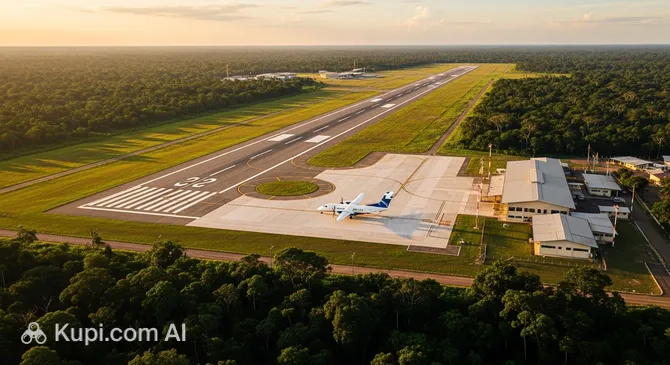
Source: Kupi.com AI
| Property | Value |
|---|---|
| IATA Code | RPU |
| ICAO Code | SBUY |
| City | Coari |
| Country | Brazil |
| Timezone | America/Manaus |
| Schedule | Online Timetable |
| Property | Value |
|---|---|
| IATA Code | RPU |
| ICAO Code | SBUY |
| City | Coari |
| Country | Brazil |
| Timezone | America/Manaus |
| Schedule | Online Timetable |
Given that Porto Urucu Airport (RPU) is a private departmental facility of the Petrobras company and is located within a restricted oil and gas field area, there is no standard tourist information service here. Interaction takes place primarily through corporate channels.
Planning a route to Urucu Airport (RPU) differs fundamentally from a trip to any standard civil airport. Since the air harbour is located in a restricted territory of an oil and gas province deep in the Amazon jungle, usual methods of travel are not applicable here. Access is possible exclusively by air or water, provided you have the appropriate permits.
Below are the logistics details for those interested in the transport system arrangement in this remote corner of the Coari municipality.
Public Transport (Buses, Trains, Metro)
Due to the complete isolation of the Urucu province from Brazil's road network, ground public transport to the airport is completely absent. No roads or railways lead to the terminal from major settlements.
The only conditional analogue of public transport can be considered river connections along the tributaries of the Amazon; however, these deliver passengers not to the airport itself, but to the Porto Urucu river port, from where further internal transport is arranged. There are no regular commercial scheduled trips for tourists.
Taxi and Transfer
There are no classic taxi services (Uber, city carriers) within the province. Transport service is organised as follows:
Car Rental
There are no car rental points at Urucu Airport. Even if rental were possible, there would be nowhere to use the car other than the limited network of internal technological roads, access to which is strictly regulated by security services.
Airport Parking
The parking zone is intended exclusively for special machinery, service buses, and emergency service vehicles. Paid parking services for private individuals are not provided, as private transport is not admitted to the territory.
Approximate Travel Time and Logistics
Since it is impossible to reach the airport by land, travel time is calculated from the nearest major hubs:
Cost of Various Transport Options
For Urucu Airport, the concept of "ticket price" is not applicable in the traditional sense:
Features and Recommendations
If your trip is related to professional activity in this region, consider the following important points:
1. Strict Pass System: Access to board an aircraft flying to Urucu is possible only with a pre-issued pass and inclusion in the passenger lists by the logistics service.
2. Medical Control: Due to the remoteness of the facility and the specific nature of work in the jungle, confirmation of vaccination (particularly against yellow fever) and passing a medical examination are often required before departure.
3. Luggage: Strict luggage weight restrictions apply on flights to Urucu, often more stringent than on ordinary commercial lines, due to the use of smaller aircraft.
The terminal complex of Porto Urucu Airport (RPU) is designed exclusively based on the functional needs of the oil and gas industry. Unlike civil airports, you will not find confusing corridors or multiple levels here. The infrastructure is maximally compact, logical, and tailored for the rapid processing of rotational shifts and cargo.
Number of Terminals and Their Purpose
The airport has one small passenger terminal. This is a single-storey building serving simultaneously as the departure and arrival hall. The terminal services exclusively domestic corporate flights (charters from Manaus and Coari) and air ambulance flights.
Since the airport is not a hub for transit passengers, transfers between terminals do not exist. All processes take place within a single structure, eliminating the need for shuttles or travelators.
Airport Map and Service Zones
The layout of the building is extremely simple and intuitive; it is impossible to get lost here. The internal space is zoned as follows:
Terminal Features
The main characteristic of the Urucu terminal is utility and austerity. There are no Duty Free shops, souvenir stalls, or restaurants here. Infrastructure is limited to the bare essentials:
Processing Times
Despite its compactness, control procedures at Urucu Airport are distinguished by strictness comparable to international aviation security standards, supplemented by corporate requirements.
Navigation Recommendations
For a passenger arriving in Urucu for the first time, navigation will not be difficult. The main rule is to follow the instructions of ground coordinators. Upon arrival, the flow of people is immediately directed to waiting corporate transport (buses or SUVs), which distributes specialists to residential modules or production sites. Independent movement across the apron is strictly prohibited.
The history of Urucu Airport (RPU) is a unique chronicle of man's conquest of nature for the sake of industrial development. Unlike most air harbours in the world, which emerged to connect cities, this airport appeared on the map solely due to the discovery of rich natural resources in the depths of the Amazon.
Inception and Opening
The history of the airport is inextricably linked to 1986, when geologists from Petrobras discovered huge reserves of oil and natural gas in the Solimões River basin. The area where the discovery was made was in complete isolation: impassable jungles and swamps stretched for hundreds of kilometres around. Building roads in such conditions was impossible and ecologically risky.
To deliver equipment and the first shift of specialists, a landing strip was urgently organised. Initially, it was a dirt strip cleared in the middle of the forest, capable of receiving only light aircraft and helicopters. The official start of the airport's operation can be considered the late 1980s, when commercial exploitation of the Urucu field began.
Stages of Development and Modernisation
The development of the air harbour proceeded in parallel with the growth of hydrocarbon extraction. The airport evolved from a temporary site to a full-fledged transport hub:
Records and Achievements
Despite the fact that Urucu Airport is private and closed to the general public, it boasts impressive statistics:
Interesting Facts from History
The existence of Urucu Airport is accompanied by a number of curious features that distinguish it from others:
Firstly, it is one of the few airports in the world that is effectively located on an "island" in the jungle. It is not connected by road to any settlement in Brazil, not even to the administrative centre of the municipality of Coari. Its entire history is a history of autonomous existence.
Secondly, the airport played a key role in preserving the ecology of the region. Thanks to the air bridge, the need to cut multi-kilometre clearings through the jungle for highways was eliminated, which allowed the unique ecosystem of the Amazon to be preserved almost intact around the production facilities.
Today, Porto Urucu Airport continues to be a symbol of technical progress, ensuring the uninterrupted operation of the region's energy heart and the safety of thousands of people working far from civilization.
The infrastructure and service at Porto Urucu Airport (RPU) differ radically from what travellers are accustomed to seeing in civil aviation hubs. Since the airport is a departmental facility serving exclusively rotational staff and specialists of the oil and gas industry, there is no commercial component here. All service is subordinated to one goal — ensuring safety and basic comfort for employees before a flight or immediately after it.
Restaurants, Cafés, and Shops
The terminal lacks the usual cafés, restaurants, coffee shops, or Duty Free stores. You will not find souvenir stalls or newsstands here.
Lounges and VIP Service
There is no division into business classes or VIP zones at Urucu Airport. All passengers, from ordinary engineers to senior management, wait for departure in a common hall.
Communication and Wi-Fi
Access to the internet and mobile communication on the airport territory is strictly regulated by Petrobras security policy.
Financial Services
There are no ATMs, currency exchange points, or bank branches in the terminal. Since cash is practically not used within the production facility (the company takes care of all provisions), there is no need for financial infrastructure here.
Medical Services
This is perhaps the only area where the level of service exceeds many civil airports. Due to the remoteness of the facility and industrial risks, medical provision is given priority attention.
Services for Passengers with Children
Urucu Airport is not intended for family travel. People arrive here exclusively for work purposes. Mother and child rooms, play areas, or changing tables are absent in the terminal.
Accessible Environment
Despite its utilitarian nature, the airport meets basic accessibility standards. Since boarding is carried out from the apron (without airbridges), ground service staff provide necessary assistance during boarding and disembarking for passengers with reduced mobility, if required (for example, during medical transport).
Accommodation: Hotels
There are no commercial hotels (Booking, Hilton, etc.) in the airport itself or near it. Accommodation for arriving personnel is provided in specialised residential modules (alojamentos) located on the production base territory.
Business Services
There are no special conference halls directly in the terminal building. All business meetings, briefings, and conferences are held in the administrative buildings of the field, which are equipped with all necessary equipment for presentations and video conferencing.
The dining situation at Coari (Urucu) Airport (RPU) differs fundamentally from the usual standards of civil aviation. It is important for passengers planning a departure or arrival in this remote corner of the Amazon to know in advance: there are absolutely no commercial food outlets in the terminal. You will not find cafés, restaurants, fast food, or even vending machines with snacks here.
Restaurants and Cafés: The Reality of a Departmental Airport
Since the airport serves exclusively oil and gas industry employees and is located in a restricted area, the concept of a "pre-flight snack" is not implemented here commercially. The terminal building performs a transit function, and infrastructure is limited to the waiting hall. It is impossible to buy food in either the airside or landside zones.
Drinking Water
The only thing passengers can count on inside the terminal is access to drinking water. Water coolers or fountains are usually installed in the waiting hall. Given the hot and humid climate of the region, it is strongly recommended to carry an empty reusable bottle to fill with water before boarding the plane.
Recommendations for Dining Before Departure
Since food cannot be bought at the airport, dining logistics are structured as follows:
Advice for Vegetarians and People with Special Diets
Due to the absence of shops and cafés, passengers with strict dietary restrictions (vegans, gluten-free diet, halal) or specific needs must bring food with them. Do not count on being able to purchase something suitable on-site.
What to Bring: "Strategic Reserve"
To avoid discomfort during the wait for a flight (which can be prolonged due to weather conditions) or the flight itself, we recommend packing the following in your hand luggage in advance:
Remember that all supplies must be brought with you from Manaus or taken from the residential block, as there is simply nowhere to spend money at Urucu Airport — the average bill here is zero.
Travelling through Coari (Urucu) Airport is a non-standard experience even for a seasoned tourist. Since RPU (Urucu) is a private corporate airport serving an oil and gas province in the depths of the Amazon, the rules of the game here are dictated not by an airline, but by the specifics of working at an industrial facility and the harsh conditions of the jungle. Below are tips to help make your business trip or technical visit as smooth as possible.
Arrival Time Recommendations
Unlike civil airports where passengers plan their arrival time themselves, logistics in Urucu are strictly centralised.
Registration and Security Features
Control procedures here resemble entry to a secure facility, which is essentially what the airport is.
What Can and Cannot Be Carried in Hand Luggage
The list of prohibited items here is broader than in ordinary aviation due to safety rules at oil and gas facilities.
Tips for Choosing a Seat on the Plane
Usually, there is no advance online seat selection on charter flights to Urucu; seating may be free or determined by the aircraft's load.
Customs and "Corporate" Control Features
There is no international customs here, as all flights are domestic. However, there is strict entry control to the field territory.
Recommendations for Transfer Passengers
Urucu Airport is a final destination, a dead-end route. Connections occur mainly at Manaus or Coari airports.
Tips for Saving Time and Money
What to Do in Case of Flight Delay
Flight delays and cancellations due to weather conditions are a frequent occurrence in the Amazon.
Reached the end of the page?
That means the route is fully explored