Support

Feira de Santana

About the Airport

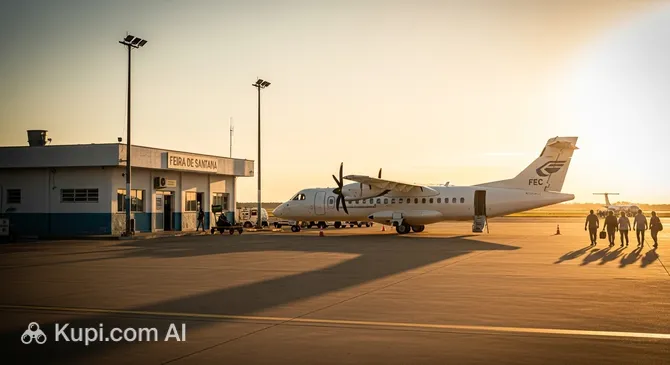
Feira de Santana. Illustration.
Source: Kupi.com AI

Feira de Santana Airport, officially named Governador João Durval Carneiro Airport, serves as the air gateway to one of the most dynamically developing cities in the Brazilian state of Bahia. Despite its modest size, it is an important regional transport hub, providing residents and visitors with connections to other major centres in the country. This air harbour will be a convenient starting point for your journey, whether it is a business trip or an exploration of the culture and sights of Feira de Santana and its surroundings.

PropertyValue
IATA CodeFEC
ICAO CodeSDIY
CityFeira de Santana
CountryBrazil
TimezoneAmerica/Bahia
ScheduleOnline Timetable

The key advantage of the airport is its compactness and functionality. Here, you will not spend much time on pre-flight formalities or finding your boarding gate, making the start and end of your journey more comfortable. The airport mainly serves domestic flights, connecting the region with other parts of vast Brazil. Its proximity to the city, the centre of which can be reached by taxi in just 15–20 minutes, is an undoubted plus for all categories of travellers.

Contact Information

Below is the main contact information for Feira de Santana Airport (Governador João Durval Carneiro Airport), managed by Aena Brasil.

  • Official Website: You will find the most complete and up-to-date information on the official website of the operator Aena Brasil in the section dedicated to the airport: www.aenabrasil.com.br.
  • Help Desk Phone: For information, it is recommended to use the contact forms on the official website. A direct public phone number for inquiries may not be available, as communication is centralised through the operator.
  • Airport Address: Rodovia BR-116 Norte, Km 439, s/n - Bairro Aeroporto, Feira de Santana - BA, 44040-010, Brazil.
  • Email: To contact the airport administration, it is recommended to use the official contact form on the Aena Brasil website.
  • Social Media: You can follow the news of the operator Aena Brasil, which manages the airport, on their official pages in popular social networks.
  • Lost Luggage Information: If your luggage has been lost, first contact your airline's representative. For items left in the terminal, look for information in the "Achados e Perdidos" (Lost and Found) section on the airport website.
  • Passenger Support Contacts: Passenger support is provided at information desks directly in the terminal building, as well as through call centres and online services of the airlines operating flights.

Getting to the Airport

Feira de Santana Airport (FEC) is located just 12 kilometres from the city centre, making the journey there quick and convenient. The most comfortable way to get to the terminal is to use taxis or ride-hailing services, such as Uber or 99, which are widely used in Brazil. The trip from the centre of Feira de Santana will take approximately 20–30 minutes. The estimated cost will be between 35 and 50 Brazilian Reais (BRL) depending on traffic conditions and demand. This is an ideal option for travellers with heavy luggage. You can also book a private transfer in advance — in this case, the driver will meet you at the specified location, and the trip price will be fixed.

For more budget-conscious travellers, public transport is an excellent choice. City buses run to the airport. Although this is the most economical option, be prepared for the trip to take longer — about 40-60 minutes. The fare is significantly lower than a taxi, usually around 4–5 BRL. Routes and schedules may change, so we recommend checking current information at bus stops or with locals. This method is well suited for those travelling light who want to immerse themselves deeper in the local atmosphere.

If you plan to actively explore the surroundings of Feira de Santana and the state of Bahia, car rental will be the best solution. You can rent a car at one of the rental points in the city. The road to the airport by car is simple and convenient, and parking is available at the terminal for both short-term and long-term stays. Renting a car gives complete freedom of movement and allows you to plan your route independently of public transport schedules. Do not forget to check the requirements for driving documents — an International Driving Permit may be required.

Terminals and Map

Feira de Santana Airport (FEC), also known as João Durval Carneiro Airport, is a compact and functional aviation hub serving the city and the surrounding region. Its structure is extremely simple, making navigation convenient even for those visiting for the first time.

The airport operates one passenger terminal, which handles all domestic flights — both arrivals and departures. Due to its small size, you will not have to worry about long walks or complex layouts. All key zones are located in one building and within walking distance of each other, which significantly simplifies pre-flight formalities.

The terminal layout is intuitive: upon entering the building, you will immediately see the check-in counters. After checking in and dropping off luggage, passengers proceed to the security screening area, beyond which is a small waiting lounge with a boarding gate. The arrivals area is equally concise — it includes a baggage claim belt and an exit to the public area, where you can meet arrivals or take a taxi.

Check-in and security control at Feira de Santana Airport usually take significantly less time than in major hubs. Nevertheless, it is recommended to arrive at the airport approximately 1.5-2 hours before departure to go through all procedures without rushing. The main advice for navigation is simple: follow the signs. Due to the compactness of the terminal, getting lost here is practically impossible, and the entire path from the entrance to the boarding gate will take you just a few minutes.

Airport History

The airport of Feira de Santana, officially known as Governador João Durval Carneiro Airport (Aeroporto Governador João Durval Carneiro), was inaugurated on September 29, 1985. Its construction was an important step in the development of the second-largest city in the state of Bahia and one of the key economic centres in northeastern Brazil. Initially, the airport was designed to receive regional commercial flights to strengthen the city's transport links with other regions of the country.

However, the history of the air harbour proved to be mixed. After an initial period of operation with regular passenger flights, they were suspended for a long time. For many years, the airport with the code (FEC) was used primarily for general aviation needs — it served private planes, business jets, and air taxis, but practically did not participate in commercial passenger transport. This period of quiet became a defining feature of its early history.

A new phase of development began in the 2010s when the state government initiated a large-scale project to revive the airport. A serious reconstruction was carried out: the runway was modernised, and the passenger terminal was expanded and refitted in accordance with modern standards. The culmination of these efforts was the resumption of regular commercial flights in 2014, which was met with great enthusiasm by the local business community and residents.

A key fact in the airport's history is essentially its "second birth" after almost two decades of absence from the country's commercial aviation map. Today, Feira de Santana Airport again plays an important role in regional logistics, contributing to the growth of business activity and tourism. As part of the national infrastructure modernisation programme, the management of the airport was transferred via concession to a private operator, creating a foundation for its further development and improvement in service quality.

Services and Amenities

Feira de Santana Airport (FEC) is a regional air hub offering passengers all the basic amenities for a comfortable wait for their flight. Although the range of services here is not as wide as in major international hubs, you will find everything you need. The terminal has small cafes and snack bars where you can have coffee and a snack with sandwiches or pastries. There are also a few shops offering travel goods, press, and local souvenirs.

General waiting halls are provided for rest before departure. Specialised VIP halls or premium lounges are generally absent here. To stay connected, passengers can use free Wi-Fi, and special stands and sockets are installed in the waiting halls for charging gadgets.

Financial services at the airport are represented by ATMs where you can withdraw cash. However, currency exchange points or full-service bank branches may be absent, so it is recommended to take care of exchanging money in advance. A medical post is on duty around the clock within the terminal, ready to provide first aid if necessary.

The airport is equipped for the comfortable stay of all categories of passengers. For travellers with small children, there are changing tables in the restrooms. Passengers with reduced mobility are provided with all necessary assistance: ramps, specially equipped toilets, and assistance from airline staff during boarding and disembarking, which should be requested in advance.

There are no hotels or business centres on the airport territory itself. If you require overnight accommodation or a place for a business meeting, it is worth considering options in the city of Feira de Santana, which is located nearby. City hotels offer a wide selection of rooms and modern conference halls for any needs, making it a convenient base for travellers arriving in this region of Brazil.

Where to Eat

Feira de Santana Airport (FEC), being a regional hub, offers passengers basic but convenient options for a snack before departure. You will not find a wide variety of restaurants here as in large international hubs, but you will not go hungry. The main food outlets are concentrated in the main terminal building, in the public area (before security control), which is convenient for both departing passengers and those seeing them off.

Mostly, small cafes and snack bars are represented here. This is a great opportunity to try classic Brazilian snacks. Look out for pão de queijo (cheese bread rolls), coxinhas (drop-shaped chicken croquettes), or sandwiches. Of course, you will be offered aromatic Brazilian coffee, fresh juices, and soft drinks. This is an ideal choice for those who want a quick and filling snack.

As for a full lunch, opportunities at the airport are limited. Most establishments are oriented towards light dishes and snacks. If you are counting on a substantial meal, it is better to do so before arriving at the airport. The price range in local cafes can be described as moderate, but, as in any airport, it is slightly higher than in the city. The opening hours of food outlets are usually tied to the flight schedule, so they are open during periods of highest activity.

Passengers with specific dietary needs (vegan, gluten-free, or Halal) may find it difficult to find specialized dishes. The selection will likely be limited to fresh fruits, juices, or simple salads if they are on the menu. It is recommended to carry suitable snacks with you if you have strict dietary restrictions. In general, Feira de Santana Airport provides a comfortable minimum for having a coffee and refreshing yourself before a flight.

Travel Tips

To ensure your journey through Feira de Santana Airport goes as smoothly as possible, take advantage of our tips. These recommendations will help you save time, stress, and money, making the start or end of your trip to Feira de Santana comfortable.

Arrival time at the airport. Feira de Santana Airport (FEC) mainly serves domestic flights. It is recommended to arrive at the airport at least 2 hours before departure. This time will be enough to check in luggage, pass security control, and walk to the boarding gate without rushing. During holidays or peak periods, it is better to add another 30-40 minutes.

Check-in and security control. To save time, use online check-in on your airline's website. This will allow you to go straight to the baggage drop-off counter or, if you are travelling light, directly to security screening. During security control, prepare your boarding pass and documents in advance, remove metal objects from your pockets, and take off your belt and outerwear. Laptops and other large electronics are usually required to be taken out of bags.

Choosing a seat on the plane. If you have the opportunity to choose a seat during check-in, consider your preferences. Window seats (A, F) offer beautiful views during takeoff and landing. Aisle seats (C, D) are convenient if you plan to get up during the flight. Seats in the front of the cabin usually allow for a quicker exit after landing.

Hand luggage. It is forbidden to carry liquids in containers larger than 100 ml, as well as sharp objects, weapons, and flammable substances in hand luggage. All liquids must be packed in one transparent bag. Be sure to check the weight and size limits for hand luggage on your airline's website, as they may differ.

Passengers with connections. If you have a connecting flight, check during registration whether you will need to collect and re-check your luggage at the intermediate airport. Keep boarding passes for all flight segments. Once you know the gate number for the next flight, head towards it immediately to assess the remaining time.

Customs control. Since Feira de Santana Airport is oriented towards domestic transport within Brazil, only passengers of very rare international charters pass customs control here. There is no customs on domestic flights. If you are arriving from another country with a transfer in a major hub (for example, São Paulo or Rio de Janeiro), you will pass customs and immigration formalities there.

Saving time and money. Book a transfer from the airport in advance or study the public transport schedule. Prices for food and drinks in airports are always higher, so you can bring an empty water bottle to fill after security screening, as well as non-perishable snacks.

Flight delays. In case of a flight delay or cancellation, first contact your airline representative. Depending on the length of the wait, you may be provided with vouchers for food, drinks, or even hotel accommodation. Keep all receipts for forced expenses to request compensation later.
Reached the end of the page?

That means the route is fully explored