Support

Cataratas International Airport

About the Airport

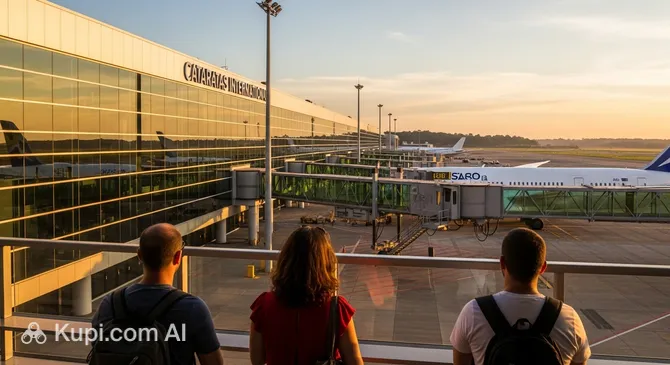
Cataratas International Airport. Source: Kupi.com Binoculars

Cataratas Airport (IGU) is not merely an air gateway to the Brazilian city of Foz do Iguaçu, but a true starting point to one of the seven natural wonders of the world — the Iguaçu Falls. Its location makes it an ideal base for tourists from across the globe seeking to witness the grandeur of nature on the border of Brazil and Argentina. The airport is specifically designed to service a huge flow of travellers, ensuring quick and convenient access to the region's main attractions.

IATA Code IGU
ICAO Code SBFI
City Foz do Iguaçu
Distance to centre 12-14 km
Status International
Passengers per year ~ 2 million (pre-pandemic data, current traffic is recovering)
Popular Airlines Gol Transportes Aéreos, LATAM Airlines, Azul Brazilian Airlines
Schedule online board "Cataratas Airport"

Cataratas Airport, while not a giant, is distinguished by infrastructure that is well-thought-out and comfortable for passengers. Here you will find everything necessary for travellers: from currency exchange points and ATMs to Duty Free shops and cosy waiting areas, including VIP lounges. A distinctive feature is its exceptional proximity to the Iguaçu National Park — the park entrance can be reached in just a few minutes by bus or taxi. Transport connections to the city are also well established: regular buses (route No. 120) connect the airport with the central urban terminal, from where it is easy to reach hotels and other locations.

Contact Information

For the most up-to-date information on flights, services, and regulations at Cataratas Airport (IGU), it is recommended to use official communication channels. Below are the main contact details:

  • Official Website: On the CCR Aeroportos operator website, you will find flight schedules, service information, and news. https://www.ccraeroportos.com.br/foz-do-iguacu-pr
  • Information Desk Phone: For general inquiries and consultations, you can call: +55 (45) 3521-4200.
  • Airport Address: Rodovia BR 469, Km 16,5, CEP 85853-860, Foz do Iguaçu, Paraná, Brazil.
  • Email: For official enquiries, it is recommended to use the contact forms available on the airport website, as a public email for general questions may not be available.
  • Social Media: Follow news and updates on the official social media pages of the managing company, CCR Aeroportos, such as Instagram and Facebook.
  • Lost and Found Information: If you have lost items within the terminal building, please contact the Lost and Found service (Achados e Perdidos) at +55 (45) 3521-4276. For issues regarding lost or damaged checked luggage, you must contact your airline's representative directly.
  • Passenger Support Service: The primary channel for support is the information desk phone, as well as information counters located directly within the airport terminal.

How to Get to the Airport

Getting to Cataratas Airport (IGU) from the city of Foz do Iguaçu is quite simple, as it is conveniently located on the way to one of the main attractions — the national park with the waterfalls. Travellers have access to several transport options, varying in cost, speed, and comfort level.

Public Transport is the most budget-friendly method. City bus No. 120 follows the route "Terminal de Transporte Urbano – Aeroporto – Parque Nacional". It runs from early morning until late evening with intervals of approximately 20-30 minutes. The journey from the central bus station (TTU) to the airport takes about 30-40 minutes depending on traffic. Fare payment can usually be made in cash to the driver or conductor. This is an excellent choice for budget-conscious tourists and those travelling light.

Taxis and Ride-Hailing Services (such as Uber) offer a faster and more comfortable way to reach the terminal. A trip from the city centre will take approximately 20-30 minutes. The cost will be significantly higher than the bus, but you enjoy the convenience of door-to-door travel. It is recommended to use official taxi services or trusted apps. You can also book a private transfer in advance, which is particularly convenient for large groups or families with children and bulky luggage.

Car Rental is an ideal option for those planning to actively explore the region, including the Argentine side of the waterfalls near the city of Puerto Iguazú or for shopping trips to Ciudad del Este. Offices of several major international and local rental companies are present at Foz do Iguaçu Airport. Having a car offers maximum freedom of movement, but consider fuel costs, insurance, and potential complexities when crossing borders.

For those arriving at the airport in their own or a rented vehicle, parking is provided. There are zones for both short-term and long-term parking. Rates depend on the duration of the stay. This is a convenient, though not the cheapest option, if you wish to leave the car for the duration of your trip.

Terminals and Map

Cataratas Airport (IGU) is distinguished by a simple and clear structure, making it very convenient for travellers. There is one passenger terminal operating here, which serves both domestic and international flights. This eliminates the need to move between different buildings and makes navigation intuitively clear.

The terminal layout is logical and simple. On the ground floor, you will find check-in counters and the arrival area where passengers reclaim their luggage. After check-in, you will need to proceed to the first floor, where the security screening area and the main departure hall with boarding gates are located. Thanks to recent modernisation, the space has become more contemporary and comfortable, and navigation is facilitated by clear signs in Portuguese and English.

Since there is only one terminal, the issue of transfers between them is irrelevant. All zones — check-in, security, departure, and arrival — are located within a single building and within walking distance of each other. This is particularly convenient for passengers with children or a large amount of luggage.

Check-in and security procedures at Foz do Iguaçu Airport usually proceed quite quickly due to its compact size. However, queues are possible during the peak tourist season. It is recommended to arrive at the airport 1.5-2 hours before a domestic flight and 2.5-3 hours before an international one, to complete all formalities without haste, enjoy a coffee, and find your boarding gate.

The main advice for navigation is not to worry; getting lost here is practically impossible. All key information is duplicated on display boards, and airport staff are generally ready to assist. Simply follow the signs for "Embarque" (Departure) or "Desembarque" (Arrival), and you will easily find the zone you need.

Airport History

The history of Foz do Iguaçu/Cataratas International Airport (IGU) is inextricably linked to the growth of the tourist appeal of one of nature's greatest wonders — the Iguaçu Falls. The need for a modern air harbour capable of receiving international flights and serving the constantly growing flow of travellers led to its creation. The airport was officially opened on January 7, 1974, replacing an old airfield and becoming a key infrastructure element for tourism development in the region.

Since its opening, the airport has undergone several stages of modernisation. Initially designed to meet the needs of the 1970s, it has been constantly expanded to meet modern requirements. One significant period of renewal was the preparation for the 2014 FIFA World Cup. Although the city of Foz do Iguaçu did not host matches, a huge influx of tourists wishing to visit the waterfalls was expected, necessitating infrastructure improvements.

The most large-scale reconstruction occurred in recent years. Between 2018 and 2021, comprehensive modernisation was carried out: the runway was lengthened and reinforced, the passenger terminal was significantly expanded, new boarding bridges were added, and the commercial area was increased. These improvements allowed the airport to receive larger long-haul aircraft and substantially increase capacity, ensuring comfort for millions of passengers annually.

Interesting fact: the name "Cataratas" translates from Portuguese as "waterfalls", directly indicating the main purpose of the visit for most tourists arriving here. Located on the triple border between Brazil, Argentina, and Paraguay, the airport serves as an important logistical hub for travellers exploring this unique international region. In 2021, airport management transferred from the state company Infraero to the private concessionaire CCR Aeroportos, opening a new chapter in its history focused on further development and service quality improvement.

Services and Amenities

Cataratas Airport (IGU) offers passengers all necessary services for a comfortable wait for their flight. Whether you are arriving or departing, you will find amenities here that make your journey simpler and more pleasant.

For those wishing to have a snack or do some shopping, the terminal features several cafes and restaurants where you can try local cuisine or drink a cup of aromatic Brazilian coffee. Also at passengers' disposal are souvenir shops and a Duty Free zone where travel goods can be purchased.

Free Wi-Fi is available throughout the airport, and waiting areas are equipped with power outlets and special stands for charging electronic devices. For financial transactions, ATMs are installed, and currency exchange points are in operation. Travellers who value enhanced comfort can utilise the services of the VIP lounge, offering a more private setting and additional services.

The airport is well-equipped for passengers with special needs. There are ramps, elevators, and specially adapted restrooms. Families with small children can use the mother and child room. In case of necessity, a medical point is operating in the terminal, ready to provide first aid. If you require extended rest, several hotels are located in the immediate vicinity of the airport.

Dining

Cataratas Airport (IGU), serving the famous Iguaçu Falls, offers passengers several convenient dining options. Despite its relatively small size, you can find establishments here for both a quick snack and a more substantial meal, located in both the public area and the departure zone.

The majority of cafes and food outlets are concentrated in the public area (landside), before security control. This is an ideal place to sit with those seeing you off. Here you will likely find branches of popular Brazilian chains, such as Casa do Pão de Queijo, where it is definitely worth trying the famous cheese buns (pão de queijo) with a cup of aromatic coffee. For a full lunch, you can choose one of the fast-food establishments offering burgers, sandwiches, and set meals.

After passing security (airside), in the departure hall, the choice becomes more limited but sufficient to refresh yourself before boarding. Typically, small coffee shops and kiosks operate here, selling beverages, pastries, sandwiches, and light snacks. This is a convenient option if there is little time left before your flight.

Regarding the menu, in addition to standard offerings, pay attention to local Brazilian specialities. Try coxinha — a popular breaded chicken snack, or a refreshing and nutritious dessert made from acai berries. Prices at the airport are moderate, comparable to city cafes, although they may be slightly higher. Most establishments operate according to the flight schedule, but it is better to check opening hours if you have a very early or late departure.

Passengers with specific dietary requirements should be attentive. Vegetarians will find it easy to locate options like cheese buns or vegetable dishes. However, finding certified gluten-free, vegan, or halal dishes may be difficult. It is recommended to clarify ingredients with staff in advance or carry suitable snacks with you.

Travel Tips

Cataratas Airport (IGU) is the main arrival point for travellers wishing to visit the famous waterfalls from the Brazil side. To ensure your journey from or to Foz do Iguaçu goes smoothly, use these tips. The airport is not very large, but the tourist flow here is consistently high, so arrive in advance: 1.5–2 hours before a domestic flight and 2–2.5 hours before an international one.

To save time, complete online check-in and save the boarding pass on your phone. This will allow you to proceed directly to the baggage drop counter (if you have luggage) or to security. The screening procedure is standard, but be prepared to remove all electronic devices and your liquids bag from your hand luggage. Note that staff may not always speak English, so basic phrases in Portuguese or a translation app may come in handy.

When choosing a seat on the plane, if possible, opt for a window seat. Sometimes during takeoff or landing, you can see beautiful panoramas of the Iguaçu River and the national park. An aisle seat is suitable for those who want the freedom to stand up during the flight without disturbing neighbours.

Standard hand luggage rules apply here: liquids in containers of no more than 100 ml each, packed in a single transparent bag. All batteries and power banks must be in hand luggage only. Sharp objects are prohibited. Be sure to check the weight and dimension limits for hand luggage on your airline's website to avoid extra charges at the airport.

If you have a connecting flight, keep in mind that when transferring from an international to a domestic flight, you are most often required to collect your luggage, pass through customs control, and then re-check it for the next flight. The airport itself is compact, so navigation will not cause difficulties. At customs control for arriving passengers, there are two channels: "Bens a Declarar" (Goods to Declare) and "Nada a Declarar" (Nothing to Declare).

To save money, bring an empty water bottle and fill it after passing security at the drinking fountains. Prices for food and drinks at the airport are significantly higher than in the city. Taxis or transfers to the hotel or waterfalls are more economical to book in advance via online services.

In case of flight delay or cancellation, immediately contact your airline representative. Under Brazilian law (ANAC), for delays of more than 2 hours, you are entitled to drinks and communication means; more than 4 hours — a hot meal; and for longer waits at night — hotel accommodation. Be sure to keep all receipts for unforeseen expenses.

Reached the end of the page?

That means the route is fully explored