Support

Itaituba

About the Airport

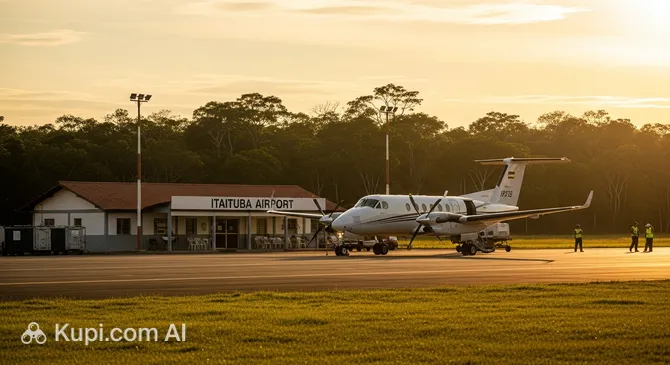
Itaituba. Illustration.
Source: Kupi.com AI

Itaituba Airport (ITB), officially known as Aeroporto Wirland Freire, is the aerial gateway to the heart of the Brazilian Amazon in the state of Pará. Located on the banks of the mighty Tapajós River, it serves as a key transport hub for one of the most natural resource-rich regions of Brazil. This small yet strategically important airport is the starting point for wildlife explorers, entrepreneurs connected to gold mining, and travellers seeking to witness pristine jungles and national parks.

PropertyValue
IATA CodeITB
ICAO CodeSBIH
CityItaituba
CountryBrazil
TimezoneAmerica/Santarem
Top AirlinesAzul Linhas Aereas Brasileiras
ScheduleOnline Timetable

Features and Advantages

The main advantage of Itaituba Airport is its indispensability for connecting this remote region with major cities such as Manaus and Belém. Despite its modest size, it plays a crucial role in logistics, serving both scheduled passenger flights and private aviation, including flights to numerous gold mining sites (garimpos). For tourists, the airport is the departure point for trips to the Amazonia National Park and other protected areas along the Tapajós River. The terminal offers basic amenities, including an air-conditioned terminal and free Wi-Fi, ensuring necessary comfort before flying deep into the wild.

Contact Information

To obtain the most up-to-date information about Itaituba Airport (ITB), it is recommended to use the following contact details. Please note that for small regional airports, some communication channels may be limited.

  • Official Airport Website: Currently, Itaituba Airport does not have a separate official website. Information about flights and services is best verified on the websites of the airlines operating flights to this airport.
  • Information Desk Phone: +55 93 3518-1377. Please pay attention to the international code for Brazil (+55) when calling from abroad.
  • Airport Address: Rodovia Transamazônica, km 5, Itaituba, PA, 68180-010, Brazil.
  • Email: An official email address for general passenger inquiries is not published. It is recommended to use the phone for communication.
  • Social Media: The airport does not maintain active official pages on social media.
  • Lost Luggage Information: For all issues related to lost, delayed, or damaged luggage, you must contact your airline's support service directly. Airport staff do not handle luggage tracing.
  • Passenger Support Contacts: For general questions about airport infrastructure, use the main phone number. For questions related to tickets, schedules, and flight check-in, please contact your airline representatives.

How to Get to the Airport

Getting to Itaituba Airport (ITB), which serves the city of the same name in Brazil, is quite simple due to its close proximity to the centre. The journey from the central part of Itaituba to the terminal usually takes no more than 10-15 minutes by car. The main modes of transport are taxis, moto-taxis, and rental cars.

Taxis and Moto-taxis are the most popular and convenient way to get to the airport. Taxis can be found at stands in the city or called by phone. This is the most comfortable option, especially if you have a lot of luggage. The trip will be inexpensive due to the short distance. An even more budget-friendly and common mode of transport in the region is the moto-taxi (motorcycle taxi). This is a fast way to reach the airport, but it is suitable only for travellers with a small backpack.

Public Transport in the form of city buses does not have a direct route to the airport. Some routes may pass near the airport zone, but this option is not recommended for tourists as it requires knowledge of the local transport network and can be inconvenient with luggage. It is better to opt for a taxi.

Car Rental is an excellent choice for those who plan not only to drive to the airport but also to travel around the region independently. Local and national rental agencies operate in the city. It is recommended to book a car in advance, especially during the tourist season. The airport has a parking area where you can leave both personal and rental vehicles.

If your travel routes pass through other cities in the Amazon region, it is worth considering flying through larger hubs. For example, Santarém-Maestro Wilson Fonseca Airport is located approximately 242 km away and serves a significantly larger number of passengers. Other nearby airports connecting remote corners of the state include the air harbours in Parintins and Maués.

Terminals and Map

Itaituba Airport (ITB) is a small regional aviation hub characterized by a simple and clear structure. It is designed to service domestic flights with maximum functionality and speed.

The airport operates one passenger terminal, which serves both departing and arriving passengers. Thanks to this, navigation through the airport is extremely simple. All key zones—check-in counters, security screening, a small waiting hall, and the boarding gate—are located in one compact building. There is no need for transfers between terminals, making movement through the airport quick and convenient.

The departure and arrival zones are located in immediate proximity to each other. After check-in and security screening, passengers enter a common waiting hall before boarding. The arrival zone is also very simple: after disembarking from the aircraft, passengers proceed to the terminal to collect luggage. The entire process takes minimum time.

Flight check-in and pre-flight security procedures at Itaituba Airport usually take place significantly faster than in major aviation hubs. The absence of long queues and large distances allows passengers to save time. As a rule, arriving at the airport 1–1.5 hours before the departure of a domestic flight is sufficient to complete all formalities.

The main advice for navigation is not to worry about getting lost. Due to the compact size and linear layout of the terminal, all its parts are easily visible. Signs, where present, are simple and clear, and staff are always ready to help you orient yourself.

Airport History

The history of Itaituba Airport (ITB), officially known as Aeroporto Alberto Alcolumbre, is inextricably linked with the exploration of the Amazon's riches. Located in the state of Pará in Brazil, it was officially opened on 13 November 1979. From the very beginning, its mission went far beyond ordinary passenger transport, becoming a key logistical hub for one of the world's largest gold-mining regions.

The most vivid period in the airport's history occurred in the 1980s, during the peak of the "gold rush." Thousands of prospectors (garimpeiros) flocked to the region, and Itaituba Airport turned into a veritable aerial hive. In those years, it was considered one of the busiest airports in the world in terms of take-offs and landings, mainly due to small single-engine aircraft shuttling between the city and countless mines in the jungle. For this chaotic but continuous activity, it earned the nickname "anthill airport" (aeroporto-formigueiro). It was a unique phenomenon in the history of world aviation.

From 1981, the management of the airport was transferred to the state company Infraero, which marked the beginning of its systematic modernization. Understanding the strategic importance of the air gateway, the authorities invested in its development. A key stage was a large-scale reconstruction completed in May 2013. As a result, a new passenger terminal was opened, the area of which increased more than threefold—from 334 m² to 1073 m². This allowed for a significant increase in the level of comfort for passengers and the efficiency of flight services.

Today, Itaituba Airport remains a vital artery for the entire Tapajós region. Although the frenzy of the "gold rush" has subsided, it continues to play a decisive role in supporting the mining industry, developing business and tourism, and ensuring connections with remote settlements, including indigenous communities. Its history is a striking example of how aviation can become an engine for economic development and the exploration of hard-to-reach territories.

Services and Amenities

Itaituba Airport (ITB) is a small regional aviation hub that provides passengers with a basic but necessary set of services for a comfortable wait for their flight. Although the infrastructure here is not as developed as in major international airports in Brazil, you will find everything essential for a short stay before departure.

There are small cafes operating for passengers where you can have a snack and drink coffee, as well as a few shops with essential goods and souvenirs. The selection of dining establishments and retail outlets is limited, so for a full meal, it is better to arrive at the airport already fed. Waiting areas are equipped with comfortable seats; however, there are no specialized VIP lounges here.

Opportunities for connecting to Wi-Fi may be limited, so it is recommended to have mobile internet with you. Charging points for electronic devices are also not found everywhere—it is better to bring a portable power bank. There is usually at least one ATM installed within the terminal for cash withdrawals, but currency exchange points are absent. In emergencies, you can contact the medical post for first aid.

The airport is adapted for passengers with special needs. Ramps and specially equipped restrooms are provided for travellers with limited mobility. Families with small children can count on the availability of a mother and child room for infant care. There are no hotels directly on the airport grounds, but several accommodation options can be found in the city of Itaituba, located nearby. Specialized conference rooms or business centres are absent at the airport.

Dining

When planning a flight through Itaituba Airport (ITB), it is worth considering that this is a small regional hub, and the choice of dining establishments here reflects that. Options are generally limited and designed for passengers who need a quick snack before departure.

In the main hall of the airport, usually before the security zone (landside), you will likely find a small cafeteria or snack bar. Here you can buy basic snacks typical of Brazil: sandwiches, pastries (for example, cheese buns known as pão de queijo or savoury pies called salgados), as well as sweets, chips, and chocolate. Drinks available include coffee, soft drinks, and bottled water. There are no full-service restaurants with hot meals and waiter service at the airport.

Regarding special dietary requirements, finding vegetarian, vegan, gluten-free, or Halal dishes here will be extremely difficult. The assortment in such small outlets is usually standard. If you have strict dietary restrictions, it is strongly recommended to bring food with you.

Prices at the airport are generally slightly higher than in the city but remain within reasonable limits for a quick snack. The cafeteria's opening hours are usually tied to the flight schedule, but it is better not to rely on it being open at night or during long intervals between flights. For a more substantial lunch or dinner, it is better to choose one of the establishments in the city of Itaituba itself before travelling to the airport.

Travel Tips

To ensure your journey through the airport of Itaituba goes smoothly and without unnecessary stress, it is important to think through all the details in advance. By following simple tips, you can save time and nerves, making your stay at the airport as comfortable as possible.

Itaituba Airport is not among the largest in Brazil, however, it is always better to have a time buffer. For domestic flights, it is recommended to arrive 1.5-2 hours before departure. This will be enough to calmly go through all pre-flight formalities without rushing.

The fastest way to check in for a flight is online check-in on your airline's website. This way, you can select a seat in advance and receive your boarding pass, avoiding queues at the counters. When passing through security control, be ready to present your documents and boarding pass. All liquids in containers larger than 100 ml, as well as sharp objects, should be checked into luggage in advance.

If the airline allows you to choose a seat, consider your preferences. Window seats (A, F) offer beautiful views during take-off and landing. Aisle seats (C, D) are convenient if you plan to get up often during the flight. Passengers with children are usually recommended the front rows, and those wanting more legroom—seats at emergency exits (note that these may be subject to a fee and restrictions).

Be sure to take documents, money, a mobile phone, a portable charger, and necessary medications in your hand luggage. A light snack and an empty water bottle, which can be filled after the security zone, will also be useful. Remember that carrying liquids in containers exceeding 100 ml, as well as flammable and explosive substances, is strictly prohibited.

If you have a connecting flight, immediately upon arrival at the transit airport, find information about your next flight on the display board: the gate number and boarding time. Clarify whether you need to collect and re-check your luggage—usually, when transferring to flights of the same airline or alliance, luggage is transferred automatically.

To save time and money, book flight tickets in advance—this increases the chances of finding favourable fares. Use online check-in to avoid standing in queues. Bring light snacks from home to avoid overpaying at the airport cafe. Also, study transfer options to the city in advance, comparing the cost of taxis and public transport.

In case of a flight delay or cancellation, contact your airline representative first. Depending on the length of the wait, you may be provided with drinks, meals, or even hotel accommodation. Remain calm and use this time to rest or work, as there is usually access to Wi-Fi in the airport.
Reached the end of the page?

That means the route is fully explored