Support

Paulo Afonso Airport

About the Airport

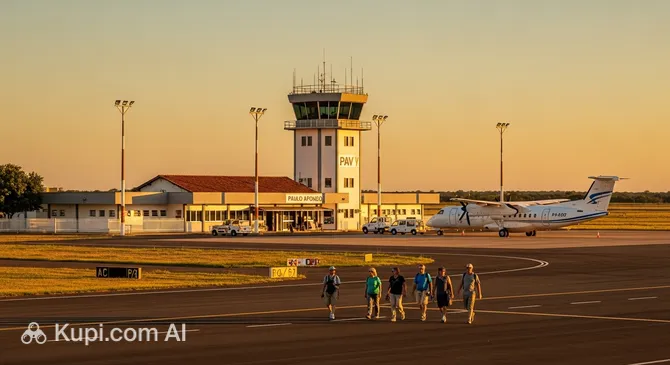
Paulo Afonso Airport. Source: Kupi.com Binoculars

Paulo Afonso Airport (PAV) is not merely an air gateway to the city of the same name in the state of Bahia, but a strategically important transport hub for the entire region. Located near the picturesque São Francisco River, it plays a key role in supporting the famous CHESF hydroelectric power plant. Built in 1972, this small and cosy single-terminal airport offers passengers all basic amenities, making the start of a journey through Brazil as comfortable as possible.

IATA Code PAV
ICAO Code SBUF
City Paulo Afonso
Distance to centre approx. 6.5 km
Status Domestic
Annual Passengers approx. 10,000
Popular Airlines Azul, Gol, VoePass
Schedule "Paulo Afonso Airport" Online Board

Despite its modest size, Paulo Afonso Airport effectively fulfils its mission, serving primarily domestic flights. Its main advantage for travellers is its compactness and ease of navigation: the single terminal allows you to quickly complete all pre-flight formalities without the hustle and bustle typical of major aviation hubs. Its proximity to the city and the region's main tourist attractions, including the famous waterfalls, makes it an ideal starting point for exploring the natural beauty of north-eastern Brazil.

Contact Information

To contact the administration of Paulo Afonso Airport (PAV) or to obtain additional information, please use the following contact details. The airport is managed by Aena Brasil.

  • Official Website: Up-to-date information on flights, services, and regulations can be found on the official Aena Brasil website.
  • Information Desk Phone: 0800 727 4720 (for calls within Brazil).
  • Airport Address: Rodovia BA-210, km 03, Bairro General Dutra, Paulo Afonso - BA, CEP 48605-640, Brasil.
  • Email: For general enquiries, you can use the email faleconosco@aenabrasil.com.br or the feedback form on the website.
  • Lost & Found: For items left in the terminal, please contact +55 (75) 3282-9510 or email: achadoseperdidos.sbuf@aenabrasil.com.br. If your enquiry concerns checked baggage, you should contact your airline directly.
  • Social Media: Follow news from the operator Aena Brasil on their official accounts on Instagram, Facebook, X (Twitter), and LinkedIn.

How to Get to the Airport

Paulo Afonso Airport (PAV) is located very close to the centre of the eponymous city in Brazil, so getting there is quick and can be done in several ways. The journey from the central part of Paulo Afonso to the terminal usually takes no more than 15-20 minutes, depending on traffic conditions and the chosen mode of transport.

The most economical way to reach the airport is by public transport. Although the city does not have specialised express shuttles, some city bus routes pass in the immediate vicinity of the air terminal. This option is suitable for travellers without large luggage who are prepared to walk a short distance from the bus stop. The fare is minimal, but it is worth checking the current schedule and route numbers in advance.

The most convenient and fastest option is a taxi or ride-hailing app. A door-to-door trip will take about 10-15 minutes and ensure maximum comfort, especially if you are travelling with bulky luggage. The cost of the trip will be significantly higher than the bus, but remains quite reasonable. For greater peace of mind, you can book a private transfer in advance so that a driver meets you at the desired location at the appointed time.

For those who prefer freedom of movement, car rental is an excellent solution. There are rental agencies in the city where you can hire a car and drive to the airport yourself. This method is particularly convenient if you plan to explore the picturesque surroundings of Paulo Afonso. The airport has a parking area where you can leave both private and rented vehicles for short or long periods.

Thus, the choice of transport depends on your priorities. For speed and comfort, a taxi is best. If your budget is limited and your luggage is light, you can use the city bus. Car rental offers maximum flexibility and is ideal for independent travellers planning trips around the region.

Terminals and Map

Paulo Afonso Airport (PAV) is a small regional aviation hub characterised by a structure that is simple and easy for passengers to understand. It consists of one compact passenger terminal that handles all arriving and departing flights. Thanks to this, you do not have to worry about complex transfers or searching for the right building.

The terminal layout is extremely simple. The departure and arrival zones are located in the same building, in close proximity to each other. Immediately after entering, you will see the airline check-in counters. After checking in and dropping off your luggage, you proceed to a small security screening area, followed by the waiting lounge with the boarding gate. Getting lost here is virtually impossible, as all key points are within sight.

Completing all pre-flight formalities at Paulo Afonso Airport usually takes minimum time. Due to the low passenger traffic, queues for check-in and security are typically non-existent or very short. The entire process from entering the terminal to arriving at the boarding gate rarely takes more than 20–30 minutes. Nevertheless, the standard recommendation is to arrive at the airport 1-1.5 hours before departure to go through all stages calmly without rushing.

To navigate the airport, simply follow the few signs available. The arrival zone is equally straightforward: after disembarking the plane, passengers enter a hall where the single baggage claim belt is located. Overall, compactness and simplicity are the main advantages of Paulo Afonso Airport, ensuring a calm and comfortable journey for passengers.

Airport History

The history of Paulo Afonso Airport (PAV) is inextricably linked to one of the largest engineering projects in Brazil — the construction of the hydroelectric power plant on the São Francisco River. The airport was built by the São Francisco Hydroelectric Company (CHESF) primarily to meet the logistical needs of this grand project. The official opening of the air harbour took place in 1972, and initially, it served mainly engineers, workers, and cargo necessary for the construction of the dams.

A key stage in the airport's development was 1980, when management was transferred to the state-owned company Infraero. This transition marked the transformation of a departmental airfield into a fully-fledged regional airport open for commercial passenger transport. From that moment, it began to play an important role in integrating the region, connecting it with major cities in the country and promoting tourism attracted by the unique canyons and waterfalls.

A new chapter in the airport's history began in 2022, when it came under the management of the Spanish operator AENA Brasil under a concession agreement. This change in management initiated another phase of modernisation aimed at improving infrastructure, enhancing passenger service quality, and expanding the route network. Although the airport cannot boast passenger traffic records, its main achievement is its invaluable role in the energy and economic development of an entire region in north-eastern Brazil.

One of the most interesting facts about Paulo Afonso Airport is its strategic location. It serves not only the state of Bahia but is also the nearest air harbour for residents of the border areas of three other states: Pernambuco, Alagoas, and Sergipe. This makes it a vital transport hub that has been, and remains, the gateway to the "energy heart" of Brazil for decades.

Services and Amenities

Paulo Afonso Airport (PAV) is a compact regional terminal that provides passengers with essential services for a comfortable journey. The terminal building houses a small café where you can order light snacks, sandwiches, and beverages. Shopping opportunities here are modest and are usually limited to a kiosk selling newspapers and souvenirs. There are no full-service restaurants or duty-free shops at the airport.

For passenger convenience, free Wi-Fi is available throughout the terminal, and the waiting lounge is equipped with power outlets and USB ports for charging electronic devices. Financial services are represented by ATMs where you can withdraw cash in the local currency. Currency exchange bureaus are absent, so it is advisable to take care of this transaction in advance at one of the banks in the city of Paulo Afonso.

The airport is equipped to serve passengers with reduced mobility: there are ramps and adapted restrooms. To receive assistance with moving through the terminal, boarding, and disembarking, it is recommended to contact your airline in advance. Travellers with small children can use the baby changing tables in the washrooms. There are no premium lounges or VIP areas at the airport — all passengers use the general waiting hall.

There are no hotels or business centres within the airport building. If you need to stay overnight or hold a business meeting, it is best to book a room at one of the hotels in the city of Paulo Afonso, which is located a few minutes' drive from the terminal. Many city hotels offer conference rooms and other business services to their guests.

Where to Eat

When planning a departure from Paulo Afonso Airport (PAV), it is important to consider that this is a small regional airport, and the choice of dining establishments here is quite limited. Nevertheless, passengers can find basic options for a snack before their flight.

In the airport's single terminal, in the public area before security control (landside), there is usually a small café or snack bar operating. Here you can purchase beverages such as coffee, water, and soft drinks, as well as classic Brazilian snacks. Typically, the assortment includes pão de queijo (cheese buns), sandwiches, and various salgados (savory pastries). This is an excellent option for a quick bite, but not for a full lunch or dinner.

Specialised dietary meals, such as vegetarian, gluten-free, or Halal options, will most likely not be available. If you have strict dietary restrictions, it is recommended to bring food with you. Prices at the airport are generally slightly higher than in the city, and the café's opening hours are usually tied to the flight schedule — it opens a few hours before departure and closes after the last plane leaves.

For a more substantial meal, we advise having lunch or dinner at one of the numerous restaurants in the city of Paulo Afonso before heading to the airport. This will allow you to enjoy the variety of local cuisine in Brazil without rushing.

Tips for Travellers

To ensure your journey through Paulo Afonso city airport goes smoothly and without unnecessary stress, make use of these helpful tips. A thoughtful approach to preparation will help save time, money, and nerves.

Arrival Time: For domestic flights within Brazil, it is recommended to arrive at the airport in advance, at least 1.5–2 hours before the departure time. This buffer is sufficient for calm check-in, baggage drop-off, and passing through pre-flight security screening.

Check-in and Screening: The fastest way to check in for a flight is via online check-in on the airline's website. This will allow you to avoid queues at the counters. If you are travelling only with hand luggage, you can proceed directly to the security control zone. During screening, be prepared to present laptops, tablets, and other large electronic devices separately from the rest of your hand luggage for scanning.

Choosing a Seat on the Plane: If it is possible to choose a seat during check-in, consider what is more important to you. An aisle seat ensures freedom of movement, which is convenient during long flights. A window seat gives you the opportunity to admire the views during take-off and landing, and in this region, they can be particularly picturesque, with panoramas of the São Francisco River.

Hand Luggage: Remember the general rules for carrying liquids: all liquids must be in containers of no more than 100 ml and packed in a single transparent resealable plastic bag. It is strictly forbidden to bring sharp objects, weapons, explosives, and flammable substances on board.

Connecting Passengers: If your itinerary includes a transfer, check with the airline in advance whether your luggage will be automatically transferred to the next flight or if you will need to collect it and check it in again. Always leave a sufficient time margin between connecting flights.

Customs Control: Since Paulo Afonso Airport serves primarily domestic flights, there is no customs control for passengers on such flights. Travellers undergo immigration and customs formalities at their first international airport of arrival in the country.

Saving Time and Money: Book flight tickets in advance to get the best price. Travelling with only hand luggage saves you money on baggage fees and time waiting for it upon arrival. You can also bring an empty water bottle and fill it at drinking fountains after passing security control.

Flight Delays: In the event of a flight delay or cancellation, immediately contact your airline representative for up-to-date information. Depending on the length of the wait, the carrier may be obliged to provide you with drinks, meals, or even hotel accommodation. Remain calm and keep all receipts for unforeseen expenses.
Reached the end of the page?

That means the route is fully explored