Support

Arctic Bay

About the Airport

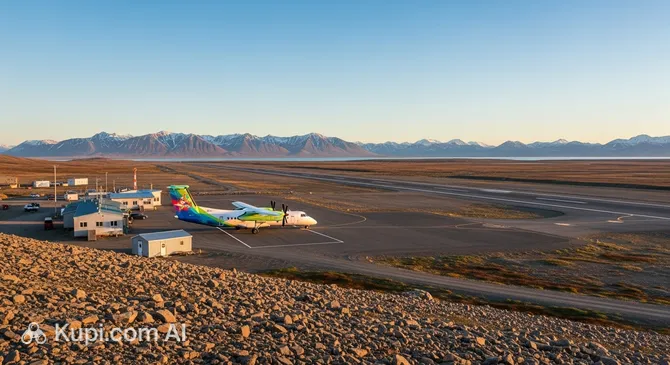
Arctic Bay. Illustration.
Source: Kupi.com AI
Arctic Bay Airport is not merely a transport hub, but a true gateway to the world of serene ice and the majestic fjords of Nunavut, Canada. Located amidst the rugged yet incredibly picturesque landscapes of Baffin Island, it connects the residents of this remote settlement with the "mainland," remaining a critically important artery for the region. Landing here offers travellers a breathtaking view of King George V Mountain and the waters of Admiralty Inlet, turning arrival into a genuine adventure.
PropertyValue
IATA CodeYAB
ICAO CodeCYAB
CityArctic Bay
CountryCanada
TimezoneAmerica/Rankin_Inlet
ScheduleOnline Timetable
**Features and Advantages of Arctic Bay Airport:** * **Convenient Location:** The airport opened in 2010, replacing the remote Nanisivik Airport. This significantly reduced travel time to the village—the journey now takes only about 10 minutes (approximately 6 km) instead of the previous 32 km along a difficult route. * **Scenic Approach:** The airfield is located in a valley surrounded by high hills, making take-offs and landings spectacular, although they require high skill from pilots due to the specific Arctic winds. * **Vital Role:** For the local community, this airport is the main "lifeline" through which fresh produce, mail, and medicines are delivered, and medical evacuations are carried out. * **Compactness and Comfort:** The small terminal is equipped with everything necessary for a short wait and is known for its warm, almost home-like atmosphere, characteristic of small northern airports.

Contact Information

To plan your journey and resolve operational questions, you can use the following contacts. Please note that Arctic Bay is a small regional airport, so many service functions are performed directly by the air carrier.

  • Official Airport Website: The airport does not have its own separate website. Up-to-date information is published on the official portal of the Government of Nunavut (Department of Economic Development and Transportation) or on the main carrier's website.
  • Information Desk Phone: +1 867-439-9934 (airport operational questions) or +1 867-439-3000 (local representative of Canadian North airline).
  • Airport Address: Arctic Bay Airport, Arctic Bay, Nunavut, X0A 0A0, Canada.
  • Email: yabops@canadiannorth.com (for cargo and operations questions); for general inquiries, it is recommended to use the feedback forms on the airline's website.
  • Social Media: The airport itself does not have official accounts. Regional news is often published on the Hamlet of Arctic Bay page, and flight information is found on Canadian North's social media.
  • Lost Luggage Information: The airline handles lost property. Contact the agent at the counter in the terminal or call the central Canadian North baggage support service: +1 800-661-3591.
  • Passenger Support Contacts: Support is provided through the carrier, Canadian North (tel. 1-800-661-3591).

How to Get to the Airport

Transport logistics in Arctic Bay have unique features dictated by the harsh climate and the region's remoteness. Since the village is not connected by a road network to the rest of Canada or neighbouring settlements, the airport is the only entry point. The distance from the terminal to the settlement centre is only about 6 kilometres, and travel time usually does not exceed 10–15 minutes.

It is important to understand that there is no familiar public transport, metro, or ride-hailing services (like Uber/Lyft) here. Transfers must be planned in advance.

Transfers from Hotels and Tour Companies

The most reliable and common way to get from the airport to the village is to use a transfer organised by your accommodation. The Taqqut Co-op Hotel (the main place where tourists stay) usually provides a guest pick-up service.

  • Cost: Often included in the room rate or is a fixed amount (about 15–20 CAD per person), but this must be confirmed when booking the room.
  • Recommendation: Be sure to inform the hotel of your flight date and number in advance. Flights in the Arctic can be delayed, but local drivers usually track aircraft arrivals.

Taxi

There are several private drivers in Arctic Bay acting as taxis. These are not branded cars but ordinary pickups or SUVs owned by locals. Driver phone numbers can be found at the airport registration desk or on the bulletin board in the village.

  • Cost: A trip around the village costs a fixed amount (usually 7–10 CAD), while a transfer to the airport may cost more—about 20–30 CAD.
  • Payment: Only cash (Canadian dollars) is accepted. The driver may not have change, so it is better to have small bills.

Car Rental

Classic car rental services (Hertz, Avis, etc.) do not exist in Arctic Bay. The road network is limited to the village streets and the road to the airport and the old Nanisivik mine. For moving around the surroundings for tourism purposes (nature viewing), you can arrange to rent a snowmobile (in winter) or an ATV (in summer) through local outfitters, but this option is not suitable for travelling to the airport with luggage.

Public Transport

There are no scheduled buses or shuttle taxis in the village.

Airport Parking

There is a small open parking area in front of the terminal building. Since traffic here is minimal, there are no issues with space availability.

  • Cost: Parking is free.
  • Features: The area has a gravel surface. Snow drifts are possible in winter, although the territory is regularly cleared before flight arrivals. Leaving a car for a long term without prior coordination with airport staff is not recommended due to extreme weather conditions.

Air Connections with Neighbours

Given the lack of intercity roads in Nunavut, "neighbouring" refers to airports that can only be reached by air. The nearest transport hubs play an important role in the logistics of Arctic travel:

  • Pond Inlet Airport (235 km) — a popular destination for tourists wishing to see narwhals and icebergs.
  • Resolute Bay Airport (362 km) — an important hub of the High Arctic, often used as a transfer point.
  • Igloolik Airport (422 km) — located on a small island in Foxe Basin.
  • Hall Beach (491 km) — another settlement in the Qikiqtani region.
  • Pituffik Airport (616 km) — a remote airfield in Greenland, access to which from Arctic Bay is possible only via complex connecting flights.

Terminals and Map

Arctic Bay Airport (YAB) represents an example of compact and functional infrastructure characteristic of remote northern settlements in Canada. Since passenger traffic here is low, the terminal structure is simplified to the maximum and oriented towards the rapid processing of flights in harsh climatic conditions.

Number of Terminals and Purpose

The airport has one small passenger terminal. This single-storey building, opened in 2010, serves both departing and arriving flights. There is no division into international and domestic sectors, as all flights are regional (within Nunavut).

Layout and Navigation

It is impossible to get lost in the Arctic Bay terminal—all key zones are within direct line of sight from the entrance. The building is designed on a "one-room concept," creating a cosy, almost home-like atmosphere.

  • Check-in Zone: Located immediately upon entering the building. Here you will find the airline counters (usually Canadian North), where passenger processing and baggage drop-off take place.
  • Waiting Hall: Occupies the central part of the terminal. This is a common space for all passengers, equipped with seats for waiting for boarding.
  • Security Zone: A small pre-flight control area is located between the check-in zone and the boarding gate.

Departure and Arrival Zones

Passenger flows in such small airports often intersect, but the logistics are simple and clear:

  • Departure: After check-in and baggage drop, passengers proceed to the waiting area. Boarding takes place through the single gate (door) leading directly to the apron.
  • Arrival: Arriving passengers enter the terminal from the airfield through the same entrance or an adjacent door. The baggage claim area is a simple designated space or a small belt within the general hall, where ground staff promptly deliver cargo from the aircraft.

Terminal Features

Despite its modest size, the terminal is designed taking into account extreme cold and human comfort:

  • No Jet Bridges: Boarding and disembarking are done exclusively on foot across the apron. Aircraft stop in immediate proximity to the building, but passengers should be prepared for a short walk in the fresh air.
  • Amenities: Inside the terminal, there are restrooms and drinking water. There are no cafes, Duty Free shops, or newsstands. It is recommended to arrange snacks in advance if you face a long wait.
  • Thermal Insulation: The building is excellently heated, providing reliable shelter from Arctic winds.

Procedure Times

Unlike large international hubs, processes here are much faster, but time should not be neglected.

  • Check-in: It is recommended to arrive at the airport 45–60 minutes before departure. Check-in counters close strictly 30–45 minutes before departure (depending on airline requirements), and late passengers may not be allowed on the flight, as staff need time to load luggage and prepare documentation.
  • Security: The procedure takes 5–10 minutes but may drag on if a full flight is departing.

Navigation Recommendations

The main advice for passengers in Arctic Bay is to keep warm clothing (jacket, hat, gloves) with you, rather than checking it in luggage. Even if the flight is short, the walk from the aircraft to the terminal at -40°C and strong wind can be uncomfortable without proper gear. Inside the terminal, navigation signs are intuitive, and staff are always ready to help and suggest the next steps.

Airport History

The history of Arctic Bay Airport (YAB) is a relatively new chapter in the annals of Arctic aviation, yet it is inextricably linked with the development of the entire region and the desire to make life in the Far North safer and more comfortable. Unlike many other northern airfields that emerged in the mid-20th century during the wave of Arctic exploration or for military needs, the modern Arctic Bay Airport is a product of the 21st century.

The Nanisivik Era

To understand the history of the current airport, one must look to the past. For a long time, the air gateway for the settlement's residents served was Nanisivik Airport, located approximately 32 kilometres from Arctic Bay. It was built in the 1970s to serve the lead-zinc mine of the same name. It had a runway capable of receiving even jet aircraft (such as the Boeing 727 and 737), which was a rarity for such remote places.

However, after the mine closed in 2002, maintaining the huge infrastructure and the long winding road connecting the mine to the village became logistically and financially unfeasible. The road to Nanisivik took about an hour, and in winter blizzards, it became a dangerous trial for drivers and passengers.

Birth of a New Harbour

The decision to build a new airport directly at the borders of the Arctic Bay settlement was a turning point. The official opening of the new Arctic Bay Airport took place in January 2010. This event was a true celebration for local residents, as it symbolised the end of the era of long and dangerous trips to the old terminal.

Key stages of establishment:

  • 2008–2009: Active construction phase. Engineers had to solve complex tasks to create a stable runway in conditions of permafrost and difficult terrain surrounded by hills.
  • January 2010: The first commercial flight landed on the new runway. From this moment, the IATA code YAB was officially assigned to the new location, and the old Nanisivik Airport was closed and mothballed (its territory was later used for naval base needs).

Development and Modernisation

Since the airport is quite young, its history does not abound with numerous reconstructions characteristic of old aviation hubs. All infrastructure was initially designed taking into account modern safety and energy efficiency requirements relevant to the Arctic.

Nevertheless, improvement works are ongoing. The main focus of services is maintaining the gravel runway in ideal condition. In conditions of sharp temperature changes and ground mobility, this requires regular resurfacing, grading, and compaction.

Interesting Facts and Achievements

Despite its short history, Arctic Bay Airport has its unique features:

  • Accessibility Record: Relocating the airport allowed reducing transfer time for passengers from 45–60 minutes to 10 minutes. This is critically important for medical evacuations when every minute counts.
  • Visual Approach: The airport is famous for one of the most picturesque landing approaches in Nunavut. Pilots have to manoeuvre amidst elevations, which requires special skill and specific certifications.
  • Compactness: The length of the new airport's runway is about 1,200 metres (3,935 feet), which is significantly shorter than Nanisivik's (1,900 metres). This changed the type of aircraft serving the village: now, predominantly turboprop planes such as the ATR-42 and DHC-6 Twin Otter land here, instead of jet liners.

Today, Arctic Bay Airport is not just a building and a strip, but a symbol of care for territorial connectivity. It serves as a reliable bridge connecting one of Canada's most northerly communities with the rest of the world.

Services and Amenities

Passengers arriving at or departing from Arctic Bay Airport need to remember: this is a small regional air hub located in one of the most remote corners of the planet. There is no abundance of services, boutiques, or food courts familiar to capital city airports here. The infrastructure of YAB is aimed at performing basic functions: ensuring flight safety and protecting people from the harsh Arctic climate.

Dining and Shops

The terminal lacks cafes, restaurants, dining outlets, and vending machines. There are also no Duty Free shops or souvenir stalls.

  • Advice for tourists: Be sure to arrange snacks and drinks in advance, especially if travelling with children. You can buy food only in the village shops (for example, at the Co-op or Northern Store) before leaving for the airport. A water cooler is usually available in the terminal building.

Connectivity and Wi-Fi

There is no open public Wi-Fi network at Arctic Bay Airport. Gadget charging services are also not standardised—you will not find special stands with USB ports here, although if strictly necessary, you can ask staff to use a spare power outlet.

  • Mobile Network: A mobile signal is usually available in the airport area (the main provider in the region is Bell/NorthwesTel), but internet quality may be unstable. It is recommended to download all necessary tickets, maps, and entertainment content to your device before arriving at the terminal.

Financial Services

There are no ATMs, currency exchange points, or bank branches within the airport territory.

  • Important: You will need cash Canadian dollars to pay for taxis or transfers. You can withdraw money only at the ATM located in the Co-op store in the Arctic Bay settlement itself. The airline check-in desk usually accepts credit cards for excess baggage payments, but relying solely on cashless payments in the Arctic is not advisable due to possible connection failures.

Lounges and VIP Services

The terminal operates on a common space principle. There are no separate business lounges, VIP rooms, or conference halls. The waiting area is a small heated hall with seats, offering a view of the airfield.

Services for Passengers with Children

There are no specialised mother-and-child rooms or play areas in the airport. Given the compactness of the premises, children remain under parental supervision at all times. The restrooms are spacious enough to change a child if necessary.

Medical Assistance

There is no medical centre or pharmacy in the terminal. Airport staff are trained in basic first aid and have standard first aid kits. In case of serious health problems, it is necessary to contact the Health Centre located in the Arctic Bay settlement.

Accessibility

Despite its modest size, the airport is adapted to serve passengers with reduced mobility. The building is single-storey, eliminating the need for elevators.

  • Boarding: Since there are no jet bridges and boarding takes place from the apron, airline staff provide assistance when ascending the aircraft stairs. For passengers in wheelchairs, special ramps or boarding devices are provided (availability of special equipment is best confirmed with Canadian North airline in advance, at least 48 hours before departure).

Accommodation Near the Airport

There are no hotels in the airport itself or within walking distance. The nearest and main place of accommodation is in the village, a 10–15 minute drive away:

  • Taqqut Co-op Hotel — the main hotel in Arctic Bay. It offers comfortable rooms, meals, and Wi-Fi. This is where the majority of tourists and visiting specialists stay. It is recommended to book a room well in advance of the trip, as the number of places is limited.

Where to Eat

Dining at Arctic Bay Airport (YAB) is a matter of strategic planning, not spontaneous choice. Travellers should be prepared for the fact that gastronomic infrastructure in the terminal itself is completely absent. There are no restaurants, cafeterias, or even familiar vending machines with chocolate or coffee here. The airport is a compact building designed exclusively for check-in and waiting for flights, so the concept of "having lunch before departure" is realised differently here than in major hubs.

Where to Find Food: Village Shops

Since it is impossible to buy food in the terminal, the only option remains purchasing provisions in the Arctic Bay settlement itself before leaving for the airport. You have two main places for "shopping":

  • Co-op: A local supermarket where you can buy ready-made snacks, pastries, canned goods, and drinks.
  • Northern Store: A chain store with a similar assortment.

Both stores are located in the settlement centre. Consider their opening hours: they are usually open from 10:00 to 18:00–19:00, but may be closed on Sundays or have reduced hours.

Local Delicacies: What to Take with You

Although there are no fine dining restaurants at the airport, you can organise a unique Arctic snack for yourself by buying local products in the village. This will be an excellent gastronomic conclusion to the trip.

  • Arctic Char: This is the main culinary pride of the region. In shops or from locals, you can often find dried or smoked char (sometimes called "pipsi"). It is an ideal travel snack: filling, tasty, and requiring no special storage conditions.
  • Bannock: Traditional Inuit unleavened bread. If you manage to buy fresh bannock at the local bakery or shop, definitely take it with you—it stays tasty for a long time and satisfies hunger perfectly.

Dietary Requirements (Vegetarian, Halal, Gluten-free)

For passengers with specific dietary needs, Arctic Bay presents a certain challenge. It is important to note that certified Halal or strictly vegan ready-made meals are practically non-existent in the settlement.

  • Recommendation: Rely entirely on self-catering. In the Co-op and Northern Store, you can find basic products: nuts, dried fruits, crackers, and fresh fruits (apples, oranges—subject to delivery availability). The selection of specialised gluten-free products is extremely limited, so it is better to bring them with you from the "mainland" or major cities.

Price Range

When preparing for a snack, remember the "northern markup." The cost of products in Nunavut is 2–3 times higher than in southern Canada due to complex delivery logistics.

  • Average Check: A simple set of a bottle of water, a packet of chips, and a sandwich or bun will cost you approximately 20–30 CAD.
  • Full Meal: If you decide to eat a substantial meal before leaving at the Taqqut Co-op Hotel (the only place with restaurant-style cuisine), expect to pay 35–50 CAD per dish.

Recommendations for Passengers

Given the location (all airport zones are in one room) and lack of service, adhere to the following plan:

  • For a quick snack: Buy energy bars, dried meat, or nuts in the village. There is a water cooler in the terminal (availability of cups is not guaranteed; it is better to have your own empty bottle).
  • For a full lunch: It is strongly recommended to eat a substantial meal at the hotel 1.5–2 hours before the flight. There will be no opportunity to heat or prepare food at the airport.
  • Drinks: A thermos with hot tea or coffee is your best friend while waiting for the plane, as hot drinks are not sold in the terminal.

Travel Tips

Travelling to Arctic Bay requires special preparation, different from a standard flight between major cities. The harsh climate, remoteness, and specifics of small aviation dictate their own rules. Here are several practical tips that will help make your experience using YAB airport as comfortable and safe as possible.

Arrival Time Recommendations

Despite the airport being very small, you cannot be late here. Unlike large hubs where flights depart every five minutes, in Arctic Bay, a plane may arrive only once a day.

  • Optimal Time: Arrive at the airport 60 minutes before departure. This time is quite sufficient to calmly check in luggage and pass through control.
  • Critical Moment: Check-in counters close strictly 30–45 minutes before departure (depending on the flight). After this time, the passenger list is finalised for aircraft balance calculations, and boarding will be impossible, even if the plane is still on the apron.

Check-in and Security Features

Procedures here take place in a more relaxed, "home-like" atmosphere, but safety requirements remain standard for Canadian aviation.

  • Documents: Keep your identification (passport) at hand. Small airports often lack electronic kiosks; check-in is done manually at the agent's counter.
  • Footwear and Clothing: Be prepared to remove bulky winter boots and outerwear when passing through the metal detector frame. Given that many passengers are dressed in heavy parkas and fur boots, the queue may move slower than usual.

Seat Selection on the Plane

Flights to Arctic Bay are usually operated by turboprop aircraft (e.g., ATR 42/72), which fly at a lower altitude than jet liners. This offers a unique chance to enjoy the views.

  • Where to sit: Definitely ask for a Window seat. During approach or take-off, stunning panoramas of the fjords, King George V Mountain, and the frozen ocean open up.
  • Noise: If you are sensitive to noise, try to choose seats in the rear of the cabin, as in turboprop aircraft, the zone near the propellers (in the front part) is the noisiest.

Hand Luggage: What is Allowed and What isn't

The main rule of Arctic flights: never check warm clothing into luggage.

  • Vital: Your parka, hat, gloves, and warm boots must be on you or in your hand luggage. If the plane makes an emergency landing or in case of evacuation, this clothing will save your life. Also, the cabin can be cool.
  • Lithium Batteries: All batteries for cameras, drones, and power banks must be exclusively in hand luggage. Batteries drain faster in the cold, so keep them in inner pockets closer to your body.
  • Weight Restrictions: On small vessels, overhead bins for hand luggage are very small. A standard "cabin size" suitcase may not fit. It is better to use a soft bag or backpack.

For Connecting Passengers

Most likely, your route to Arctic Bay lies through a hub in Iqaluit or Resolute Bay.

  • Luggage: Clarify at the first check-in whether your luggage will be checked through to the final destination. Usually, Canadian North airline arranges transit, but it is better to verify this personally by showing the tags to the agent.
  • Time Buffer: If you are buying tickets as separate segments (different bookings), allow at least 3–4 hours for the connection, or better yet—a full day. Weather in the Arctic is unpredictable, and a delay of the first flight can ruin all plans.

Customs Control

Arctic Bay Airport serves only domestic flights. There is no customs or border control here. If you are flying from abroad, you will pass all formalities at the first point of arrival in Canada (usually Montreal, Ottawa, or Toronto) before transferring to a flight to Nunavut.

Saving Time and Money

  • Food to Go: Food prices in Arctic Bay are extremely high, and there is no food at the airport at all. Buy sandwiches, snacks, and an empty water bottle back on the "mainland" or in Iqaluit before flying here.
  • Excess Baggage: The cost of carrying excess baggage in the Arctic is astronomical. Weigh your bags in advance. If you are bringing food or equipment, it is often cheaper to send them in advance via cargo flight than to pay for excess passenger baggage.
  • Cash: Always have 50–100 CAD in cash in small bills for taxis, as payment terminals may not work due to connection issues.

What to Do in Case of Flight Delay

Delays and cancellations due to fog, blizzards, or wind are common for YAB.

  • Stay Calm: Shouting and arguing will not change the weather. Locals treat this philosophically; follow their example.
  • Don't Go Far: If the flight is delayed but not cancelled, stay in the terminal. A weather window can open suddenly, and boarding will start very quickly.
  • Plan "B": Keep the phone number of the Taqqut Co-op Hotel at hand. If the flight is cancelled until the next day, you will need to urgently return the room, as space in the hotel is scarce.
  • Entertainment: Download movies, books, and music to your phone in advance. There is no internet at the airport, and waiting can drag on for several hours.

Reached the end of the page?

That means the route is fully explored