Support

Deer Lake Regional Airport

About the Airport

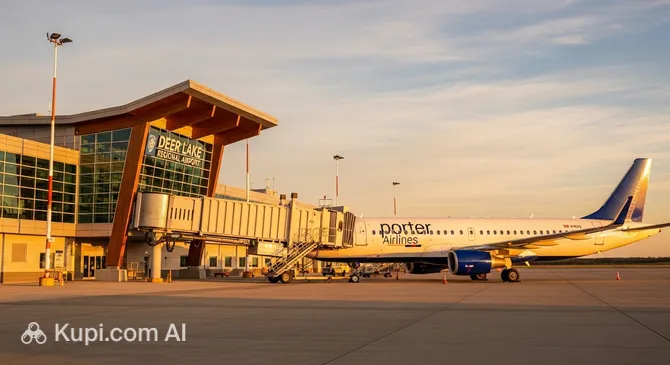
Deer Lake Regional Airport. Source: Kupi.com Binoculars

Deer Lake Airport (IATA: YDF) is not merely a transport hub, but a true gateway to the wildlife and adventures of western Newfoundland. Located in the town of the same name, it serves as the starting point for thousands of tourists eager to witness the breathtaking landscapes of Canada. It is from here that the journey begins to the famous Gros Morne National Park, a UNESCO World Heritage Site. Despite its relatively small size, the airport offers everything necessary for a comfortable journey.

IATA Code YDF
ICAO Code CYDF
City Deer Lake
Distance to Centre About 6 km
Status Regional (with seasonal international flights)
Annual Passengers About 324,000 (based on 2019 data)
Popular Airlines Air Canada, WestJet, PAL Airlines
Schedule online flight information for "Deer Lake Airport"

The main advantage of Deer Lake Airport is its strategic location. It is situated just a half-hour drive from Gros Morne National Park, making it the ideal starting point for eco-tourism enthusiasts and hikers. Inside the terminal, which was significantly renovated in 2007 to serve the growing flow of passengers, a cosy and friendly atmosphere prevails. Travellers have access to free Wi-Fi, a café, and several car rental desks, which is particularly important for exploring the picturesque surroundings. The compactness of the airport allows for pre-flight formalities to be completed quickly and without unnecessary hassle.

Contact Information

  • Official Website: deerlakeairport.com
  • Information Desk Phone: +1 (709) 635-3601
  • Airport Address: 1 Airport Road, Deer Lake, Newfoundland and Labrador, A8A 1A3, Canada
  • Email: To contact the airport administration, it is recommended to use the contact form on the official website.
  • Social Media: The airport maintains pages on social networks where it publishes current news and updates for passengers.
  • Lost Luggage Information: For issues regarding lost or damaged luggage, you must contact your airline's support service directly.
  • Passenger Support Contacts: For enquiries, you may use the main airport phone number or visit the information desk within the terminal.

How to Get to the Airport

Getting to Deer Lake Airport (YDF), a key transport hub for western Newfoundland, from the town of Deer Lake in Canada is quite simple due to its close proximity. The trip from the city centre usually takes just 5–10 minutes. The choice of transport depends on your budget, amount of luggage, and further travel plans.

Taxi and Private Transfer
This is the most convenient and fastest way to reach the terminal. Taxis can be found in the city or ordered by phone. The cost of a trip from the city centre is typically around 15–25 Canadian Dollars (CAD). Some hotels also offer shuttle services for their guests — it is worth checking this possibility when booking. This option is ideal if you have a lot of luggage or value comfort and speed.

Car Rental
For tourists planning to explore the scenic surroundings, especially Gros Morne National Park, renting a car is the best choice. Counters for several major rental companies are located within the Deer Lake Airport building. You can easily drive to the airport in your rental car and leave it at the rental agency's parking lot. It is strongly recommended to book a vehicle in advance, especially during the peak tourist season (from June to September).

Airport Parking
If you are arriving in your own or a rented vehicle, the airport provides both short-term and long-term parking. The lots are located in the immediate vicinity of the terminal. Rates vary: short-term parking may cost a few dollars per hour, the daily rate is approximately 15–20 CAD, and parking for a week will cost around 70–90 CAD. It is recommended to check current prices on the official airport website before your trip.

Public Transport
In a small town like Deer Lake, the public transport system is limited. There may not be direct regular bus routes to the airport. However, some regional bus companies might stop nearby. It is recommended to study the schedules and routes on local carriers' websites in advance or verify information at your hotel.

Alternative Airports
Although Deer Lake Airport is the main hub for this region, depending on your itinerary, other air harbours may be useful. Among them are Gander International Airport (YQX) at a distance of about 209 km, as well as smaller airports in Chevery (YHR), Blanc-Sablon (YBX), and St. Anthony (YAY).

Terminals and Map

Deer Lake Airport (YDF) is a compact and modern air terminal in Canada, distinguished by a simple and clear structure. It consists of one main terminal serving both domestic and some seasonal international flights. Such an organisation makes the airport extremely convenient for passengers, eliminating the need for long walks and complex navigation, as transfers between terminals simply do not exist.

The terminal layout is intuitively clear. All key zones — check-in counters, security screening, boarding gates, and the baggage claim hall — are located in one building a short distance from each other. Navigation will not cause difficulties even for those here for the first time: clear signs are placed everywhere, and the small size of the terminal allows for quick orientation.

The departure and arrival zones are logically separated but located in immediate proximity. After entering the building, you immediately find yourself in the common area with check-in counters. After passing pre-flight security, passengers find themselves in a comfortable waiting hall with boarding gates. The arrival zone includes a baggage claim belt and car rental company counters located right by the exit.

One of the main advantages of Deer Lake Airport is the speed of completing all formalities. Thanks to its compactness and the efficient work of the staff, flight check-in and security control usually take significantly less time than in major airports. Nevertheless, it is recommended to arrive at the airport approximately 90 minutes before a domestic flight departure and 2 hours before an international one, to check in luggage and go through all procedures without haste. Getting lost here is practically impossible, making travel through YDF maximally comfortable and calm.

History of the Airport

The history of Deer Lake Airport (YDF) began in the mid-20th century. Its construction was initiated by the Bowater forestry company for the needs of its enterprise, and the official opening took place in 1955. Initially, the runway was gravel and intended to serve corporate flights delivering personnel and cargo for the paper mill.

An important stage in development occurred in 1959 when the airport came under the management of Transport Canada, which paved the way for its use as a fully-fledged civil airport. In 1998, the Deer Lake Regional Airport Authority was created, taking over the management and further development of the air harbour. This step allowed for a more flexible response to the region's needs and the attraction of investment for modernisation.

With the growth of tourism and the economy of western Newfoundland, the airport has been upgraded repeatedly. One of the most significant reconstructions was completed in 2007, when the terminal was substantially expanded and renovated. This allowed for increased capacity, improved passenger comfort, and the commencement of handling a larger number of flights, including international charters during the winter season, which are popular among winter sports enthusiasts.

Today, Deer Lake Airport is the second busiest in the province of Newfoundland and Labrador after St. John's Airport. It plays a key role in the region's transport system, serving as the main air gateway for visitors to Gros Morne National Park, a UNESCO World Heritage Site. Its history is a vivid example of how a small corporate airfield transformed into an important regional transport hub contributing to the development of tourism and the economy.

Services and Amenities

Deer Lake Airport (YDF) offers passengers a basic set of services to make waiting for a flight as comfortable as possible. Despite its relatively small size, the terminal is designed for traveller convenience. There is a café in the terminal where you can order hot drinks, sandwiches, and light snacks. There is also a small shop offering souvenirs, press, and travel goods, allowing you to purchase memorable gifts from the province of Newfoundland and Labrador — a picturesque corner of Canada.

For those who need to stay connected, free Wi-Fi is available throughout the terminal. In the waiting areas, you can find sockets for charging mobile phones and other gadgets. ATMs for cash withdrawals are installed in the airport building. Please note that full currency exchange points are absent here, so it is better to attend to financial matters in advance.

The airport cares for all categories of passengers. For travellers with small children, baby care rooms are provided. The terminal is fully adapted for people with disabilities: there are ramps and specially equipped toilets, and staff are ready to provide assistance with boarding and disembarking upon prior request through the airline. There are no special VIP lounges at the airport, but the general waiting halls are sufficiently spacious and comfortable.

There are no hotels directly within the airport building, but in the immediate vicinity, in the town of Deer Lake, several hotels are located, many of which provide transfer services for their guests. Separate conference rooms or business centres are absent at the airport, however, the presence of stable internet allows for addressing work issues. In emergency cases, first aid can be provided to passengers.

Where to Eat

When planning a snack at the airport serving the town of Deer Lake, it is important to consider that this is a small regional aviation hub. Dining options here are concentrated in one main establishment, which offers convenient and quick solutions for travellers. Do not expect a large variety of restaurants as in major hubs, but you will certainly be able to refresh yourself before departure.

The main and only place to eat at Deer Lake Airport is the Cloud 9 Cafe and Gift Shop. It is conveniently located in the main terminal building, in the public zone (pre-security), meaning before passing through security control. This allows not only passengers but also those seeing them off to have a snack. The establishment combines a café and a souvenir shop where you can also buy something as a keepsake.

The Cloud 9 Cafe menu focuses on classic and filling dishes. Here you will find freshly prepared sandwiches, soups of the day, and salads that are excellent for a full lunch. For a quicker snack, a variety of pastries is offered, including muffins and cookies, as well as various snacks and beverages — from coffee and tea to soft drinks. Sometimes the assortment includes pastries with local berries, such as bakeapple (cloudberry) or partridgeberry (lingonberry), offering a chance to taste something local right at the airport.

Passengers with specific dietary needs should be prepared for a limited selection. Vegetarian options are generally available in the form of vegetable sandwiches or salads; however, finding certified vegan, gluten-free, or Halal dishes may be difficult. It is recommended to arrange for snacks in advance if you have strict dietary restrictions. The café's operating hours are tied to the flight schedule, and prices are at an average level for airports in Canada.

Travel Tips

To ensure your journey through Deer Lake Airport goes as smoothly as possible, take advantage of our useful tips. This small but convenient airport serves western Newfoundland in Canada, and knowing a few nuances will help save time and reduce stress.

Arrival Time at the Airport. For domestic flights, it is recommended to arrive at the airport at least 90 minutes before departure. If you have an international flight, it is better to allocate 2-3 hours to pass all formalities, including customs and border control, without haste.

Check-in and Security Control. The fastest way to check in for a flight is to do so online on your airline's website. This will allow you to avoid queues at check-in counters. The security checkpoint at Deer Lake Airport usually operates quickly, but it is always useful to prepare liquids (in containers up to 100 ml) in a separate transparent bag and remove electronics from hand luggage in advance.

Seat Selection on the Plane. If you wish to enjoy breathtaking views of Gros Morne National Park or the Newfoundland coast during takeoff or landing, choose a window seat. An aisle seat is suitable for those who plan to get up during the flight.

Hand Luggage Rules. Standard security rules prohibit carrying sharp objects, flammable substances, and liquids in volumes greater than 100 ml per container. All liquids must be packed in one transparent bag with a volume of no more than 1 litre. Electronics, power banks, and valuables should always be in your hand luggage.

Connecting Passengers. Deer Lake Airport is compact, so navigation here will not cause difficulties. If you have a connecting flight, check with the airline at check-in whether your luggage will be transferred automatically or if you need to collect it and check it in again. There is usually ample time for transfers.

Customs Control. Upon arrival on an international flight, you will need to pass customs control. Prepare your passport and completed declaration (ArriveCAN) in advance to speed up the process. Be ready to answer questions about the purpose of your trip and declare all goods subject to mandatory declaration.

Saving Time and Money. To save money, bring an empty water bottle with you and fill it after passing security control. Prices for food and drinks at the airport can be high, so bringing a light snack is a good idea. Also, study transfer options from the airport in advance to choose the most cost-effective one.

In Case of Flight Delay. In the event of a flight delay or cancellation, first contact your airline representative. They will provide current information and explain your rights. Depending on the length of the delay, you may be offered vouchers for meals, drinks, or even hotel accommodation.
Reached the end of the page?

That means the route is fully explored