Support

Fort Simpson

About the Airport

Fort Simpson Airport is not merely a runway in the heart of the vast northern territories of Canada, but a true aerial gateway to a world of wild nature and adventure. Located in the village of the same name, it serves as a vital link for local communities and a starting point for travellers seeking to witness the grandeur of Nahanni National Park. This small but strategically important airport is a symbol of Northern exploration and a key hub for anyone exploring the Dehcho region.
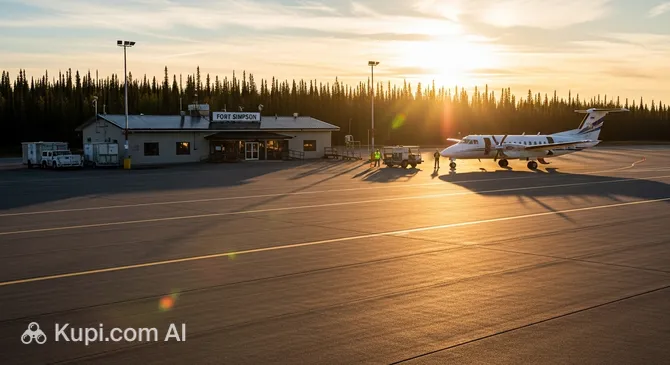
Fort Simpson. Illustration.
Source: Kupi.com AI
PropertyValue
IATA CodeYFS
ICAO CodeCYFS
CityFort Simpson
CountryCanada
TimezoneAmerica/Inuvik
ScheduleOnline Timetable

The main feature of Fort Simpson Airport is its strategic importance for the entire region. It plays a key role not only in passenger transport but also in the delivery of mail, food, and vital cargo to remote settlements. The airport is also a base for air ambulance services and charter flights, including scenic flights over Nahanni National Park, a UNESCO World Heritage Site. For tourists, this is the starting point for unforgettable adventures: canoe expeditions, hikes, and aerial excursions begin here. Despite its modest size, the airport ensures a reliable connection with major cities such as Yellowknife and is an indispensable part of the transport infrastructure of the Northwest Territories.

Contact Information

Below is contact information for Fort Simpson Airport (YFS), which will help you plan your trip and resolve potential questions.

  • Official Website: Basic information about the airport is available on the Government of the Northwest Territories of Canada portal. Although the airport does not have a separate website, up-to-date data can be found here. Link: www.inf.gov.nt.ca.
  • Inquiry Service Phone: For general questions and information about airport operations, you can call: (867) 695-2331.
  • Airport Address: The airport is located at: Fort Simpson, NT, X0E 0N0, Canada. It is situated in immediate proximity to the town.
  • Email: A specialized email address for passengers is not provided. It is recommended to use the telephone for communication.
  • Social Media: Fort Simpson Airport does not have official pages on social media.
  • Lost Luggage Information: If your luggage has been lost or damaged, you should immediately contact your airline's representative. Airport services do not handle luggage tracing.
  • Passenger Support Contacts: For all questions related to booking, flight changes, check-in, and carriage rules, please contact your airline directly.

How to Get to the Airport

Fort Simpson Airport (YFS) is a key transport hub for the settlement of the same name in Canada. Given the small size of Fort Simpson, getting to the airport from any point in the settlement is effortless. The distance from the centre to the terminal is just a few kilometres, so the trip will take no more than 10-15 minutes.

Taxi and Transfer. This is the most common and convenient way to reach the airport. Several local taxi services operate in the village. It is recommended to book a car in advance, especially if you have an early flight. Some hotels and guest houses offer transfer services to their guests, which is a reliable option. A taxi ride will be relatively inexpensive due to the short distance, but it is the costliest option compared to others.

Car Rental. If you plan to explore the surroundings, renting a car can be a good solution. By renting a car, you gain complete freedom of movement. Parking is provided near the airport terminal where you can leave a personal or rented vehicle. Given the scale of the village, parking is likely to be free or very cheap.

Public Transport. It is important to note that there is no regular public transport, such as city buses, metro, or trains, in Fort Simpson. Therefore, tourists should not rely on this mode of transport. The main options remain taxis, pre-booked transfers, or private vehicles.

When planning your trip, consider that other regional airports, such as Yellowknife Airport or the airport in the town of Hay River, are located more than 300 kilometres away, which highlights the importance of arranging local transport in Fort Simpson in advance.

Terminals and Map

Fort Simpson Airport (YFS) is a small regional aviation hub in Canada, the structure of which is maximally simple and convenient for passengers. It consists of one compact terminal that handles all flights — both departures and arrivals. Thanks to this, travellers do not need to worry about transfers between buildings or complex navigation, as all necessary services are located in one place.

The airport layout is extremely clear. Inside the single building, all key zones are located: check-in counters, the security screening point, a small waiting area for departing passengers, and the baggage claim area for arrivals. Departure and arrival zones are in immediate proximity to each other. Navigation is intuitively understandable, and getting lost here is practically impossible.

Check-in and screening procedures generally take minimum time. The airport is not overloaded with high passenger traffic, so long queues characteristic of large aviation hubs are rare here. Despite this, it is recommended to arrive at the airport in advance to calmly complete all formalities and be ready for possible schedule changes, which sometimes happen in northern regions.

History of the Airport

The history of Fort Simpson Airport (YFS) is not just a chronicle of runway construction, but a reflection of key stages in the development of northern Canada. This small but strategically important airport played a significant role in events of global scale as well as in the everyday life of the region.

The founding of the airport is directly linked to the Second World War. It was built in the early 1940s as part of the Northwest Staging Route. This air corridor was of immense importance for ferrying thousands of aircraft from the USA to Alaska and further to the Soviet Union under the Lend-Lease programme. Thus, a modest airstrip in the Canadian wilderness became a link in a chain influencing the course of world history. After the war ended, the airport's military significance declined, and it was transferred to civil administration, starting a new chapter as a vital transport artery for the local population.

In subsequent decades, Fort Simpson Airport constantly developed to meet the growing needs of the region. The initially gravel runway was paved, allowing for the reception of larger and more modern aircraft. New navigation and lighting systems were installed to ensure flight safety in difficult northern weather conditions. The terminal building also underwent modernization to provide greater comfort for passengers.

Today, the airport is not only a passenger and cargo hub but also an important base for emergency response services. In summer, it serves as a staging ground for amphibious aircraft fighting forest fires, which is critical for protecting settlements and nature. Furthermore, Fort Simpson Airport is the main aerial gateway for tourists and researchers heading to the famous Nahanni National Park, a UNESCO World Heritage Site. This role highlights its unique position at the intersection of history, modernity, and wild nature.

Services and Amenities

Fort Simpson Airport (YFS) is a small regional air station serving the settlement of the same name and its surroundings in the Northwest Territories of Canada. Given its compact size, the range of services here is basic and focused on meeting the essential needs of passengers before departure. Travellers are recommended to take care of all important matters, such as dining or currency exchange, in the village itself beforehand.

There are no restaurants, cafes, or shops in the terminal building. If you need snacks, drinks, or travel goods, it is better to purchase them in Fort Simpson before arriving at the airport. There are also no specialized lounges or VIP zones here — a general waiting hall is available for all passengers.

Access to Wi-Fi at the airport may be limited or unavailable, so it is worth relying on mobile internet. To charge electronic devices, you can use standard electrical outlets in the waiting hall, though their number may be small. ATMs, currency exchange points, business centres, and medical facilities are not provided in the terminal — all these services are available in the village.

Passengers with reduced mobility are recommended to contact the airline in advance to organize necessary assistance for boarding and disembarking. The terminal itself is equipped with basic amenities to ensure accessibility. There are no special mother-and-child rooms or play areas for children. There are also no hotels on the airport territory, but various accommodation options can be found in nearby Fort Simpson, which is a few minutes' drive away.

Dining

When planning travel through Fort Simpson Airport (YFS), it is important to understand that this is a small regional airport in Canada, and its infrastructure corresponds to its size. Dining options here are quite modest and differ from what might be expected in large international hubs.

On the territory of the Fort Simpson Airport terminal, there are no full-service restaurants or cafes. Travellers usually only have access to vending machines offering a limited selection of snacks, such as chips, chocolate bars, and soft drinks in bottles or cans. One cannot count on hot meals, fresh pastries, or a specialized menu (such as vegetarian, gluten-free, or Halal) directly in the terminal building.

In this regard, travellers are strongly advised to arrange meals in advance. The best option is to have a full lunch or dinner at one of the establishments in the town of Fort Simpson before travelling to the airport. It would also be wise to bring your own sandwiches, fruit, or other snacks, especially if you have a long wait for your flight or special dietary needs.

Travel Tips

Travelling through Fort Simpson Airport can be simple and convenient if you know a few key points. The airport primarily serves regional flights, so there is no hustle and bustle of large international hubs. To ensure your trip goes smoothly, we have gathered several useful tips.

Arrival Time and Check-in. For domestic flights within Canada, it is recommended to arrive at the airport approximately 1.5–2 hours before departure. This time will be sufficient to pass check-in and security screening without rushing. If possible, use online check-in to save time. Screening procedures here generally proceed faster than in large airports, but security rules are standard: be ready to present your boarding pass and identification.

Hand Luggage. Pay close attention to packing your hand luggage. All liquids, gels, and aerosols must be in containers of no more than 100 ml and packed in a single transparent resealable bag. It is prohibited to carry sharp objects, weapons, and flammable substances in the cabin. It is better to check the dimensions and weight of hand luggage in advance on your airline's website, as requirements may vary.

Seat Selection and Transfers. When flying from Fort Simpson, choose a window seat to enjoy breathtaking views of the northern landscapes. If you have a transfer planned at a larger airport, study its map in advance and clarify whether you will need to collect and re-check your luggage. Leave sufficient time between connecting flights, especially if flying with different airlines.

Customs Control. Since Fort Simpson Airport mainly handles domestic flights, most passengers will not need to pass through customs control. This procedure is relevant only for those arriving on international flights, which is a rarity for this airport.

Saving and Unforeseen Situations. To save money, book tickets in advance and consider travelling with only hand luggage. Prices for food and drinks in small airports can be high, so you can take a small snack with you (except liquids). In case of a flight delay, first contact the airline representative for information. Keep a book, a charged power bank, or downloaded movies with you, as leisure opportunities in the terminal may be limited.

Reached the end of the page?

That means the route is fully explored