Support

Fort Smith Airport

About the Airport

Fort Smith Airport (YSM) is not merely a runway in northern Canada, but a true aerial gateway to a world of wildlife and adventure. Located on the border of the Northwest Territories and Alberta, it serves as a starting point for travellers seeking to witness pristine landscapes and unique fauna. For local residents, it is a vital hub connecting them to the rest of the country, while for tourists, it marks the beginning of an unforgettable journey to the famous Wood Buffalo National Park.
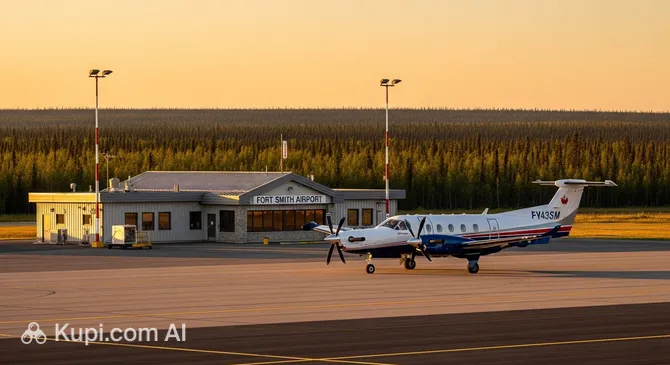
Fort Smith Airport. Source: Kupi.com Binoculars
IATA Code YSM
ICAO Code CYSM
City Fort Smith
Distance to centre About 2 km
Status Domestic
Annual passengers About 15,000 (pre-pandemic data)
Popular Airlines Northwestern Air, Calm Air

Despite its modest size, Fort Smith Airport plays a key role in the region's transport system. It serves as the base for Northwestern Air, which provides scheduled connections to major cities such as Yellowknife and Edmonton, as well as charter flights to remote settlements. The airport's main advantage is its strategic location. It is situated just a few minutes' drive from the city centre and is the closest airport to Wood Buffalo National Park, the largest in Canada and a UNESCO World Heritage Site. This makes it the ideal starting point for eco-tourists, photographers, and anyone wishing to experience northern nature.

Contact Information

Below is the essential contact information for Fort Smith Airport (YSM), which will help you plan your trip and resolve any potential queries.

  • Official website: Fort Smith Airport is managed by the Government of the Northwest Territories. Official information can be found on their portal in the section dedicated to the region's infrastructure and airports.
  • Inquiry desk phone: For general questions and information regarding airport operations, you can call: +1 867-872-2259.
  • Airport address: 100 King St, Fort Smith, NT X0E 0P0, Canada.
  • Email: A public email address for general inquiries is typically not provided. It is recommended to use the telephone for communication.
  • Social media: The airport does not maintain its own official social media pages.
  • Lost luggage information: If your luggage has been lost or damaged during the flight, you must contact your airline's baggage tracing service directly. For items left within the terminal building, please contact the airport administration via the main phone number.
  • Passenger support contacts: For all matters related to booking, ticket changes, flight schedules, and carriage regulations, you should contact your airline directly. Airport staff can assist with terminal navigation and general queries.

How to Get to the Airport

Getting to Fort Smith Airport (YSM) from the city of Fort Smith in Canada is quite simple, as it is located very close to the central part of the city. Given the small size of the settlement, the journey will not take much time, though the choice of transport has its own specifics.

Taxi and Transfer: This is the most common and reliable way to get to the airport. The trip from the city centre will take approximately 5–10 minutes. It is recommended to book a car in advance, especially if you have an early flight. The cost of the trip is reasonable, but it is best to confirm it with the operator when booking. Some hotels may also offer a transfer service for their guests, which is a convenient alternative.

Car Rental and Parking: If you have rented a car to travel around the region, you can easily drive to the airport yourself. Signs will help you navigate quickly. Fort Smith Airport has a car park where you can leave your vehicle for both short and long terms. This option provides maximum flexibility and independence.

Public Transport: It is important to note that there is no regular public transport service (buses, trains) connecting Fort Smith with the airport. Therefore, travellers should not rely on this method. The main options remain taxis or private vehicles.

Terminals and Map

Fort Smith Airport (YSM) is a small regional airport characterised by a simple and clear structure. There is only one passenger terminal here, serving both domestic departures and arrivals. Thanks to its compact dimensions, all zones are located within a single building, making navigation incredibly convenient for travellers.

The terminal layout is intuitive. Immediately at the entrance, you will find the check-in counters and baggage drop-off. After passing through the security zone, passengers enter a small departure lounge. The arrival area is located here as well, with a separate exit and a baggage claim area. Due to the airport's small size, moving between zones takes only a few minutes, and getting lost here is practically impossible.

Check-in and security procedures at Fort Smith Airport are very quick, as passenger traffic is low. Unlike major international hubs, there are no long queues here. Generally, it is sufficient to arrive at the airport 60-90 minutes before departure to check in, drop off luggage, and pass through security control without haste.

Thus, the main feature of Fort Smith Airport is its compactness and simplicity. Travellers do not need to allocate a lot of time for moving through the terminal or completing pre-flight formalities. It is a convenient and functional transport hub focused on the fast and effective service of regional flight passengers.

Airport History

The history of Fort Smith Airport (YSM) is inextricably linked with key events in world history. Its creation began in the early 1940s as part of the construction of the Northwest Staging Route during World War II. The airfield played a strategic role, serving as a vital point for ferrying aircraft supplied from the USA to the USSR under the Lend-Lease programme. This fact makes it not just a transport hub, but a site with a rich historical past.

After the war ended, the airport's military significance diminished, and it was repurposed for civil needs. For the city of Fort Smith, which held the status of the capital of the Northwest Territories of Canada until 1967, the airport became a vital artery. It provided regular connections with the rest of the country, handling passenger and cargo transport, mail, as well as air ambulance flights and forest fire suppression services, which was of critical importance for the remote northern region.

Over the decades, Fort Smith Airport has gone through various stages of modernisation. Reconstructions of the runway were carried out, navigation equipment was updated, and terminal infrastructure was improved to meet modern safety and comfort standards. Today, the airport is under the administration of the Government of the Northwest Territories and continues to fulfil its mission, being a key link in the region's transport system and a living monument to northern aviation history.

Services and Amenities

Fort Smith Airport (YSM) is a small regional airport in Canada, offering a basic but necessary set of services for a comfortable wait before your flight. It is important to consider its size — you will not find the variety of large international hubs here, but everything essential for a traveller is available.

The terminal usually houses a small cafe or snack bar where you can have coffee and a snack with sandwiches or pastries. Vending machines with drinks and snacks are also installed. Shopping opportunities are limited, typically to a small kiosk selling newspapers, magazines, and travel goods.

Free Wi-Fi is available to all passengers throughout the airport. If you need to charge your phone or laptop, there are specially equipped stands and power outlets in the waiting hall. There are no separate VIP lounges or business lounges at Fort Smith Airport — all passengers use the general waiting area. Currency exchange points are absent, though an ATM for withdrawing cash in the local currency may be available in the terminal.

The airport is fully adapted for passengers with reduced mobility: there are ramps, accessible restrooms, and special parking. To receive assistance with boarding or moving through the terminal, it is recommended to notify your airline in advance. For families with small children, changing tables are equipped in the restrooms. Basic medical assistance can be obtained by contacting any airport staff member.

There are no hotels directly on the airport grounds. The nearest hotels are located in the city of Fort Smith, just a few minutes away by taxi or rental car. Specialised business centres and conference rooms are also not available at the airport, although the presence of Wi-Fi allows for handling work tasks in the general waiting hall.

Where to Eat

Fort Smith Airport (YSM), being a small regional air hub, offers passengers limited but functional dining options. It is important to note that the choice of establishments here is not comparable to major international airports, so it is worth planning your time and meals in advance.

A small cafe or snack bar usually operates within the airport terminal. The assortment typically includes basic items, ideal for quickly satisfying hunger before departure: coffee, tea, soft drinks, sandwiches, and light snacks. Additionally, vending machines are installed in the terminal building where you can purchase chips, chocolate bars, and bottled water. Specialised meals, such as vegetarian, gluten-free, or Halal options, are likely not to be found here.

Given these features, travellers who wish to have a full lunch or dinner, as well as those with specific dietary preferences, are strongly recommended to eat at one of the establishments in the city of Fort Smith before arriving at the airport. This approach will allow you to avoid inconvenience and wait for your flight calmly, starting your journey through the picturesque expanses of Canada with comfort.

Travel Tips

Travelling through Fort Smith Airport (YSM) generally proceeds smoothly, as it is a small regional airport. Nevertheless, good preparation will help make your trip as comfortable as possible. Here are several useful tips for passengers departing from this northern air hub in Canada.

Arrival Time and Check-in: For domestic flights, it is recommended to arrive at the airport 90 minutes to 2 hours before departure. This time is sufficient to check in luggage and pass through security control without rushing. To save time, use online check-in on your airline's website if such an option is available.

Hand Luggage and Security Control: Remember the general rules for carrying liquids: all containers must be no more than 100 ml in volume and packed in one transparent bag. Laptops and other large electronics must be removed from bags for screening. Since the airport is small, queues at security control usually move quickly. When choosing a seat on the plane, prefer a window seat — you may be treated to incredible views of the northern landscapes.

Passengers with Connections and Customs: If you have a connecting flight, ensure at check-in that your luggage is checked through to your final destination. Keep in mind that the weather in the north can be unpredictable, so allow sufficient time between flights. Customs control at Fort Smith Airport is only undergone by passengers arriving on international flights (which happens rarely). For domestic flights, this procedure is not required.

Economy and Unforeseen Situations: To save money, pack light luggage to avoid excess weight fees, and take an empty water bottle with you, which can be filled after passing security. In case of a flight delay or cancellation, immediately contact your airline representative at the airport. Familiarise yourself with your rights as a passenger — sometimes compensation, provision of meals, or accommodation is applicable. Remain calm and be prepared for the fact that in remote regions, alternative flight options may be limited.

Reached the end of the page?

That means the route is fully explored