Support

Inuvik Mike Zubko Airport

About the Airport

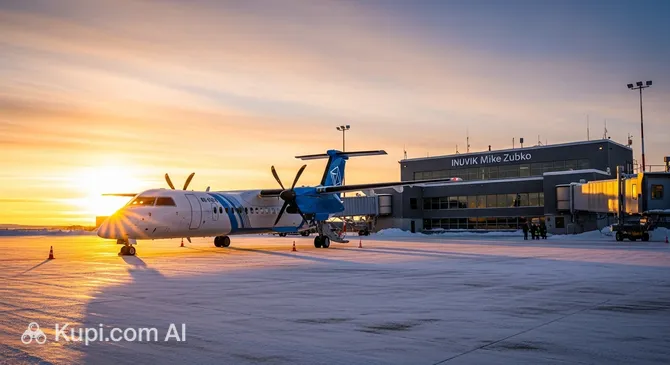
Inuvik Mike Zubko Airport. Source: Kupi.com Binoculars

Mike Zubko Airport is not merely a transport hub, but a true gateway to the boundless and mysterious Western Arctic. It is here, landing amidst the tundra, that travellers first feel the breath of the North and prepare to encounter the amazing nature of the Mackenzie River Delta. This small but strategically important airport serves as a starting point for those dreaming of seeing the midnight sun, driving on the famous ice road, or reaching the coast of the Arctic Ocean.

Named in honour of a legendary local aviator, the airport preserves the spirit of pioneers and polar romance while remaining a modern and reliable haven for aircraft. For many residents of remote communities, it is the only link to the "outside world", and for tourists, it is the beginning of an unforgettable adventure in one of the most unique corners of Canada.

IATA Code YEV
ICAO Code CYEV
City Inuvik
Distance to Centre 13 km
Status Regional
Passengers per Year About 40,000 — 50,000

Features and Advantages of the Airport:

The main advantage of Mike Zubko Airport is its compactness and absence of queues. Unlike major hubs, all procedures here — from check-in to baggage claim — take mere minutes, allowing travellers to avoid unnecessary stress and save time. The airport staff is renowned for their northern hospitality and is always ready to assist, creating an almost home-like atmosphere.

Furthermore, the airport boasts a strategic location. It is situated in immediate proximity to the famous Dempster Highway, the only all-season road in the country crossing the Arctic Circle. This makes it an ideal base for road trippers who can rent a car right on the spot and set off to conquer the northern expanses. Flights are also operated from the airport to even more remote settlements, such as Aklavik or Sachs Harbour, opening access to the wildest corners of the region.

Contact Information

For your convenience, we have compiled the essential contact information for Mike Zubko (Inuvik) Airport (YEV). Please note that for issues related to tickets, schedules, and baggage, you should primarily contact your airline.

  • Official Website: Information about Inuvik (Mike Zubko) Airport is available on the official portal of the Government of the Northwest Territories, Canada, which operates the airport.
  • Helpline Phone: +1 867-777-2467. You can call this number to clarify information regarding terminal operations and services.
  • Address: 1 Airport Rd, Inuvik, NT X0E 0T0, Canada.
  • Email: A specialised email address for general passenger inquiries is usually not provided. It is recommended to use the telephone for communication.
  • Social Media: The airport does not have its own official social media accounts. The most up-to-date information on flight status is best checked on airline websites and apps.
  • Lost Luggage Information: If your luggage was lost or damaged during the flight, you must immediately contact the representative of the airline you flew with. For items left in the terminal building, please contact the airport helpline.
  • Passenger Support Service: All questions regarding booking, ticket changes, flight check-in, and special services on board are handled directly with your airline.

How to Get to the Airport

Getting to Mike Zubko Airport (YEV) from the city of Inuvik is quite simple, as it is located just 13 kilometres southeast of the centre. Given the compact size of the city and its northern location in Canada, transport options have their own specific features.

Taxis and Shuttles are the most common and convenient way to reach the airport. A taxi ride takes approximately 15-20 minutes. Several local taxi services operate in the city. It is highly recommended to book a car in advance, especially for early morning or late-night flights. Some hotels also offer transfer services for their guests, which can be a cost-effective alternative — check for this possibility when booking your accommodation.

Car Rental is an excellent option for travellers wishing to explore the surroundings, including the famous Dempster Highway. Car rental agencies are located within the city itself. It is best to book a car well in advance of your trip, as quantities are limited, particularly during the tourist season. Collecting or returning the car can often be arranged directly at the airport by prior agreement with the rental company.

For those arriving at the airport in their own or a rented vehicle, parking is provided at the terminal building. It offers spaces for both short-term and long-term parking. Issues with finding free spaces rarely arise.

It is important to note that Inuvik lacks a public transport system in the conventional sense — there are no city buses, trains, or metro lines running to the airport. Therefore, travellers should rely on taxis, shuttles, or rented transport.

Terminals and Map

Mike Zubko Airport (YEV) in the city of Inuvik is a small regional airport, typical for the northern part of Canada. Its structure is as simple as possible and oriented towards the convenience of passengers travelling within the country. You will not have to deal with a complex terminal system, as the airport consists of one compact passenger terminal that serves both departing and arriving flights.

The terminal layout is intuitively clear. Upon entering the building, you immediately find yourself in the general area where airline check-in counters are located. After receiving a boarding pass and dropping off luggage, passengers proceed to a small security screening area, followed by a cosy departure lounge. The arrival area is just as simple: after disembarking from the aircraft, passengers enter the baggage claim hall, which is located next to the main airport exit. Getting lost here is practically impossible.

Since there is only one terminal, the issue of transfers between them is irrelevant. All services — from check-in to boarding — are located in one building within a few steps of each other. This significantly saves time and eliminates the stress associated with navigating large airports. Departure and arrival zones are clearly separated but are in immediate proximity.

Check-in and screening procedures at Mike Zubko Airport generally proceed very quickly. Due to the low passenger flow and limited number of flights, long queues are rare here. Usually, completing all formalities takes no more than 20-30 minutes. Nevertheless, the standard recommendation is to arrive at the airport 1.5–2 hours before departure to complete all stages and check in luggage without haste.

The main advice for navigation is to follow the signs; there are few, but they are extremely clear. All necessary infrastructure is located on a single floor. If you have any questions, the airport staff is always ready to help. Compactness and simplicity are the key characteristics of Inuvik's airport, making the start or end of your Arctic adventure as comfortable as possible.

Airport History

Mike Zubko Airport, the main air hub of the city of Inuvik, has a rich history closely tied to the development of the Canadian Arctic. Its construction began in the mid-1950s as part of the creation of a new administrative centre in the Mackenzie River Delta. The official opening took place in 1959, and the airport immediately became a key infrastructure element ensuring the connection of the isolated region with the rest of Canada.

Initially built with a gravel runway approximately 1,800 metres (6,000 feet) long, the airport played an important strategic role during the Cold War as part of the Distant Early Warning (DEW) Line system. In the 1970s and 1980s, during the oil and gas exploration boom in the Beaufort Sea, the airport experienced a period of rapid growth. It served as the main base for helicopters and aircraft servicing drilling rigs and research camps, leading to a significant increase in traffic and the modernisation of its facilities.

An important milestone in the airport's history was its renaming in 1995. It received the name of Mike Zubko, a legendary local bush pilot who made an invaluable contribution to the development of aviation in the North and became a symbol of courage and skill for generations of pilots. This event highlighted the airport's deep connection with the local community and its pioneering spirit.

Throughout its history, the airport has been modernised repeatedly to meet contemporary requirements. The runway was paved and lengthened, allowing it to accommodate larger jet aircraft such as the Boeing 737. Today, Mike Zubko Airport is not just a transport hub, but a vital artery for the entire Western Arctic region, providing passenger and cargo transport, medical evacuation, and support for scientific research.

Services and Facilities

Mike Zubko Airport (YEV) is a small regional air hub serving the city of Inuvik and its surroundings in northern Canada. Given its size and purpose, the range of services here is focused on providing basic comfort and meeting the essential needs of passengers before departure.

The selection of dining and shopping establishments within the terminal building is limited. Typically, there is a small café or vending machines where you can purchase snacks and beverages. Souvenir shops or large stores are absent. Free Wi-Fi is available for passengers, and power outlets for charging mobile devices can be found in the waiting area. It is recommended to arrange currency exchange in advance, as there are no specialised exchange bureaus at the airport, although an ATM may be installed.

Specialised VIP zones or business lounges are not provided at Mike Zubko Airport — all passengers use the general waiting hall. The terminal is equipped to serve travellers with reduced mobility, including ramps and accessible restrooms. Passengers requiring additional assistance should notify their airline in advance. There are no dedicated playrooms for children, but basic amenities are available for passengers with infants.

There are no hotels, business centres, or conference rooms at the airport. The nearest hotels and other accommodation options are located in Inuvik itself, which can be reached by taxi or shuttle in a few minutes. All business meetings and events are also more conveniently held in the city.

Where to Eat

When planning a snack or lunch at Mike Zubko Airport (YEV), it is important to remember that this is a small regional airport serving the northern regions of Canada. Consequently, the choice of catering establishments here is very limited and not comparable to major international hubs.

All available dining options are concentrated in the single airport terminal, in the public area before security control (landside). Typically, a small café or snack bar operates here. It offers a basic range of services for passengers awaiting their flight.

Menu and Offers: The assortment usually includes hot drinks (coffee, tea), soft drinks, sandwiches, pastries (muffins, buns), and light snacks (crisps, chocolate). Sometimes the menu may feature a soup of the day or other simple hot dishes. This is a good option for a quick snack, but the selection may be insufficient for a full lunch. Unique local cuisine dishes are rarely found here.

Dietary Options: Specialised vegetarian, vegan, halal, or gluten-free dishes are likely absent from the menu. Passengers with strict dietary restrictions are strongly advised to bring food with them from the city of Inuvik.

Prices and Opening Hours: Prices at the airport may be slightly higher than in the city itself, which is common practice for remote airports. The café's opening hours are directly linked to the flight schedule — it opens before departures and closes after the last aircraft leaves. During quiet periods between flights, the establishment may be closed.

Recommendation: If you have time and wish to have a proper meal, it is better to do so at one of the restaurants in Inuvik before travelling to the airport. The airport café is ideal for having a coffee and a light snack immediately before departure.

Travel Tips

To ensure your journey through Mike Zubko Airport goes smoothly and comfortably, make use of these helpful tips. This small but important transport hub in the north of Canada has its own specific characteristics worth considering when planning a trip from Inuvik.

Arrival Time and Check-in. Despite the modest size of the airport, it is recommended to arrive at least 2 hours before a domestic flight departure. Northern weather is unpredictable, and it is better to have time in reserve. Check-in and screening procedures here usually proceed faster than in metropolises, but it is always useful to complete online check-in in advance to save time.

Seat Selection and Hand Luggage. If possible, choose a window seat. Flights over Arctic territories offer unforgettable views of the boundless tundra and the Mackenzie River Delta. Regarding hand luggage, the rules are standard, but bear in mind that flights are often operated on small aircraft with limited space. Check baggage allowances with your airline and do not forget to bring a portable charger, as charging opportunities in the small terminal may be limited.

Connections and Customs. Most flights from Inuvik are connecting flights. Allow sufficient time for transfers at hubs such as Edmonton or Yellowknife, especially in winter. Mike Zubko Airport serves domestic flights, so there is no customs control here. You will go through all international formalities at your first airport of arrival in Canada.

Saving Time and Money. Book tickets well in advance — this is the main way to save on flights to the North. Prices closer to the departure date can be very high. Bring snacks and an empty water bottle (you can fill it after security), as the selection of food and drinks at the airport is small, and prices may be above average.

In Case of Flight Delay. Delays and cancellations due to weather are common in the Arctic. Please treat this with understanding. Download films, music, or books to your phone or tablet in advance. Regularly check the flight status and maintain contact with airline representatives for the latest information.

Airports in nearby cities

Reached the end of the page?

That means the route is fully explored