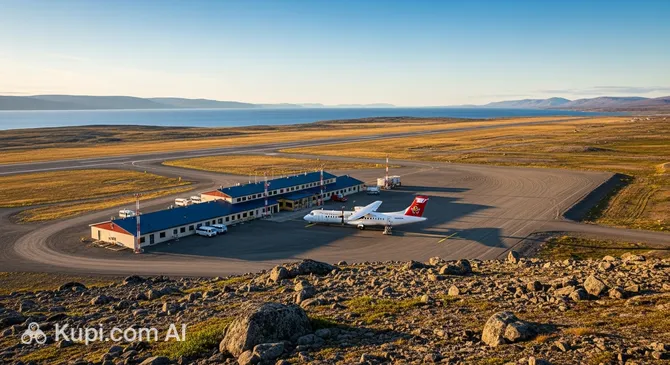
Source: Kupi.com AI
| Property | Value |
|---|---|
| IATA Code | YLC |
| ICAO Code | CYLC |
| City | Kimmirut |
| Country | Canada |
| Timezone | America/Iqaluit |
| Schedule | Online Timetable |
| Property | Value |
|---|---|
| IATA Code | YLC |
| ICAO Code | CYLC |
| City | Kimmirut |
| Country | Canada |
| Timezone | America/Iqaluit |
| Schedule | Online Timetable |
Kimmirut Airport is a small regional hub managed by the Government of Nunavut, while essential passenger services are provided by the operating airline. Below is the current contact information:
Transport logistics in Kimmirut differ significantly from the standards of major metropolises. Since Kimmirut is a small and isolated Inuit settlement (hamlet), there is no complex system of public transport, railways, or highways. The airport is located practically within the village limits, so you can reach it very quickly and without traffic jams.
Below are the main ways to get to the airport from the centre of the settlement and recommendations for planning your trip.
Walking
Given that the runway is in close proximity to residential houses, many locals and tourists with light luggage prefer to walk to the terminal. The distance from the village centre (for example, from the Co-op building or administration) to the airport is less than 1 kilometre. In good weather, the walk will take 10–15 minutes. This is an excellent opportunity to enjoy the views, although in winter or during strong winds, this option can be extreme.
Taxi and Transfers
There are no conventional taxi services with meters or ride-hailing apps (Uber, Lyft) in Kimmirut. However, convenient alternatives exist for tourists:
Public Transport
Kimmirut completely lacks public transport in the classical sense: there are no buses, minibuses, or metro. Due to the compactness of the settlement, there is simply no need for them.
Car Rental and Alternative Transport
Classic car rental services (such as Hertz or Avis) are not represented here. The road network is limited to the settlement itself and a couple of kilometres of gravel roads around it. The main means of transport for locals are:
Tourists can rent an ATV or snowmobile along with a guide through local outfitters, but using them solely for an airport transfer is impractical unless it is part of a larger tour.
Airport Parking
Near the tiny terminal building, there is a small open area. This is an unfenced zone where locals leave their ATVs, snowmobiles, or pickup trucks when meeting cargo or passengers. Parking is free and unguarded. There is usually enough space for everyone, given the low passenger flow.
How to Get to the Region (Important Information)
Since there are no roads connecting Kimmirut to the rest of Canada, aviation is the only year-round way to get here. The absolute majority of flights arrive from the capital of Nunavut. Iqaluit Airport is the main hub from where regular flights to Kimmirut operate (flight time is about 40 minutes). Air connections may also link the settlement with other communities in the region, such as Cape Dorset (Kinngait), however, the schedule often depends on seasonality and weather.
Summary:
Structure and Number of Terminals
Kimmirut Airport (YLC) is designed as simply and rationally as possible, dictated by the harsh climatic conditions and small passenger volume. The complex consists of a single one-story terminal building (Air Terminal Building). There is no separation into domestic and international sectors, as the airport serves exclusively local flights within the territory of Nunavut.
Layout and Zoning
The interior space of the terminal is a single hall combining all necessary functions. An airport map is not required, as it is impossible to get lost here. Inside the building, you will find:
Arrival and Departure Zones
There are no jet bridges or shuttle buses in Kimmirut. All movements between the terminal building and the aircraft are done on foot across the apron.
Terminal Features
The main feature of the Kimmirut terminal is its intimacy and community atmosphere. There are no familiar attributes of large airports: no Duty Free shops, ATMs, cafes, or business lounges. The building serves primarily as a reliable shelter from the wind and frost. Toilets are available, but amenities are minimal. Passengers are advised to carry water and snacks, as there may be nowhere to buy them on-site.
Check-in and Pre-flight Procedures
Despite the miniature size of the airport, adhering to time frames remains an important rule:
Navigation Recommendations
The main advice for travellers in Kimmirut is to dress for the weather before leaving the terminal. Since boarding takes place outside, you may be met by a piercing Arctic wind immediately upon stepping out. Be prepared that in bad weather, waiting for a flight may be prolonged, and all passengers will be in one small room.
The Era of Seaplanes and Foundation
Before the advent of a stationary runway, aviation connection with the settlement (which bore the name Lake Harbour until January 1, 1996) was carried out primarily via seaplanes in summer and ski-equipped aircraft in winter. Lake Harbour was one of the Hudson's Bay Company's first trading posts on the island, established back in 1911, so the need for regular communication arose here earlier than in many other parts of the Arctic. The construction of a permanent gravel strip in the mid-20th century was a true engineering challenge: builders literally had to carve it into the rocky rock of the narrow valley.
Change of Name and Status
An important milestone in the airport's history was 1996, when the settlement officially reclaimed its traditional Inuit name Kimmirut ("The Heel"), which is related to the characteristic shape of a nearby rock outcrop. Following the town, the airport also changed its name. Since then, it appears on navigation charts as Kimmirut Airport, although the IATA code (YLC) still retains a reference to the old name Lake Harbour (L-C).
Geographical Deadlock and Relocation Plans
Over the past decades, the history of the airport has been a story of constant discussions about its relocation. The current location does not allow lengthening the runway (about 580 metres) by even a metre due to cliffs on one side and residential buildings on the other. The airport's history records many stages of planning for a new air harbour 5–8 kilometres from the village:
Records and Achievements
Although no passenger flow records have been set here, Kimmirut Airport holds the informal status of one of the most difficult and shortest active airports in the regular passenger transport system of North America. Pilots working on this route are considered the elite of polar aviation, as landing here requires surgical precision and special certification (Captain’s Check).
Interesting Facts
Passengers planning a trip to Kimmirut should adjust their expectations regarding the level of service at the local airport in advance. The YLC terminal is a strictly functional structure designed for short-term shelter from the weather before departure or after arrival. The infrastructure here is minimalist and corresponds to the status of a remote northern settlement.
Restaurants, Cafes, and Shops
Dining and retail outlets are completely absent in the airport building. There are no cafeterias, vending machines with coffee or snacks, nor souvenir or press shops.
Financial Services and Communication
The airport does not provide banking services. There are no ATMs or currency exchange points here. Cash withdrawal options in the settlement itself are also extremely limited, so travellers are advised to carry a sufficient supply of Canadian dollars in cash, especially for paying private drivers or buying souvenirs from local artisans.
Wi-Fi and Charging Stations: There is no public Wi-Fi network in the terminal. Mobile reception in the airport area may work, but signal quality depends on your operator and weather conditions. There are no specialised charging stations for gadgets, but you may find a few spare power outlets in the waiting area. It is recommended to carry a fully charged portable power bank.
Lounges and VIP Services
There is no separation into service classes at Kimmirut Airport. Separate business lounges, VIP rooms, or airline lounges are not provided. All passengers wait for their flight in a single small common hall. Conference rooms and business centres are also absent in the terminal.
Services for Passengers with Children
There is no specialised mother and child room or play area in the terminal. Given the short waiting time and the compactness of the room, parents usually keep children with them. A restroom is available, but it is equipped with only basic amenities.
Services for Passengers with Reduced Mobility
The airport is a single-story building, which facilitates access for citizens with limited mobility (no stairs inside the terminal). However, a number of difficulties should be considered:
Medical Services
There is no medical post or pharmacy in the terminal. There is only a basic first aid kit with the staff. The nearest medical facility — the Community Health Centre — is located in the settlement of Kimmirut itself, a few minutes' drive away.
Hotels and Accommodation
There are no hotels on the airport territory itself, and overnight stays in the terminal are not provided (the building closes at night). Since the airport is within the settlement limits, accommodation places are located very close by:
When planning a trip through Kimmirut Airport, it is important to be prepared for the fact that the usual concept of airport dining does not apply here. Due to the remote location and low passenger flow, restaurants, cafes, bars, and food outlets are completely absent in the YLC terminal.
Below is detailed information on how to organise meals in the absence of service, and recommendations for travellers.
Restaurants and Cafes in the Terminal
In the sole terminal building, there are no catering establishments in either the public zone (landside) or the secure zone (airside). You will not find coffee shops, fast food, or even kiosks with snacks here. Vending machines for drinks and food are also not installed.
Dining Recommendations: Where to Find Food?
Since it is impossible to eat directly at the airport, passengers need to use alternative options:
The best solution is to eat a hearty meal before leaving your home or hotel. If you need a snack for the road, be sure to visit the local Co-op store (Kimmirut Co-operative), located in the centre of the settlement, before heading to the airport. There you can purchase baked goods, canned food, fruits (subject to delivery availability), drinks, and snacks. Given that the journey to the airport takes only a few minutes, food will not have time to cool down or spoil.
It is strongly recommended to have lunch or buy food to take away at the point of departure. Most often, flights arrive from the regional capital. Iqaluit Airport has cafes and shops where you can purchase sandwiches, salads, and hot drinks before boarding the flight. This is your last opportunity to buy ready-made food before arriving in the settlement.
Local Cuisine and Dietary Requirements
Although there are no gastronomic delights in the airport itself, travellers should be aware of the specifics of food in the region for independent preparation:
Drinking Water
There are no drinking fountains in the Kimmirut terminal. Tap water in the restroom is technical and may not be suitable for drinking without boiling. Be sure to carry a bottle of water, especially if travelling with children. There will be nowhere to buy water after checking in (in the waiting area).
Price Range
If you decide to stock up on provisions at the local Kimmirut store before departure, be prepared for "northern prices". The cost of products here is significantly higher than on the "mainland" due to complex delivery logistics.
Summary for the Passenger
Treat Kimmirut Airport like a bus stop in the wilderness. It is warm and dry, but there is no food service. Your strategy is "bring everything with you". This ensures that a flight delay due to weather conditions will not leave you hungry.
Travelling through Kimmirut Airport is a unique experience requiring flexibility and good preparation from the tourist. To ensure your flight is as comfortable as possible, we have compiled practical recommendations considering the specifics of flying in the Canadian Arctic.
Optimal Arrival Time
Unlike major international hubs, there is no need to arrive 3 hours early here. The optimal arrival time at the airport is 45–60 minutes before the scheduled departure. This is sufficient to complete check-in, which usually closes 30 minutes before departure. However, you must not be late: passenger lists and cargo manifests are compiled in advance, and the plane may leave without you if you do not appear on time.
Check-in and Security Control
The screening procedure here is simplified but has its nuances. Since flights are operated within the region, you are unlikely to encounter full scanning of shoes and liquids as in big cities. However:
Seat Selection on the Plane
On flights operated by small turboprop aircraft to this region, the principle of open seating usually applies. Seat numbers are not indicated on the boarding pass.
Hand Luggage: What is Allowed and What is Not
The main rule for hand luggage in Kimmirut is compactness. The shelves in the aircraft cabin are very narrow or non-existent (items are placed under the seat).
Transit and Connections
The absolute majority of passengers fly via Iqaluit Airport. When planning a connection with flights to the "mainland" (to Ottawa or Montreal), allow a minimum of 3–4 hours, or better yet — an overnight stay in Iqaluit. Weather in the Arctic is unpredictable, and a delay in departure from Kimmirut by several hours or even days is not uncommon. Single tickets (through-booking) are preferable, as the airline will be responsible for missed connections.
Customs Control
Since the airport serves only domestic flights, there is no customs or passport control (border service) here. However, remember strict biosecurity and nature conservation rules: exporting art objects made of whale bone or walrus ivory outside Canada requires special CITES certificates, which cannot be issued at the airport.
Saving Time and Money
Actions in Case of Flight Delay
Delays and cancellations of flights due to fog, wind, or blizzards are part of the reality of travelling to Nunavut. If your flight is postponed:
Reached the end of the page?
That means the route is fully explored