Source: Kupi.com AI
| Characteristic | Value |
|---|---|
| IATA code | YMN |
| ICAO code | CYFT |
| City | Makkovik |
| Country | Canada |
| Time zone | America/Goose_Bay |
| Schedule | Online timetable |
| Characteristic | Value |
|---|---|
| IATA code | YMN |
| ICAO code | CYFT |
| City | Makkovik |
| Country | Canada |
| Time zone | America/Goose_Bay |
| Schedule | Online timetable |
Makkovik Airport (YMN) is a small regional airfield managed by the Government of Newfoundland and Labrador. Since there is no permanent terminal administration here, the main contacts for passengers are associated with the operating airline, Air Borealis.
Makkovik is a compact and isolated settlement, so logistics here differ radically from typical urban conditions. The airport is located just 1 kilometre from the community centre. Thanks to this proximity, the journey to the terminal takes mere minutes; however, the choice of transport is dictated not by commercial services, but by seasonality and the harsh climate of Labrador.
Public Transport
There is no public transport system in the classical sense in Makkovik. There are no bus routes, metro, or trains. Given the size of the settlement and the number of residents, there is no need for regular urban transport.
Transfers and Taxis
Official taxi services with signage may not exist here. Transport connections are usually built on personal arrangements:
Car Rental and Parking
Counters for international car rental companies (Hertz, Avis, etc.) are absent in the terminal. It is impossible to rent a car in Makkovik due to the isolation of the road network — roads exist only within the village. Parking at the airport consists of a small open area. It is free but is used mainly by local residents meeting or seeing off flights.
Recommendations and Travel Time
Travel time from any point in the village to the runway is from 2 to 5 minutes by transport. In good weather, you can walk to the airport in 15–20 minutes, enjoying the views, but consider the wind and the condition of the gravel road. The main recommendation: always check weather conditions before setting out, as flights may be delayed or cancelled due to fog or blizzards.
Neighbouring Airports and Air Connections
You can only reach Makkovik by air, and most often the route is built through larger hubs. The main transfer hub of the region is Goose Bay Airport (Happy Valley-Goose Bay), located approximately 212 km to the south. It is from there that most flights to coastal communities depart.
The air network also connects Makkovik with other settlements in Labrador, allowing tourists to plan complex routes along the coast. The nearest neighbouring airfield is Rigolet (about 110 km), and further north you can travel to Nain, which is the northernmost permanent community in the province. For further expeditions deep into the continent, flights towards the town of Schefferville are sometimes used, but they are less regular for tourism purposes.
Terminal Structure and Navigation
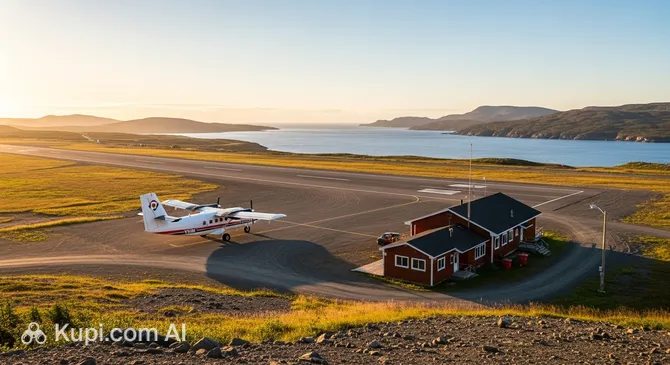
Makkovik Airport (YMN) is an example of a classic airfield for remote northern regions. Here you will not find confusing corridors, jet bridges, or multi-level car parks. The entire airport complex consists of one compact single-story building, which performs all functions for handling passengers and cargo. The terminal resembles a small, cosy house, the main task of which is to protect travellers from the harsh winds of Labrador while waiting for a flight.
Zoning and Interior
The internal layout of the terminal is extremely simple and intuitive, so a map or navigation scheme is completely unnecessary here. The space is organised as a single hall:
There are no transfers between terminals as there is only one building. It is impossible to get lost here — it is just a few steps from the entrance to the exit onto the airfield.
Features of Departure and Arrival Zones
In Makkovik, there are no typical "secure zones" with Duty Free shops. Departure and arrival procedures have their own northern specifics:
Processing Time
Thanks to the intimate nature of the airport, all formalities take minimum time. There are no queues for passport control or long security checks.
Navigation Recommendations
The main advice for tourists in Makkovik is to dress for the weather, even if you plan to spend only a couple of minutes outside when moving from the taxi to the terminal and from the terminal to the plane. Strong winds on the open space of the airfield can be piercing. Follow the instructions of the ground staff: they will indicate the safe route across the airfield to your aircraft.
The Era of Seaplanes and Ice Airfields
The history of aviation in Makkovik began long before the construction of a stationary runway. In the mid-20th century, before the advent of the modern airport, connection with the outside world depended on the changing seasons. In summer, seaplanes ("flying boats") landed in the sheltered bay, and in winter, when the ocean was locked in ice, pilots used ski landing gear to land directly on the frozen water surface. Periods of freezing and thawing (spring and autumn) meant complete isolation for the settlement, when neither boats nor planes could reach the community.
Opening of "YMN" and Breaking Isolation
The turning point came in the 1970s, when the provincial government launched a large-scale programme to build permanent airfields in the coastal communities of Labrador. The construction of Makkovik Airport (YMN) was a true engineering challenge: it was necessary to create a flat site amidst a rocky landscape and marshy tundra. The opening of the gravel strip forever changed the lives of local residents, ensuring year-round access to emergency medicine, fresh produce, and mail, regardless of the state of the ice in the ocean.
Development Stages and Airlines
Initially, the airport infrastructure was minimal — a small dirt strip and a tiny wooden structure for waiting. For decades, the main aircraft serving this route has been the legendary De Havilland Twin Otter. This aircraft has proven itself ideally in harsh conditions, becoming a symbol of reliability for locals. Historically, flights were operated by Labrador Airways (later Air Labrador), which, through reorganizations and mergers, became part of the modern Air Borealis alliance.
Modernisation and Technology
Despite the fact that the airport retains its status as regional and small, it has gone through several important stages of modernisation:
Interesting Facts
There are no records of giant liners landing in the history of Makkovik Airport, but it has its unique achievements. The airport is a vital link in the chain of so-called "milk runs" — flights that, like a bus, sequentially fly along the entire coast, from Rigolet to Nain, delivering everything: from school textbooks to snowmobiles. For pilots, landing in Makkovik is considered a test of skill due to frequent crosswinds and complex terrain on the approach.
Given the remoteness and compact size of Makkovik Airport (YMN), passengers should expect a completely different level of service here than in major international hubs. The terminal is a small building designed exclusively for short-term waiting for flights and protection from the weather. There is no familiar commercial zone here, so travellers are advised to prepare for the flight in advance.
Dining and Shops
The terminal building lacks cafes, restaurants, and vending machines. There are also no Duty Free shops or souvenir stalls.
Connectivity, Wi-Fi, and Finance
Technical amenities in the terminal are also limited to basic needs:
Waiting Halls and Comfort
The airport has one general waiting hall. Separation into business classes or the presence of separate VIP lounges is not provided here. The room is heated and has seating. The atmosphere is more reminiscent of a home living room or the lobby of a small guesthouse, where all passengers are together.
Services for Special Categories of Passengers
Despite the lack of specialised equipment, the staff of the airport and Air Borealis are known for their responsiveness and readiness to help.
Hotels and Accommodation Nearby
There are no hotels on the airport territory itself, but thanks to the proximity to the settlement, accommodation can be found literally a kilometre from the runway.
Business Services
Conference rooms and business centres are absent in the terminal. If you need to hold urgent negotiations or send documents, it is better to do this from the Adlavik Inn or the municipal office in the village, where there is access to the internet and fax.
Dining Features in the Terminal
Passengers planning to depart from Makkovik Airport (YMN) should take into account that gastronomic infrastructure in the terminal itself is completely absent. The terminal building is a compact waiting hall not equipped with zones for preparing or selling food. Here you will not find restaurants, coffee shops, or lounges. Moreover, the hall lacks even vending machines with water, chocolate bars, or snacks.
Where to Eat Before Departure
Since the airport is located only 1–2 kilometres from the settlement centre, the issue of food must be resolved before arriving for check-in. In Makkovik itself, the choice of establishments is limited but sufficient for the basic needs of a traveller:
Local Cuisine and Souvenirs
Although food is not sold at the airport, Makkovik is famous for its northern delicacies, which tourists often take with them as gifts. If you manage to find them in the village from locals or at craft fairs, be sure to try:
Dietary Requirements (Vegetarian, Halal, Gluten-free)
In the conditions of the remote north, finding specialised nutrition is extremely difficult. The store assortment is limited to basic products, and the hotel cooks according to a fixed menu.
In-flight Catering
Flights from Makkovik are operated by small Twin Otter type aircraft of Air Borealis. Due to the short duration of flights and the type of aircraft, full hot meals are not provided on board. Usually, flight attendants (if present on the flight) or pilots can only offer passengers water and, in rare cases, light packaged snacks. Therefore, having your own bottle of water and a sandwich in your carry-on luggage is the key to your comfort en route.
Price Range
Food prices in the village of Makkovik are higher than the Canadian average due to the complex logistics of delivering cargo to the north (Air Foodlift Service). Be prepared for familiar snacks and drinks in the local store to cost more than in supermarkets on the "mainland".
Travelling to the remote corners of Labrador is a unique experience that requires special preparation. Makkovik Airport (YMN) operates under rules different from major international hubs, where much depends on the weather and the type of aircraft. To ensure your flight goes smoothly, use these practical tips.
Optimal Arrival Time
Despite the fact that the airport is tiny and there are practically no queues here, you should not arrive at the last minute. Air Borealis recommends being on site 45–60 minutes before departure. This time is necessary not for passport checks, but for the correct preparation of the aircraft. Pilots and ground staff need to weigh all baggage and cargo to calculate the balance of the small aircraft (Twin Otter). Being late even by 10 minutes can lead to your luggage not flying with you if the calculations are already closed.
Check-in and Security Specifics
The check-in process here is as personalised and simple as possible:
Seat Selection on the Plane
In Twin Otter aircraft flying to Makkovik, an open seating system usually applies. You can take any free seat upon boarding, however, the final word always rests with the pilots. To maintain the balance of the aircraft, you may be asked to move to the front or rear part of the cabin.
Carry-on Luggage: What is Allowed
The main rule for flights to Makkovik is minimalism. Overhead bins for carry-on luggage in the Twin Otter are tiny or non-existent.
Tips for Transit Passengers
Most travellers fly through the hub in Goose Bay (Happy Valley-Goose Bay). If you have a connecting flight:
Saving Time and Money
What to Do in Case of Flight Delay
Delays and cancellations due to wind or poor visibility are common for Labrador. Treat this philosophically.
Have you reached the end of the page?
So the route has been studied inside and out