Support

Moosonee

About the Airport

Moosonee Airport (YMO) is not merely a runway in Northern Ontario, but a true gateway to the world for this town on the shores of James Bay. For the residents of Moosonee and the surrounding settlements, it is a vital hub connecting them to the rest of Canada, as reaching this area by land is impossible for most of the year. This small but strategically important airport serves as a starting point for travel, cargo delivery, and emergency assistance in the harsh conditions of the Canadian North.
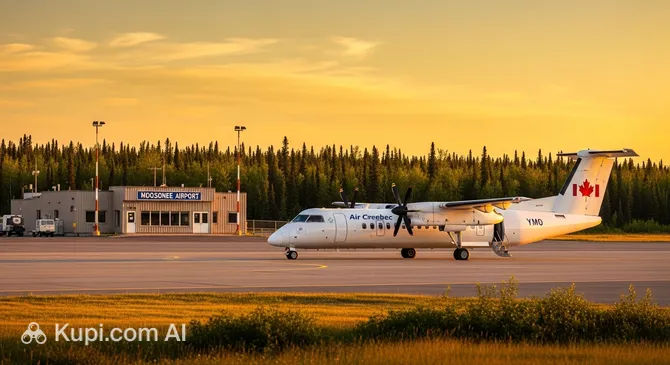
Moosonee. Illustration.
Source: Kupi.com AI
PropertyValue
IATA CodeYMO
ICAO CodeCYMO
CityMoosonee
CountryCanada
TimezoneAmerica/Toronto
ScheduleOnline Timetable

The main feature of Moosonee Airport is its indispensable role in the life of the region. It handles regular passenger and cargo flights, which remain the only year-round means of connection with the southern provinces. The airport also serves as a base for air ambulance services, ensuring emergency medical care for residents of remote communities. For tourists, YMO is the key to unique adventures: it is from here that many wildlife viewing tours begin, and it is the access point to the terminal station of the famous "Polar Bear Express" train. Despite its modest size, the airport effectively fulfills its mission, serving as a reliable transport hub in one of the country's most inaccessible corners.

Contact Information

For your convenience, we have compiled the essential contact information for Moosonee Airport (YMO). Please note that this is a small regional airport, so some communication channels common in major hubs may not be available.

  • Official Website: The airport is managed by the Ontario Ministry of Transportation. Current information is available on the government portal: www.ontario.ca/page/moosonee-airport.
  • Information Desk Phone: +1 705-336-2361. You can obtain general information about flights and airport operations at this number.
  • Airport Address: Airport Rd, Moosonee, ON P0L 1Y0, Canada.
  • Email: An official public e-mail for contacting the airport administration is not provided.
  • Social Media: Moosonee Airport does not maintain official pages on social networks.
  • Lost Luggage Information: For all issues related to lost or damaged luggage, it is recommended to contact your airline's representative directly.
  • Passenger Support Contacts: For inquiries and assistance, you may use the main airport information phone number.

How to Get to the Airport

Getting to Moosonee Airport (YMO) from the town itself is a straightforward task, though it has specific nuances due to the unique location of this settlement in Northern Canada. Moosonee is a small and compact town, so distances here are minimal, and modes of transport common in metropolises may not be available.

Taxi or Local Transfer is the most common and convenient way to reach the airport. Several private carriers operate in the town. A trip from any point in Moosonee to the terminal will take just 5–10 minutes. The cost is generally fixed and affordable. It is recommended to book a car in advance, especially if your flight coincides with the train's arrival or departure, as demand for transport increases.

Walking. Given the town's modest size, it is quite possible to walk to the airport. If you are travelling lightly and the weather permits, a walk from the central part will take no more than 15–20 minutes. This is an excellent way to better experience the atmosphere of this remote corner.

Public Transport. There is no city bus or metro system in Moosonee, which is typical for larger cities. The main means of communication with the rest of Ontario is the train, but it is not used for movement within the town itself.

Car Rental and Parking. It is important to know that there are no roads connecting Moosonee to other cities, so car rental services are not available here. Consequently, long-term parking at the airport is not provided. There is only a small area for short-term parking, intended for local residents dropping off or picking up passengers.

Terminals and Map

Moosonee Airport (YMO) is a small regional air station, so its structure is extremely simple and understandable for any traveller. There is only one small terminal here, which serves both arriving and departing flights. Thanks to its compact size, getting lost is practically impossible, making your stay at the airport as comfortable and stress-free as possible.

The terminal layout is very logical. Upon entering, you immediately find yourself in the general area where the check-in counters of the airlines operating at the airport are located. The waiting area for passengers and greeters is also located here. Departure and arrival zones are not separated into complex wings as in major hubs. After check-in, you will proceed to a small security screening area, and then to the boarding gate. The entire path from the entrance to the gate takes just a few minutes.

Since there is only one terminal, the issue of transfers between terminals is not relevant. All procedures—from check-in to boarding—take place in one building. Check-in and security screening usually take a minimum amount of time due to the low passenger flow. Nevertheless, it is recommended to arrive at the airport in advance, in accordance with your airline's rules, especially if you are travelling with luggage.

The main tip for navigation is simply to follow the signs; there are few of them, and they are all extremely clear. Airport staff are always ready to help and suggest directions. Due to the simplicity and compactness of the terminal, you will not have to worry about long walks or the risk of missing your flight while moving through the terminal building.

Airport History

The history of Moosonee Airport (YMO) is closely intertwined with the military and civilian history of Northern Ontario. Its foundation dates back to World War II, when in 1941 the Department of National Defence of Canada opened a Royal Canadian Air Force base here (RCAF Station Moosonee). Initially, the facility served as a training and transit point, playing an important role in ensuring the security of the country's northern borders.

After the war, the military significance of the base diminished, and it was transferred to the Department of Transport of Canada, beginning its transformation into a civilian airport. This transition was a turning point, as for the isolated town of Moosonee, which has no road connection to the rest of the province, air travel became vital. The airport turned into a true "lifeline," ensuring the delivery of cargo, mail, and passengers.

Significant infrastructure improvements occurred in subsequent decades. One of the key events was the modernization of the runway in the 1990s, when the gravel surface was replaced with asphalt. This allowed for the accommodation of larger and more modern aircraft. The next important step was the construction of a new modern terminal, which opened in 2011, significantly increasing the level of comfort for passengers.

An interesting fact: during the Cold War years, the airport was part of the "Mid-Canada Line"—a chain of radar stations designed to detect bombers. Today, Moosonee Airport is primarily an important civilian hub that continues to play an indispensable role in the lives of northern communities, serving as a gateway to the James Bay region and a symbol of connection with the wider world.

Services and Amenities

Moosonee Airport (YMO) is a small regional airport serving the northern part of the province of Ontario. Given its size and remote location, the range of services here is focused on the basic needs of passengers and differs noticeably from major international hubs.

Dining and shopping opportunities in the terminal are extremely limited. You will not find restaurants, cafes, or duty-free shops here. Vending machines with snacks and drinks may be available to passengers, but it is recommended to bring food with you or have a meal before arriving at the airport.

The airport has a main waiting hall for all passengers. There are no VIP lounges or business lounges. Access to Wi-Fi and charging stations for electronic devices may be limited, so it is best to carry a portable power bank. There are no specialized banking services, ATMs, or currency exchange points in the terminal building—all financial transactions should be completed in town beforehand.

The airport is equipped to serve passengers with reduced mobility, but it is recommended to inform the airline in advance regarding the need for special assistance, such as the provision of a wheelchair. There are no specialized mother-and-child rooms or play areas. Medical assistance is limited to first aid provision.

There are no hotels directly on the Moosonee Airport grounds. The nearest accommodation options are located in the town of Moosonee itself, a short distance from the airport. Conference rooms and business centres are also not provided in the terminal.

Dining

When planning a trip through Moosonee Airport (YMO), it is important to understand that this is a small regional air hub in Canada, and the choice of dining establishments here is extremely limited. Unlike large international airports, the single compact terminal building does not house full-service restaurants or cafes. All services are reduced to the most basic amenities.

The only opportunity to purchase food and drinks on the airport premises is via vending machines. Their assortment usually includes standard options for a quick snack: crisps, chocolate bars, biscuits, as well as bottled water and fizzy drinks. This can be helpful if you need to urgently satisfy hunger or thirst before a flight, but one should not count on hot food or a full meal.

Passengers with specific dietary requirements (vegetarians, vegans, as well as those looking for gluten-free or Halal options) are strongly advised to bring food with them, as such options are practically never available in the machines. For a more substantial meal, the best solution is to visit one of the establishments in the town of Moosonee before arriving at the airport.

Traveller Tips

Planning a trip through Moosonee Airport? This small but important transport hub is the gateway to a unique region on the shores of James Bay. To ensure your trip goes smoothly, make use of our tips.

Arrival Time at the Airport. Moosonee Airport (YMO) is a small regional airport, so large crowds are rare here. Nevertheless, it is recommended to arrive approximately 90 minutes before your flight's departure. This time will be sufficient to check in, drop off luggage, and pass through security without rushing.

Check-in and Security. Most airlines flying from Moosonee offer online check-in, which can save you time. There is only one security checkpoint here, and the procedure usually goes much faster than in major airports. However, security rules are standard: be prepared to remove laptops and liquids from your hand luggage.

Seat Selection. Flights to/from Moosonee are often operated on small turboprop aircraft. If you want to enjoy breathtaking views of the northern forests and rivers of Canada, choose a window seat. Due to the design features of such aircraft, it can be quite noisy in the cabin—do not forget your headphones.

Hand Luggage. You are permitted to take liquids in containers up to 100 ml in your hand luggage, packed in a transparent bag. Be sure to keep all valuables, documents, medication, and a portable charger in the cabin with you. Given the remoteness of the region, it is worth bringing a light snack and a book or a tablet with downloaded films.

Connecting Passengers. If you have a connecting flight, clarify during check-in at Moosonee whether your luggage will be checked through automatically to the final destination. Study the map of the connecting airport in advance, as it will likely be significantly larger.

Customs Control. Since Moosonee Airport primarily serves domestic flights, passing through customs and passport control when flying to other Canadian cities is not required.

Saving Time and Money. Book tickets in advance—this is the main way to save, as flights to remote regions can be expensive. Travel light to avoid surcharges for excess baggage. Services at the airport are few, so bring a water bottle (to fill after security) and snacks.

Flight Delays. Weather in Northern Ontario can be unpredictable, especially in winter, so delays do happen. Monitor updates on the airline's website and remain calm. There is a waiting area in the airport terminal, but amenities are limited. If the delay is lengthy, contact an airline representative to inquire about the possibility of providing meals or accommodation.

Reached the end of the page?

That means the route is fully explored