Support

Anqing Tianzhushan Airport

About the Airport

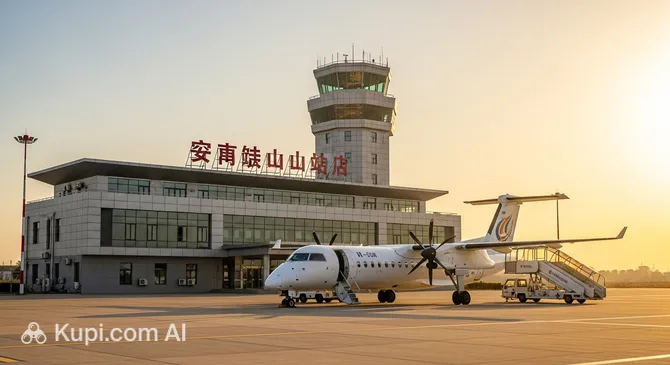
Anqing Tianzhushan Airport. Source: Kupi.com Binoculars

Tianzhushan Airport (Anqing) serves as the air gateway to the city of Anqing, located in the Anhui province of China. Originally a military airfield, it was converted into a dual-use airport and opened for civil flights in 1993. It received its current name in honour of the nearby scenic Mount Tianzhu, highlighting its role as a starting point for tourists wishing to explore the region's natural beauty. Despite its modest size, the airport is an important transport hub for domestic flights, connecting Anqing with major cities across China.

IATA Code AQG
ICAO Code ZSAQ
City Anqing
Distance to Centre 6.3 km
Status Domestic
Annual Passengers 596,482 (2021)
Popular Airlines China Southern Airlines, Hainan Airlines, Tianjin Airlines
Schedule Online Board "Tianzhushan Airport (Anqing)"

The main advantage of Tianzhushan Airport is its convenient location: it is situated just a few kilometres from the Anqing city centre, making transfers quick and affordable. The airport features one terminal and one runway, which simplifies navigation for passengers. As a regional hub, it focuses on domestic flights, offering travellers a convenient way to reach Anhui province from metropolises such as Beijing and Guangzhou. In recent years, the airport has undergone several stages of modernisation aimed at improving infrastructure and enhancing safety standards.

Contact Information

You can contact representatives of Tianzhushan Airport using the following details:

  • Official Website: Currently, the airport does not have a separate website. It is managed by Anhui Provincial Airport Group Co., Ltd., and up-to-date information can be found on their corporate site (usually in Chinese): www.aaac.com.cn.
  • Information Desk Phone: +86 556 528 4567. This is the main number for flight information, airport services, and general enquiries.
  • Airport Address: Luogang Town, Daguan District, Anqing, Anhui, China.
  • Email: An official email address for passengers is not provided. It is recommended to use the telephone for communication.
  • Social Media: The airport does not maintain official pages on international social networks.
  • Lost Luggage Information: For issues related to lost or damaged luggage, please contact your airline's representative or the general airport information desk.
  • Customer Support: For assistance and consultations, please call the main airport information number: +86 556 528 4567.

Getting to the Airport

Tianzhushan Airport (AQG) is conveniently located just a few kilometres northeast of the city centre of Anqing, making the journey there quick and simple. Travellers have access to several modes of transport to easily reach the terminal depending on their budget and preferences.

Public Transport: Bus
The most economical way to get to the airport is by using the city bus. A dedicated airport bus route (often referred to as Route No. 18) connects the airport with the main districts of the city. The bus journey usually takes about 30–40 minutes, depending on traffic and the number of stops. This is an excellent choice for those travelling without a large amount of luggage who wish to save money.

Taxi and Transfer
For maximum comfort and speed, a taxi is the best option. A trip from the centre of Anqing to Tianzhushan Airport will take approximately 15–20 minutes. This is the fastest method, especially if you have an early flight or lots of luggage. The cost will be higher than the bus, but quite reasonable. Important: use official taxi companies and ask the driver to use the meter. Alternatively, you can book a private transfer in advance via online services, which guarantees a fixed price and a meet-and-greet service.

Car Rental and Parking
If your plans include not only visiting the city but also exploring the picturesque surroundings, such as the Tianzhushan National Park, then car rental would be the best solution. This gives you complete freedom of movement. However, it is worth remembering that foreigners usually require a local driving licence to drive in China. For those arriving at the airport in a private or rented car, there is parking available on-site where you can leave your vehicle for both short and long terms.

Terminals and Map

Tianzhushan Airport in Anqing (AQG) is a compact and modern aviation hub distinguished by a structure that is simple and clear for passengers. Its key feature is that it consists of one terminal serving both domestic departures and arrivals. Such an organisation significantly simplifies navigation and makes the stay at the airport as comfortable as possible.

The terminal layout is logical and intuitive. All key zones are located sequentially, minimising the risk of getting lost. The ground floor typically houses check-in counters and the baggage claim area, while the first floor contains the security checkpoint and boarding gates. Thanks to the airport's small size, the transition from the building entrance to the boarding gate takes minimal time. Transfers between terminals are not required, as all operations are concentrated in a single building.

Departure and Arrival Zones are clearly demarcated. Upon arriving at the airport for departure, you immediately enter the check-in hall, after which you proceed to security control and the waiting area with several boarding gates. The arrival hall is located separately and leads passengers from the aircraft to the baggage reclaim belts and the exit to the city.

Check-in and screening procedures at Anqing Airport generally proceed significantly faster than in major international hubs. Nevertheless, it is recommended to arrive at the airport 1.5-2 hours before a domestic flight departure to complete all formalities without rushing. For navigation, simply follow the signs, which are duplicated in English, as is standard for Chinese airports.

Airport History

The history of Tianzhushan Airport in the city of Anqing is a journey from a military airfield to a modern civil aviation hub playing a vital role in the region's development. Its story began long before the appearance of commercial flights: the Anqing airfield was built back in 1928 and was used for military purposes for decades. This dual status—as a military and civil facility—has been preserved to this day, which is its distinctive feature.

A new era for the airport arrived in the 1990s when the decision was made to reconstruct it to serve civil aviation. After the necessary infrastructure modernisation works, Anqing Airport officially opened for commercial flights in December 1993, linking the city with other parts of China. This event became a key moment in the economic and tourism development of Anqing.

With the aim of increasing tourism appeal and regional recognition, the airport received its modern name in 2005—Tianzhushan, in honour of the famous National Park and Mount Tianzhu located nearby. In subsequent years, the airport underwent several stages of modernisation, including the expansion of the runway and the construction of a new, more spacious terminal to meet growing passenger traffic and modern service standards.

Today, Tianzhushan Airport represents an important air gateway that not only ensures convenient transport connections for residents and guests of Anqing but also contributes to the development of tourism in Anhui province. Its history reflects the rapid development of the aviation industry in China and the transformation of former military facilities into modern centres for travellers.

Services and Amenities

Tianzhushan Airport (AQG) in Anqing provides passengers with all the basic amenities necessary for a comfortable wait before departure. The terminal houses cafes and small eateries where you can taste local cuisine or enjoy a cup of tea. There are also shops offering souvenirs, travel goods, and local products.

For the convenience of travellers, free Wi-Fi is available throughout the airport, and waiting halls are equipped with power sockets and special stands for charging mobile devices. Passengers valuing extra comfort can utilise the services of the VIP lounge, which offers a quieter atmosphere, snacks, and beverages.

There are ATMs in the terminal building for cash withdrawals. In case of need, a medical post is available at the airport, ready to provide first aid. For passengers with young children, a Mother and Child room is equipped where you can feed and change your baby in a calm environment.

The airport is fully adapted to serve passengers with reduced mobility. Ramps and accessible restrooms are provided, and airport staff are always ready to supply a wheelchair and assist with passing through controls and boarding the flight.

Although there is no hotel directly inside the terminal building, in the city of Anqing itself, located a few minutes' drive away, you can find numerous accommodation options to suit any taste and budget. Separate conference halls for business meetings are not provided at the airport; however, basic conditions for work can be found in the VIP lounge.

Dining Options

Tianzhushan Airport (Anqing) is a regional aviation hub, so the choice of dining establishments here may be limited compared to major international airports. Nevertheless, passengers can find several options to have a snack before departure. Most cafes and small restaurants are concentrated in the main terminal building, primarily in the public area (landside) before security control.

For a full meal, it is worth looking for small establishments offering Chinese cuisine. Here you can try classic options such as noodle soup, fried rice with toppings, or dumplings. Sometimes the menu includes dishes characteristic of Anhui province, which serves as an excellent opportunity to experience local gastronomy. If time is short, small cafes serving tea, coffee, pastries, and sandwiches, as well as vending machines with drinks and snacks, are suitable for a quick bite.

Passengers with specific dietary needs, such as vegetarians, should be prepared for limited choices. Typically, one can order vegetable and rice dishes, but finding certified Halal, vegan, or gluten-free options in a small regional airport may be difficult. It is recommended to clarify the ingredients of dishes with the staff.

Food prices at Anqing airport, as in most air harbours, are usually higher than in the city. Opening hours of establishments are generally tied to the flight schedule and may close in the evening after the departure of the last aircraft. If you have enough time, the best solution would be to eat in the city of Anqing before travelling to the airport.

Travel Tips

Travelling through Tianzhushan Airport in the city of Anqing will be easier and more pleasant if you prepare in advance. Here are some useful tips to help you orient yourself at the airport and avoid unnecessary stress during your trip to China.

Arrival time at the airport. To manage everything without rushing, it is recommended to arrive at the airport at least 2 hours before the departure of a domestic flight. Although Anqing Airport is not the largest, it is better to have a buffer of time in case of unforeseen queues at check-in or security.

Check-in and security control. To save time, use online check-in if your airline provides this option. Have your passport and ticket ready at the check-in counter. Security services in Chinese airports operate very thoroughly. Be prepared to remove all electronic devices from your hand luggage, including power banks, and take off your outer clothing.

Choosing a seat on the plane. If you have the opportunity to choose a seat during check-in, consider your preferences. A window seat (A, F) will offer beautiful views during take-off and landing. An aisle seat (C, D) allows you to stand up freely without disturbing neighbours. Seats at emergency exits usually offer more legroom but may require an extra fee.

Hand luggage rules. Standard restrictions include a ban on liquids exceeding 100 ml in a single container, as well as sharp and flammable items. Particular attention in China is paid to power banks: they can be carried only in hand luggage, their capacity must be clearly marked on the casing, and usually must not exceed certain limits (often up to 20,000 mAh). Unmarked batteries may be confiscated.

For passengers with connections. If you have a connecting flight, check with the airline in advance whether you need to collect your luggage and re-register it in Anqing. Typically, on domestic flights with the same airline, luggage is transferred automatically, but it is better to be safe. Leave enough time between flights in case of possible delays and re-screening.

Customs control. When entering the country via an international flight, you must fill out a declaration if you are carrying items subject to declaration (for example, large sums of cash). For most tourists without such items, passing through the "Green Channel" is sufficient. Upon departure, be prepared for checks regarding the export of antiques and cultural valuables.

How to save time and money. Besides online check-in, save money by bringing an empty reusable water bottle—it can be filled at special fountains after passing security. Prices for food and drinks in airports are traditionally higher, so bringing a light snack with you also won't hurt.

What to do in case of flight delay. In the event of a delay or cancellation, contact your airline representative immediately. Find out about your rights: depending on the length of the delay, you may be provided with drinks, meals, or even hotel accommodation. Ensure your phone is charged and your hand luggage contains everything necessary for a long wait.
Reached the end of the page?

That means the route is fully explored