Source: Kupi.com AI
| Characteristic | Value |
|---|---|
| IATA code | BZJ |
| City | Bozhou |
| Country | China |
| Time zone | Asia/Shanghai |
| Schedule | Online timetable |
| Characteristic | Value |
|---|---|
| IATA code | BZJ |
| City | Bozhou |
| Country | China |
| Time zone | Asia/Shanghai |
| Schedule | Online timetable |
For your convenience, we have compiled the main contact information for Bozhou Airport (BZJ). Please note that this is a small regional airport, and some details may only be available upon arrival.
You can reach Bozhou Airport from the city centre in several ways, each with its own advantages depending on your budget, time, and comfort preferences. When planning your trip, it is worth considering traffic conditions, especially during peak hours.
Public Transport. The most budget-friendly option is usually the dedicated shuttle buses or city routes heading to the airport. Information regarding route numbers, schedules, and exact departure points is best clarified on-site — at your hotel or at information desks. Taking the bus is a great way to save money, though it may take more time than other modes of transport.
Taxi and Transfer. The most convenient and fastest way to get to the airport is by taxi. A trip from the centre of Bozhou will take approximately 30-50 minutes depending on traffic. You can use official city taxis (ensure the driver switches on the meter) or popular car-hailing apps in China, such as DiDi. For maximum convenience, especially if you have a lot of luggage or are travelling in a group, you can book a private transfer in advance.
Car Rental and Parking. If you prefer maximum freedom of movement, you might consider car rental. However, please remember that foreign tourists often require a temporary Chinese driving licence to drive in China. For those arriving at the airport in their own or rented vehicle, parking is provided on the terminal grounds, offering both short-term and long-term rates.
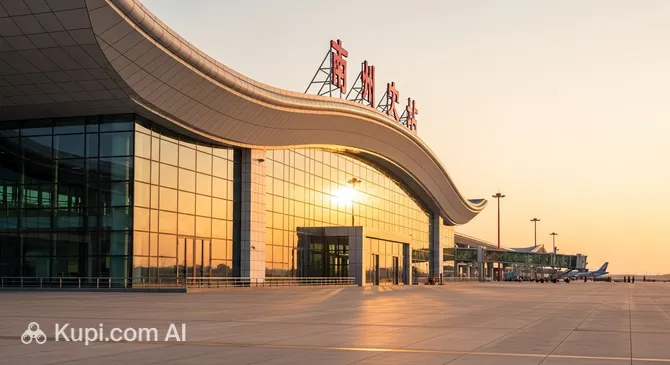
Bozhou Airport (BZJ) is a modern and compact aviation hub designed for maximum passenger convenience. Currently, there is one passenger terminal in operation, serving all domestic flights. Thanks to its thoughtful layout and small size, navigating the airport is intuitive and presents no difficulties, even for first-time visitors.
The terminal layout is quite simple. Upon entering the building, you find yourself in the general hall where check-in counters and baggage drop-off points are located. After receiving a boarding pass, passengers proceed to the pre-flight security screening area. Waiting lounges and boarding gates are located immediately after passing security control. All key zones — check-in, screening, and departures — are arranged sequentially, minimising movement time.
Arrival and departure zones are clearly separated. The Departure Zone includes check-in counters and waiting lounges with necessary infrastructure. The Arrival Zone is located in a separate part of the terminal and is equipped with baggage claim belts and an exit to the city. Since there is only one terminal, you do not need to worry about transferring between buildings — all operations are carried out within a single complex.
Completing all formalities at Bozhou Airport usually takes little time. Flight check-in and pre-flight screening proceed quite quickly. Nevertheless, it is recommended to arrive at the airport in advance — approximately 1.5-2 hours before departure. This time will be sufficient to check in luggage without rushing, pass through security, and find your boarding gate.
For easy navigation through the terminal, pay attention to the signs, which are duplicated in English. Airport staff are always ready to help and answer your questions. The compactness of the airport is its main advantage: it is practically impossible to get lost here, and the walk from the terminal entrance to the gate takes just a few minutes.
Bozhou Airport (BZJ) is one of the youngest and most modern in China, so its history is primarily the story of its creation. Unlike airports with a decades-long past, the air gates of Bozhou symbolise the rapid development of the region and its integration into the national transport network.
The airport construction project was part of a large-scale plan to improve the infrastructure of Anhui Province. Work began in 2018, and on December 28, 2022, the airport officially opened for commercial flights. This event became a key milestone in the modern history of the city, significantly simplifying access to this cultural and economic centre.
Since the airport was built from scratch according to modern standards, it has not gone through stages of reconstruction or modernisation. Its history is one major phase of construction and commissioning. The main achievement of the airport at the moment is its opening itself, which gave a powerful boost to the development of tourism and business in Bozhou, known as the "capital of Chinese medicine".
Thus, the history of Bozhou Airport is just beginning. Today, it represents an example of modern aviation infrastructure designed to meet the growing needs of the region. Travellers arriving here witness a new chapter in the life of an ancient city that is confidently looking into the future.
Bozhou Airport (BZJ) is a modern but compact regional aviation hub in China. Passengers should bear in mind that it offers a basic set of amenities necessary for a comfortable wait for departure, but does not possess the wide range of services typical of large international airports.
In the terminal, you will find comfortable seating areas and, typically, a small cafe or vending machines where you can buy beverages and light snacks. Opportunities for shopping here are quite limited, so do not count on a large selection of shops.
For the convenience of travellers, free Wi-Fi is available within the terminal, and there are charging stations for mobile devices. These services will help you stay connected while waiting for your flight.
It is important to note that the airport likely lacks currency exchange points. It is recommended to arrange currency exchange in the city beforehand. ATMs may be available for withdrawing local currency.
The airport is equipped for the needs of passengers with children — there are mother and child rooms. Conditions have also been created for the comfortable movement of passengers with reduced mobility, including ramps and specially equipped restrooms. If necessary, you can visit the medical point.
There are no hotels, VIP lounges with extended service, or specialised conference centres on the airport grounds. All options for accommodation and business meetings are located in the city of Bozhou itself, which can be easily reached by taxi or public transport.
Planning to grab a bite at Bozhou Airport (BZJ)? It is important to understand that this is a modern yet compact regional airport, so the choice of dining establishments corresponds to its size. Although you will not find a wide variety of restaurants, the available cafes and eateries allow you to comfortably satisfy your hunger before departure or after arrival.
Most food outlets are generally concentrated in the main hall before passing pre-flight security (landside). Here, passengers usually have more choices for a full meal. After passing security control, in the secure waiting area (airside), there is usually at least one cafe operating where you can order beverages and light snacks.
The basis of the menu at Bozhou Airport consists of Chinese cuisine dishes. Travellers can expect popular and filling options such as noodle soup, fried rice, dumplings, or steamed buns (baozi). This is a great opportunity for a quick introduction to local gastronomy. For those looking for something more familiar, cafes may offer sandwiches, pastries, and coffee.
If you have enough time for a full lunch, it is best to visit one of the eateries in the general hall. For a quick snack, packaged snacks from a vending machine or small shop, as well as pastries from a local cafe, are ideal. Passengers with strict dietary requirements (e.g., vegan, gluten-free, or Halal) are advised to carry food with them, as finding specialised meals in a small airport may be difficult.
Regarding prices, as in most airports around the world, they are somewhat higher than in city establishments in Bozhou. The opening hours of cafes and restaurants are directly linked to the flight schedule: they open a few hours before the first departure and close after the last aircraft has departed.
To ensure your journey through Bozhou Airport goes smoothly and without unnecessary hassle, take advantage of our tips. These recommendations will help you better prepare for your flight and save both time and peace of mind.
Arrival Time and Check-in. We recommend arriving at the airport at least 2 hours before a domestic flight departure. This time is sufficient to check in luggage without rushing, pass security control, and reach the boarding gate. Security screening procedures at airports in China can be very thorough, so be prepared to remove all electronic devices and liquids from your hand luggage in advance.
Seat Selection and Hand Luggage. If possible, select your seat on the plane during online check-in. Seats at the front of the cabin allow for a quicker exit upon arrival, window seats let you enjoy the views, and aisle seats offer the freedom to stand up easily. Pay special attention to the rules for carrying hand luggage. China has strict requirements regarding power banks: they can only be carried in hand luggage, and they must have clear capacity markings. Lighters and matches are generally prohibited.
Passengers with Connections. If you have a connecting flight, check in advance whether you need to collect and re-check your luggage. For domestic flights with the same airline, luggage is most often checked through to the final destination. Leave a sufficient time margin between flights to avoid rushing.
Customs Control. This procedure is relevant for international travellers. When entering the country via another city, you will pass customs inspection at the first airport of arrival. Be sure to declare goods subject to control to avoid issues.
Saving Time and Money. To save time, complete flight check-in online. This eliminates the need to queue at the counter. Prices for food and beverages at the airport are traditionally higher, so you might consider eating before arrival or bringing permitted snacks with you.
In Case of Flight Delay. If your flight is delayed, remain calm. First, contact an airline representative for information about the reasons and the new departure time. Keep an eye on the information screens for updates. Depending on the length of the delay, you may be provided with beverages, meals, or hotel accommodation.
Have you reached the end of the page?
So the route has been studied inside and out