Support

Chizhou Jiuhuashan Airport

About the Airport

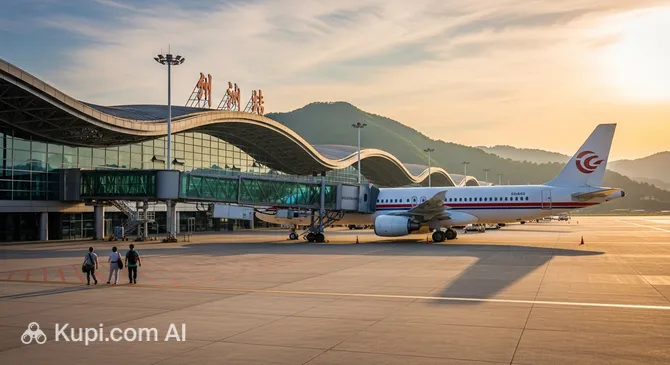
Chizhou Jiuhuashan Airport. Source: Kupi.com Binoculars

Chizhou Jiuhuashan Airport is not merely a transport hub, but a true aerial gateway to one of the four sacred Buddhist mountains of China. Located in a picturesque valley, it successfully combines modern functionality with the atmosphere of tranquility inherent to this region of Anhui Province. The terminal is situated almost halfway between the city centre and the famous temples of Mount Jiuhuashan, making it an ideal starting point for pilgrims and tourists wishing to experience ancient culture without long transfers.

IATA Code JUH
ICAO Code ZSJH
City Chizhou
Distance to centre approx. 20 km
Status Domestic
Passengers per year approx. 200,000 (capacity up to 500,000)
Schedule Available on the airport's online flight board

The main advantage of the airport is its compactness and convenience. Thanks to the small size of the terminal, all procedures — from check-in to baggage claim — are completed as quickly as possible, sparing travellers from the tiring queues typical of large hubs. The terminal building is designed in a modern style with elements of traditional Hui architecture, harmoniously blending into the surrounding mountain landscape.

Furthermore, the airport is distinguished by a strategic geographical location. It serves not only the city of Chizhou but also neighbouring Tongling, and provides the fastest access to Mount Jiuhuashan (only about a 30-minute drive). For the convenience of passengers, bus services have been established connecting to both the city centre and tourist zones, allowing you to begin your journey immediately after landing.

Contact Information

For your convenience, we have compiled the main contact information for Chizhou Jiuhuashan Airport (JUH). Please note that the airport primarily serves domestic flights, and most information resources may be available only in Chinese.

  • Official Website: http://www.czjhsjc.com/ (site may be in Chinese).
  • Inquiry Service Phone: +86 566 879 8888. Knowledge of Chinese may be required when calling.
  • Airport Address: Guichi District, Chizhou, Anhui, China, 247100.
  • Email: An official email address for general inquiries is not published. It is recommended to use the telephone for communication.
  • Social Media: The airport does not have official pages on international social networks. Up-to-date information may be published on Chinese platforms.
  • Lost Luggage Information: For issues related to lost or damaged luggage, you should first contact the representative of the airline you flew with.
  • Passenger Support Contacts: For general support and answers to questions, you can contact the main airport inquiry service phone number.

How to Get to the Airport

Getting to Chizhou Jiuhuashan Airport (JUH) from the centre of Chizhou is quite simple, and travellers can choose from several convenient methods depending on their budget, time, and preferences. The airport is located at a reasonable distance from the city, making the journey quick and uncomplicated.

The most economical way to reach the terminal is the shuttle bus. Special bus routes connect the airport with key points in the city, including major hotels and the bus station. This is an excellent choice for budget-conscious tourists. The trip usually takes about 40-60 minutes depending on the route and traffic conditions. The ticket price is generally low, making this the most accessible option.

For those who value comfort and time, a taxi or pre-booked transfer will be the ideal solution. A taxi ride from the centre of Chizhou to the airport will take approximately 30-40 minutes. This is the fastest and most convenient way to reach the terminal, especially if you have a lot of luggage. In China, taxi-hailing apps like Didi Chuxing are widely used and often offer better rates compared to street taxis. The cost will be significantly higher than the bus, but justified by the convenience of a direct door-to-door route.

Car rental is another possible option, providing maximum freedom of movement. However, it is worth noting that foreign tourists generally require a local driving license to drive in China. This option is more suitable for those planning a long stay in the region who have already sorted out document formalities. Chizhou Jiuhuashan Airport provides parking where you can leave a car for both short and long terms.

When planning your trip, it is also worth considering flying into one of the neighbouring airports, especially if you are looking for a wider choice of flights. These include Anqing Tianzhushan Airport (64 km), Huangshan Tunxi International Airport (124 km), or larger hubs such as Hefei Xinqiao International Airport (155 km) and Nanjing Lukou International Airport (158 km), from where you can reach Chizhou by high-speed train or bus.

Terminals and Map

Chizhou Jiuhuashan Airport (JUH) is a modern and compact aviation hub distinguished by a structure that is convenient and easy for passengers to understand. The airport operates one passenger terminal serving all domestic flights. Thanks to this, travellers do not need to worry about complex transfers or searching for the right building — all processes, from check-in to boarding, are concentrated in one place.

The terminal layout is designed logically and intuitively. Arrivals and departures zones are clearly separated. The departures area houses check-in counters, security screening points, and boarding gates. The arrivals area includes baggage claim belts and the exit to taxi stands and bus stops. All signage is duplicated in English, which significantly facilitates orientation for international tourists.

Completing all pre-flight formalities at Chizhou Airport usually does not take much time thanks to its small size and optimised processes. Flight check-in and security screening proceed quite quickly. Nevertheless, it is recommended to arrive at the airport as standard, 1.5-2 hours before departure, to check in luggage, pass controls, and find your boarding gate without rushing. Due to the terminal's compactness, it is practically impossible to get lost here, and the walk from the entrance to the gate takes just a few minutes.

Airport History

Chizhou Jiuhuashan Airport (JUH) is a modern aviation hub with a relatively recent history. The official opening of the airport took place on July 29, 2013. It was built with the primary goal of improving transport accessibility to the city of Chizhou and Mount Jiuhuashan, one of the four sacred Buddhist mountains of China, which attracts pilgrims and tourists from all over the world.

Construction of the airport began in August 2009 and became a significant project for the economic development of Anhui Province. Initially, the airport was designed as a 4C-class facility capable of accommodating medium-haul aircraft such as the Airbus A320 and Boeing 737. The projected capacity at the initial stage was 500,000 passengers per year, reflecting ambitious plans for tourism development in the region.

A significant event in the airport's history was the first flight operated by Hainan Airlines from Beijing. Since its opening, Chizhou Jiuhuashan Airport has successfully fulfilled its mission, becoming the key aerial gateway for access to Mount Jiuhuashan and the surrounding territories. Its creation significantly reduced travel time for voyagers who were previously forced to use ground transport from more distant airports.

One interesting fact is that Chizhou Jiuhuashan Airport is a dual-use airfield — it is used for both civil and military aviation. Since the airport was built in the 21st century, it was initially equipped with modern infrastructure, and large-scale reconstructions have not been required during its short history. Its construction itself became the largest act of modernisation of the region's transport system in recent decades.

Services and Amenities

Chizhou Jiuhuashan Airport (JUH) is a modern and compact aviation hub offering passengers all necessary services for a comfortable wait for their flight. Despite its relatively small size, the airport is designed with travellers' needs in mind, ensuring convenient and clear navigation throughout the terminal.

For those wishing to have a snack or do some shopping, the airport has several cafes and restaurants where you can try both local cuisine dishes and more familiar snacks. There are also shops where you can purchase souvenirs, travel essentials, and other necessary products.

Free Wi-Fi is available throughout the terminal, allowing you to stay connected or work while waiting for departure. Special stands and sockets are provided for charging electronic devices, located in waiting halls and near boarding gates.

The airport is equipped with comfortable general waiting areas with sufficient seating. It is worth noting that due to the compact size of the terminal, separate VIP lounges or business centres for holding business meetings are not provided here. Nevertheless, the general atmosphere in the waiting halls is quite calm.

For the convenience of passengers, the airport operates a medical station for first aid and a mother and child room where you can take care of your baby in a quiet environment. ATMs are installed in the terminal for financial matters. Travellers needing to exchange currency are advised to do so in the city beforehand, as the availability and operating hours of the exchange point at the airport may be limited.

Chizhou Jiuhuashan Airport is adapted for passengers with reduced mobility. Ramps, special restrooms, and elevators are provided for their convenience. Passengers requiring additional assistance can request an escort service from their airline in advance.

Although there are no hotels directly within the airport building, several hotels are located a few minutes' taxi ride away. This is a convenient option for travellers with early departures or late arrivals.

Dining

Chizhou Jiuhuashan Airport (JUH) offers passengers a basic but sufficient selection of dining establishments, mainly focused on Chinese cuisine and quick snacks. Most cafes and restaurants are concentrated in the main terminal building, both in the public area and in the departures zone after security control.

For those wanting a full meal, the airport has several Chinese restaurants, located primarily in the public area (landside). Here you can try dishes characteristic of Anhui Province, which is famous for its "Hui Cai" culinary school. Look out for braised dishes, noodles, and soups — this is a great opportunity to get acquainted with local gastronomy before departure. For a quicker snack, small eateries and cafes are suitable, which can also be found in the departures zone (airside). They offer sandwiches, pastries, coffee, tea, and other beverages.

Regarding special dietary needs, finding establishments with certified vegetarian, vegan, Halal, or gluten-free menus at Chizhou Airport may be difficult. In Chinese restaurants, you can order vegetable and rice dishes, but it is worth clarifying the ingredients to exclude the presence of meat broth or sauces. Travellers with strict dietary restrictions are recommended to carry their own snacks.

Food prices at the airport are generally higher than in the city but remain at an acceptable level for an air terminal. The opening hours of most establishments are tied to the flight schedule: they open in the morning before the first departures and close after the last plane leaves. If you plan a full lunch or dinner, it is better to do so before passing security control, as the selection in the departures zone may be more modest.

Travel Tips

Travel through Chizhou Jiuhuashan Airport usually proceeds smoothly, but proper preparation will help avoid unnecessary stress. We recommend arriving at the airport at least 2 hours before a domestic flight and 3 hours before an international one. This time will be sufficient to complete all formalities without rushing, even if small queues arise.

To save time, use online check-in for your flight if your airline provides this option. This allows you to go straight to the baggage drop counter or, if you are travelling light, to the security screening zone. Security procedures here are standard for China: be prepared to remove laptops, tablets, and liquids in a transparent bag from your carry-on luggage.

When choosing a seat on the plane, be guided by your preferences. Window seats will give you the opportunity to admire the views during takeoff and landing, especially if you are flying to picturesque regions. Aisle seats are convenient for those who want to stand up freely during the flight without disturbing neighbours. On short flights from the city of Chizhou, seat selection is less critical, but for long flights, it can significantly increase your comfort.

Pay close attention to carry-on luggage rules. The standard restriction for liquids is containers up to 100 ml, packed in one transparent bag with a volume of no more than 1 litre. It is forbidden to carry sharp objects, flammable substances, and other dangerous goods in the cabin. Always check the exact rules on your airline's website, as they may differ slightly.

If you have a connecting flight, check in advance if you need to collect and re-check your luggage. In most cases, when flying with one airline or alliance, luggage is transferred automatically. Leave enough time between flights — at least 1.5-2 hours, to calmly find the necessary boarding gate and pass additional checks if required.

When passing through customs control, have your passport, visa, and completed migration or customs declaration (if required) ready. Honestly declare all goods subject to mandatory declaration to avoid fines and delays.

A few simple tips will help you save money: book a taxi or transfer from the airport online in advance — this is often cheaper. Take an empty water bottle with you to fill it after passing security screening and avoid buying expensive water. Travelling with only carry-on luggage will save you from baggage fees and waiting for it on the belt upon arrival.

In case of flight delay or cancellation, first contact your airline representative. Depending on the length of the delay, you may be provided with drinks, meals, or even hotel accommodation. Keep all receipts for forced expenses and clarify the compensation procedure with the air carrier. Having travel insurance can also prove very useful in such a situation.

Reached the end of the page?

That means the route is fully explored