Support

Dunhuang Airport

About the Airport

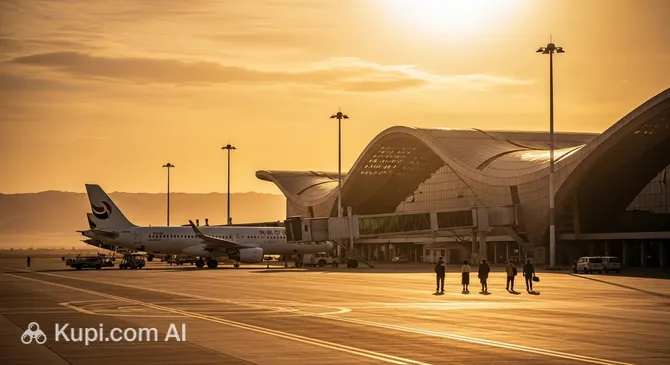
Dunhuang Airport. Source: Kupi.com Binoculars

Dunhuang Mogao International Airport is not merely an air hub, but a true gateway to the history of the Great Silk Road. Located in Gansu Province, it serves as the starting point for travellers eager to witness the legendary Mogao Caves, a UNESCO World Heritage Site, and other treasures of the ancient Dunhuang oasis. The airport was named in honour of these caves, highlighting its cultural significance. Modern and constantly developing, it plays a key role in connecting this historic region with major cities in China and other countries.

IATA Code DNH
ICAO Code ZLDH
City Dunhuang
Distance to centre approx. 13 km
Status International
Annual Passengers over 1.2 million (2023)
Popular Airlines China Eastern Airlines, Air China, Tianjin Airlines.
Schedule Online Board "Dunhuang Airport"

Dunhuang Mogao Airport is continuously being upgraded to meet the growing flow of tourists. Its infrastructure is designed for comfortable passenger service, offering all necessary amenities for travellers. Its unique location makes it an important transport hub not only for tourists but also as an alternate airfield for flights along Eurasian routes. Thanks to convenient connections, one can easily reach both the city centre and major attractions, including the famous Singing Sand Dunes and Crescent Lake, from here.

Contact Information

  • Official Website: Basic information about Dunhuang airport is published on the Gansu Airport Group portal: www.gsjcjt.com/dhaq/. Please note that the site is primarily presented in Chinese.
  • Information Desk Phone: To obtain information about flights and airport services, you may call: +86 937 886 61 33. We recommend considering the time difference before calling.
  • Airport Address: The airport is located approximately 13 km east of the city centre, at: Dunhuang Mogao International Airport, Dunhuang, Gansu, China.
  • Email: The airport does not provide a public email address for communication. It is recommended to use the telephone for inquiries.
  • Social Media: Official airport pages may be present on local Chinese social networks (such as WeChat). Links to them can usually be found on the official website.
  • Lost and Found Information: For items left in the terminal, you can contact the Lost & Found service by phone: +86 937 595 30 52. If your luggage was lost or damaged during the flight, please contact your airline's representative office first.
  • Passenger Support Contacts: For general questions, use the main airport information desk phone. If your question concerns tickets, schedule changes, or special services on board, you should contact the airline you are flying with directly.

How to Get to the Airport

Dunhuang Airport (DNH) is located approximately 13 kilometres east of the city centre of Dunhuang. You can get to or from the city in several ways, each with its own advantages. On average, the trip takes about 20-30 minutes, depending on the chosen transport and traffic conditions.

The most economical option is the airport shuttle bus. These buses usually run between the airport and key points in the city, such as major hotels or the central square. The schedule is often linked to flight arrival and departure times. This is an excellent choice for budget travellers willing to spend a little more time in exchange for significant savings. The fare is minimal compared to other modes of transport.

A taxi ride is the fastest and most convenient way to reach your destination. Taxis can be found at the designated rank outside the arrivals terminal. This is an ideal option if you have a lot of luggage or are travelling with family. The cost of the trip will be higher than the bus, but it ensures comfort and "door-to-door" delivery. It is recommended to have the hotel name or address written in Chinese to avoid misunderstandings with the driver. You can also book a private transfer in advance, which guarantees a meet-and-greet at the airport and a fixed price.

For those planning to actively explore the surroundings of Dunhuang and other corners of China, car rental can be a convenient solution. Car rental counters can be found both at the airport and in the city itself. Having your own transport gives you complete freedom of movement. The airport provides parking where you can leave a car for a short or long term, which is convenient for those arriving in their own vehicle.

Terminals and Map

The Dunhuang Airport (DNH), officially known as Dunhuang Mogao International Airport, is the key aerial gateway to this historic region of China. Thanks to its compactness and thoughtful layout, it offers passengers convenient and fast service.

Terminals and Their Purpose

The airport consists of one main terminal, which serves both domestic and international (mainly seasonal and charter) flights. The terminal building is modern and designed to effectively handle the tourist flow, especially during the peak season. Since there is only one terminal, you do not need to worry about transferring between different buildings — all processes are concentrated in one place.

Airport Layout and Navigation

The structure of the terminal is intuitive. On the ground floor, generally, the arrival and check-in zones are located. Upon entry, you will immediately see the check-in counters of various airlines. After checking in and dropping off luggage, passengers proceed to the second floor, where the security check and boarding gates are located. Signs are in Chinese and English, which significantly simplifies navigation for foreign tourists.

Departure and Arrival Zones

The Departure Zone is located after passing security control. It is a small but comfortable waiting lounge with several boarding gates. There are basic amenities here: cafes, souvenir shops, and travel goods. The Arrival Zone is located in a separate part of the ground floor. After disembarking, passengers proceed to the baggage claim belt and then exit into the general hall, where they are met by hotel representatives, guides, and taxis.

Processing Times and Recommendations

Dunhuang Airport is not known for long queues, so all pre-flight formalities usually proceed quite quickly. It is recommended to arrive at the airport 1.5–2 hours before a domestic flight departure. This time will be more than sufficient for a calm check-in, luggage drop-off, and security screening. Navigation within the airport is very simple due to its compact size — it is practically impossible to get lost here.

Airport History

The history of Dunhuang Airport (DNH), also known as Dunhuang Mogao International Airport, is inextricably linked with the transformation of this ancient Silk Road city into a global tourism hub. The airport was first opened in 1982 with the primary goal of making the famous Mogao Caves, a UNESCO World Heritage Site, easily accessible to tourists. In its early years, it was a small airfield serving mainly domestic flights.

As Dunhuang's popularity as a tourist destination grew, the old airport ceased to cope with the flow of travellers. This led to the first radical stage of modernization: in August 2002, the airport was effectively rebuilt at a new location. The new complex included a longer runway and a terminal that was modern for its time, allowing it to accommodate a greater number of flights and aircraft types.

The most significant event in the airport's history was a large-scale reconstruction completed in 2017. This expansion coincided with the "Silk Road (Dunhuang) International Cultural Expo". As part of the project, a new, spacious Terminal T3 was built, and the runway was extended to 3,400 metres. It was after this modernization that the airport received international status and its current name — Dunhuang Mogao International Airport. This allowed it to receive direct flights from other countries and increase the airport's capacity to 2 million passengers per year.

Today, Dunhuang Airport is a prime example of how modern infrastructure serves to preserve and popularize ancient heritage. It is not just a transport hub, but a modern "gateway" to the Gobi Desert, opening access to the treasures of the Great Silk Road for travellers from all over the world. An interesting fact: architectural and design solutions in the new terminal often reference local culture, such as sand dunes and the famous frescoes from the Mogao Caves.

Services and Amenities

Dunhuang Airport (DNH), despite its compact size, offers passengers all the necessary services for a comfortable wait. The terminal's infrastructure is designed to make your stay here as convenient as possible before departing on a journey to the iconic sites of China.

Within the airport, you will find several cafes and eateries where you can have a snack of local or European cuisine or drink a cup of tea. There are also shops where you can purchase souvenirs reminding you of your trip to Dunhuang, or travel essentials. The selection is not as vast as in megacities, but all the essentials are present.

For comfortable waiting, there are general lounges and VIP lounges with a higher level of service. Passengers can use free Wi-Fi throughout the terminal, as well as find charging stations for electronic devices, which is especially important for modern travellers.

Basic financial services are available at the airport: there are ATMs and currency exchange points where you can exchange money upon arrival or before departure. For emergencies, a medical station is operating in the terminal, ready to provide first aid.

Families with small children will appreciate the mother and child room, equipped with everything necessary for baby care. For passengers with reduced mobility, a barrier-free environment has been created: ramps, specially equipped toilets, and the possibility to request staff assistance for escorting through the airport.

Although there are no hotels directly inside the airport building, many accommodation options can be found in the city of Dunhuang itself, which is easily accessible by taxi or bus. For business travellers, basic business services such as faxing or photocopiers may be available in the VIP lounges.

Where to Eat

Dining options at Dunhuang Airport (DNH) correspond to its status as a regional air hub — the selection here is not as wide as in megacities, but sufficient for a snack or a full lunch before departure. The main establishments are concentrated in the main terminal, both in the public area (landside) and in the departure zone after passing security (airside).

For a full meal, it is worth paying attention to small restaurants offering Chinese cuisine. This is a great opportunity to taste the authentic flavours of the region. Since Gansu Province is famous for its noodle traditions, a hot and hearty bowl of noodles can be an excellent choice. Such establishments are usually located in the public zone before security control and offer a more diverse menu. In the departure zone, the choice is generally more modest.

If time is limited, cafes and kiosks for a quick snack are at your service. Here you can buy coffee, tea, soft drinks, as well as pre-packed sandwiches, pastries, and light snacks. This is a convenient option to take something on board or quickly refresh yourself before boarding. Several such points exist in the departure zone as well.

Regarding specialized diets, finding vegan, gluten-free, or specific Halal options might be challenging. It is recommended to clarify the ingredients of dishes directly with the staff, however, the language barrier may be an obstacle. It is easier for vegetarians — Chinese restaurant menus often feature dishes made from vegetables and tofu. Nevertheless, for travellers with strict dietary restrictions, it will be more reliable to bring food with you.

Prices at the airport are traditionally higher than in the city. Most dining establishments operate in accordance with the flight schedule — they open before the first morning departure and close after the last evening flight departs.

Tips for Travellers

To ensure your journey through the airport of Dunhuang city goes smoothly and without unnecessary hassle, follow our tips. This is a small but important transport hub on the Silk Road, and knowing a few nuances will make your experience much more pleasant.

Arrival Time and Check-in. We recommend arriving at the airport at least 2 hours before a domestic flight departure. Although Dunhuang airport is not as large as capital hubs, this time will be sufficient for a calm passage through all procedures. A passport is always required for flight check-in and security control for foreign citizens. Security checks at airports in China are generally thorough — be prepared to remove all electronics, including chargers and power banks, from your carry-on luggage.

Carry-on Luggage Rules. Pay special attention to the rules for transporting batteries. All power banks are allowed only in carry-on luggage, and their capacity must be clearly marked on the casing. Lighters and matches are prohibited. Standard restrictions for liquids (up to 100 ml in one container) also apply.

Seat Selection and Transfers. If you want to enjoy stunning views of the Taklamakan Desert or the oasis from above, choose a window seat. For greater comfort and freedom of movement — an aisle seat. Dunhuang Airport mainly serves domestic destinations, so if you have a connecting flight, it will likely be in one of the major hubs such as Xi'an, Lanzhou, or Beijing. Check with your airline in advance whether you need to collect and re-check your luggage at the transit airport.

Saving Time and Money. To save time, complete online check-in for your flight if possible. Prices for food and drinks in small airports can be high, so you can bring an empty water bottle (which can be filled after passing security) and light snacks. It is better to order a taxi from the airport to the city through an official service or use ride-hailing apps to avoid inflated prices.

In Case of Flight Delay. In the event of a delay or cancellation, contact your airline counter immediately. In China, during long delays, airlines are obliged to provide passengers with food and drinks, and for multi-hour waits — hotel accommodation. Having a translation app on your smartphone will significantly facilitate communication with airport staff, as the level of English proficiency may vary.

Airports in nearby cities

Reached the end of the page?

That means the route is fully explored