Support

Hami Airport

About the Airport

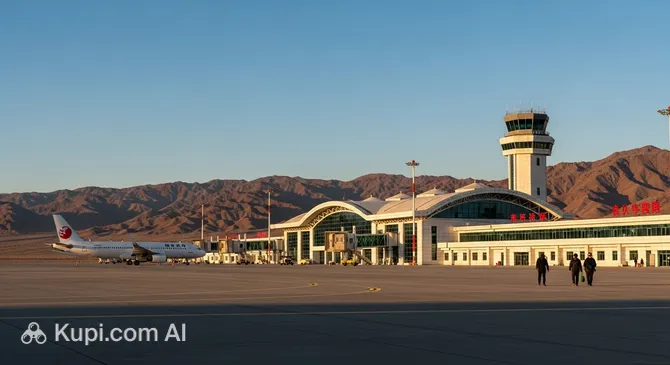
Hami Airport. Source: Kupi.com Binoculars

Hami Airport (HMI) serves as the air gateway to the prefecture-level city of the same name, located in the Xinjiang Uyghur Autonomous Region of China. Playing the role of an important regional transport hub, it connects this remote region, rich in history and natural beauty, with the country's major cities. The airport welcomes both tourists eager to explore the unique culture and landscapes of the Gobi Desert, and local residents, providing them with accessible transport links. Despite its modest size, the airport has undergone several stages of modernisation to meet contemporary requirements for passenger comfort and safety.

IATA Code HMI
ICAO Code ZWHM
City Hami
Distance to Centre About 13 km
Status Domestic
Annual Passengers Exact current data on annual passenger traffic is unavailable, yet the airport is key for the region.
Popular Airlines China Southern Airlines, Tianjin Airlines, Air China
Schedule "Hami Airport" online schedule

Features and Infrastructure

Although Hami Airport is not a major international hub, it offers passengers all the necessary basic services for a comfortable wait for their flight. Within the terminal, there are rest areas, small cafes, and shops. The airport primarily serves domestic destinations, among which flights to Urumqi, Beijing, Xi'an, and Zhengzhou are popular. Its convenient location relative to the city makes it easily accessible for travellers arriving in Hami to explore the ancient Silk Road and the unique natural monuments of Xinjiang.

Contact Information

  • Official Website: Generally, small regional airports in China do not have a dedicated website. It is recommended to check up-to-date flight information on airline websites or general booking portals.
  • Information Desk Phone: The main contact number for enquiries is: +86-902-6522315. Please consider the time difference when calling.
  • Airport Address: The airport is located at: Hami, Xinjiang, China, approximately 12.5 km northeast of the city centre of Hami.
  • Email: A public email address for general enquiries is usually not provided. It is recommended to use the telephone for communication.
  • Social Media: There are no official airport accounts on social media.
  • Lost & Found Information: For all issues regarding lost or damaged luggage, please contact the Lost & Found service of your airline directly at the airport.
  • Passenger Support Contacts: For general questions, you may use the information desk phone. If your query concerns tickets, check-in, or flight details, please contact your airline directly.

Getting to the Airport

Getting to the airport in the city of Hami, an important transport hub in China, is possible via several convenient methods. The airport is located relatively close to the city, so the journey will not take much time, and the choice of transport depends on your preferences, budget, and amount of luggage.

Taxi is the fastest and most comfortable option. A trip from the centre of Hami to the terminal will take approximately 20-30 minutes. The estimated cost of the trip is 30-40 Chinese Yuan (CNY), depending on traffic conditions and the exact departure point. This is particularly convenient if you are travelling with children or a large amount of luggage. It is recommended to use official metered taxis.

The most budget-friendly method is the airport shuttle bus. It connects the airport with key points in the city, including major hotels. The fare is significantly lower than a taxi, costing approximately 15 Yuan (CNY). Although the bus journey will take slightly longer due to stops, it is an excellent way to save money. The shuttle schedule is usually coordinated with flight arrivals and departures, but it is worth verifying in advance.

For those who value independence, car rental is available. This option gives you the freedom to explore the surroundings of Hami at your own pace. It is important to remember that for driving in China, foreign tourists generally require a temporary Chinese driving licence, which is processed locally. If you arrive at the airport in a private or rented car, parking is at your service, where you can leave the vehicle for both short and long periods.

Terminals and Map

The Hami Airport (HMI) is a modern and compact aviation hub characterised by a simple and clear structure for travellers. The airport operates one passenger terminal, which serves all domestic flights arriving in this region of China and departing from it. Thanks to this, navigation through the airport is intuitive and presents no difficulties.

The terminal layout is very logical. Typically, the ground floor houses the check-in counters and the arrivals area with luggage reclaim belts. After check-in, passengers proceed to the first floor, where the security screening area and the main departure lounge with boarding gates are located. Since all flights are serviced under one roof, transfers between terminals are not required, which significantly saves time and effort.

Departure and arrival zones are clearly demarcated. Arriving passengers, after collecting their luggage, immediately proceed to the terminal exit, where taxis and other transport await them. The departure zone on the first floor is generally equipped with several gates, a small number of shops, and cafes where one can pass the time before boarding.

Completing all formalities at Hami Airport usually takes little time. Due to the small passenger flow compared to major international hubs, queues for check-in and screening are a rarity here. It is recommended to arrive at the airport 1.5–2 hours before departure. This time will be more than sufficient to check in luggage, pass security control, and find your boarding gate without rushing.

For navigation, simply follow the standard signs, which are duplicated in English. The compactness of the terminal is its main advantage. It is practically impossible to get lost here, making the journey through Hami Airport as comfortable and predictable as possible.

Airport History

The history of Hami Airport (HMI) dates back to the first half of the 20th century, demonstrating a long journey from a modest airfield to a modern transport hub. It was founded in 1934, initially as a military facility. In those years, it played a strategic role, serving as an important intermediate point on the aviation route connecting China and the Soviet Union.

The path to the status of a fully-fledged civil airport was winding. After the initial period of operation, civil flights were suspended and resumed several times. This unstable period reflected historical changes in the region and the country, and for a long time, the airport ceased serving passenger transport.

The true revival of the air harbour began in the 21st century. In 2007, a large-scale reconstruction project was launched, and on 16 December 2008, the renovated Hami Airport was ceremoniously opened to passengers. This event became a key moment, transforming it into a modern and in-demand aviation hub.

To meet growing demands and increasing passenger traffic, the airport entered a modernisation phase again in 2014. During the works, a new, more spacious terminal with an area of 8,300 square metres was built, and additional aircraft parking stands were equipped. Following the completion of all improvements, the airport reopened in February 2016, significantly increasing its potential and the level of comfort for travellers.

Services and Amenities

Hami Airport (HMI) offers passengers a basic but sufficient set of services for a comfortable wait for their flight. In the terminal, you will find several cafes and eateries where you can have a snack before departure, or enjoy coffee or tea. There are also small shops selling souvenirs, travel essentials, and local delicacies. The range is not very wide, but everything necessary for a traveller is usually available.

For passenger convenience, comfortable waiting lounges are provided in the airport. Business class passengers and loyalty card holders can utilise the services of the VIP lounge, offering a more private atmosphere. Free Wi-Fi is available throughout the terminal, and charging stations for mobile devices are installed in the waiting areas, so you can always stay connected.

Basic financial and medical services are available at Hami Airport. You can find ATMs for cash withdrawal. Currency exchange points may have limited operating hours, so it is recommended to exchange money in advance in major cities. In case of unforeseen situations, a medical post operates in the terminal to provide first aid.

The airport is equipped for the needs of passengers with reduced mobility. Ramps and accessible toilets are provided, and staff are ready to assist with boarding and disembarking. For travellers with small children, there is a mother and child room where you can feed and change your baby in a quiet environment.

If you require a place to work, basic business services may be available at the airport. For a long stopover or overnight stay, you can consider hotels in the city of Hami, which is a few minutes' drive from the airport. There are no hotels directly on the terminal premises, but transport to the city is easily accessible.

Dining

Hami Airport (HMI) is a regional aviation hub, so the choice of dining establishments here is quite modest, yet sufficient for a snack before departure. Do not expect a wide variety of restaurants and cafes as in major international airports. Mostly, small eateries and cafes offering a basic set of dishes and drinks are represented here.

Within the airport terminal, you can find several food outlets both in the public area (before security control) and in the departure zone. The assortment usually includes Chinese fast dining: instant noodles, rice dishes with chicken or vegetables, as well as sandwiches, pastries, and packaged snacks. This is a convenient option for a quick bite. If you are counting on a full lunch or dinner, it is better to have it in the city beforehand.

Regarding local cuisine, you can sometimes find simple options typical of the Xinjiang region, such as lagman or pilaf (plov) in a format adapted for quick service. Given the region's culture, many local meat dishes are traditionally prepared using beef or lamb, which is often suitable for travellers seeking Halal-friendly options, though specialised restaurants with specific certification are not present in the airport. For passengers with special dietary needs (vegetarians, vegans, gluten-free diet), the choice is practically non-existent. It is recommended to bring food with you, as finding suitable dishes on-site will be extremely difficult.

Prices in airport establishments are generally higher than average compared to the city. The opening hours of cafes and eateries are usually tied to the flight schedule: they open a few hours before the first departure and close after the last aircraft leaves. Therefore, if you have a night or early morning flight, it is worth checking in advance if the food outlets will be open.

Travel Tips

To ensure your journey through the airport of Hami city goes as smoothly and comfortably as possible, take advantage of our tips. These simple recommendations will help save time and reduce stress, making the start or end of your trip around China pleasant.

Arrival Time: Since the airport serves domestic flights, it is recommended to arrive at least 1.5–2 hours before departure. This time will be sufficient to check in, drop off luggage, and pass pre-flight security screening without rushing.

Check-in and Security Control: If possible, check in for your flight online — this will save you time at the airport. Before passing security control, prepare your boarding pass and ID in advance. Remember that all liquids in hand luggage must be in containers up to 100 ml and packed in a transparent bag, and laptops and other large electronics must be placed in a separate tray for scanning.

Seat Selection: If the airline provides the opportunity to select a seat, use it. Window seats will offer you beautiful views during take-off and landing, while aisle seats allow you to stand up freely without disturbing neighbours. For greater comfort, consider seats with extra legroom, which are often available for an additional fee.

Hand Luggage: It is prohibited to take sharp objects (such as knives or scissors), as well as flammable liquids and aerosols, in hand luggage. Always keep valuables, documents, necessary medication, and electronics with you in your carry-on and do not check them into luggage.

Transfer Passengers: If you have a connecting flight in Hami, check with your airline in advance whether you will need to collect and re-check your luggage. Study the airport map to orient yourself easily and quickly find the necessary boarding gate. Ensure you have enough time between flights — generally, it is recommended to allow at least 1.5 hours.

Saving Time and Money: To save money, order a taxi or transfer from the airport via official apps or at special counters in the arrivals hall. Prices for food and drinks in the departure zone may be higher, so you can bring an empty water bottle and fill it at drinking fountains after passing security.

Flight Delays: In case of a flight delay or cancellation, first contact your airline representative. They will provide up-to-date information and explain your rights, which may include the provision of drinks, meals, or hotel accommodation depending on the waiting duration. Remain calm and monitor updates on the departure boards.

Airports in nearby cities

Reached the end of the page?

That means the route is fully explored