Support

Jiamusi Airport

About the Airport

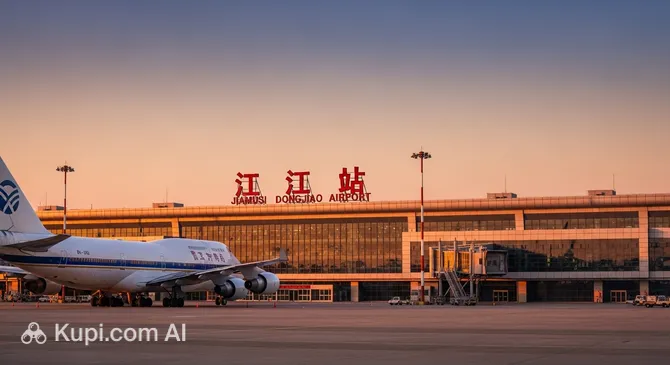
Jiamusi Airport. Source: Kupi.com Binoculars

Jiamusi Dongjiao Airport is the air gateway to the northeastern part of Heilongjiang province, playing a key role in the region's transport system. Located near the city of Jiamusi, it serves as an important hub connecting this picturesque area with major metropolises in China and select international destinations. The airport accepts both domestic and international flights, ensuring convenience for tourists and business travellers arriving in this unique corner of the country.

IATA Code JMU
ICAO Code ZYJM
City Jiamusi
Distance to Centre 10 km
Status International
Passengers per Year 1,041,725 (2023)
Popular Airlines Air China, China Eastern Airlines, China Southern Airlines
Schedule "Jiamusi Airport" online board

Despite its modest size, Jiamusi Airport offers passengers everything necessary for a comfortable journey. The single terminal houses halls for domestic and international departures, shops, cafes, and ATMs. Getting to the city centre, which is approximately 10 kilometres away, is possible by taxi or a special shuttle bus, taking about 25-30 minutes. This air harbour is the starting point for exploring the culture and nature of Northeast China, offering flights to cities such as Beijing, Shanghai, and even international destinations like Seoul.

Contact Information

Below is the main contact information for Jiamusi Dongjiao International Airport. Please note that contacting airports in China via email or international social networks can often be difficult, and a phone call remains the most reliable method of communication.

  • Official Website: As of the latest update, Jiamusi Airport is part of the Heilongjiang Airport Group. Current information can be found on the group's website: www.hljairport.com.cn.
  • Help Desk Phone: +86 454 887 8000. Please consider the international dialing format and time zone differences when calling.
  • Airport Address: Jichang Road, Dongfeng District, Jiamusi, Heilongjiang, China.
  • Email: A public email address for general enquiries is generally not provided. It is recommended to use the telephone for prompt communication.
  • Social Media: Official pages for an international audience on popular social networks (Facebook, Instagram) are unavailable. Information may be published on Chinese platforms such as Weibo.
  • Lost Luggage Information: For issues regarding lost or damaged luggage, you must first contact the representative of the airline you flew with. Additional information can be obtained from the airport's Lost & Found service by calling the general inquiry number.
  • Passenger Support Contacts: For assistance and consultations regarding airport services, please call the main help desk number: +86 454 887 8000.

How to Get to the Airport

Getting to Jiamusi Airport (JMU) from the city centre is quite simple, as it is located just a few kilometres away. Travellers can choose the most convenient method depending on their budget, amount of luggage, and available time.

Public Transport is the most economical option. Typically, special bus routes operate to the airport, connecting it with key points in the city, including the railway station. The bus journey will take about 30-45 minutes, but this time may increase during peak hours due to traffic. This is an excellent choice for solo travellers with light luggage.

Taxi or Transfer is the fastest and most comfortable method. A taxi ride from the centre of Jiamusi to the terminal takes just 15-25 minutes in the absence of serious traffic congestion. The cost will be significantly higher than the bus, but the convenience, especially if you are travelling with children or a large number of suitcases, fully justifies it. It is recommended to use official taxi services with a meter or to agree on the price in advance.

For those who prefer maximum freedom of movement, car rental is available. Several rental agencies operate in the city, offering cars to suit any preference. If arriving at the airport in your own or a rented vehicle, you can use the parking facilities. The airport territory has both short-term and long-term parking lots where you can safely leave your vehicle for the duration of your trip.

Terminals and Map

Jiamusi Airport (JMU) is a modern and compact aviation hub distinguished by a simple and clear structure. It consists of one main terminal that serves all domestic flights — both departures and arrivals. Thanks to this, passengers do not need to worry about transferring between different buildings, which significantly simplifies navigation and saves time.

The terminal layout is intuitively understandable. The space is logically divided into several zones. Upon entry, you find yourself in the general hall where check-in counters and luggage wrapping points are located. After receiving a boarding pass, passengers proceed to the security screening area, and then to the sterile departure lounge. Here, you will find boarding gates, several cafes, and shops. The arrival zone is located separately and includes luggage reclaim belts and the exit to the city, where taxis or other transport can be found.

Check-in and screening procedures at Jiamusi Airport generally proceed faster than in large international hubs. Nevertheless, it is recommended to arrive at the airport at least 1.5–2 hours before your flight's departure. This time will be sufficient to drop off luggage without rushing, pass security control, and find your boarding gate. During peak hours or national holidays, queues may be longer, so it is worth allowing extra time.

For ease of navigation, signs in Chinese and English are installed throughout the terminal. Airport staff are generally responsive and ready to help, even if language difficulties arise. Since all key zones — from check-in to boarding — are within one building and a short distance from each other, orienting yourself here is very easy even for those visiting this airport for the first time.

Airport History

The history of the airport in the city of Jiamusi is a journey from a modest military airfield to a modern regional transport hub. Its predecessor was built back in the 1930s for military purposes. It received the status of a civil facility and a starting point for passenger flights significantly later — the first flights began in 1958, opening a new page in the development of the transport system of Northeast China.

The development of the airport was not linear. Its history included periods of suspended activity; for example, from 1968 to 1985, flights were not operated. After resuming work, a stage of gradual modernisation began, which reached its peak in the 2010s. It became obvious that radical changes were necessary to meet growing demand and modern aviation requirements.

A key event in the recent history of the airport was a large-scale reconstruction completed in 2017. As part of this project, a completely new terminal with an area of over 13,000 square metres was built, and the runway was reconstructed and extended to 2600 metres. This allowed the airport to be assigned class 4C and to start accepting medium-haul aircraft, such as the Airbus A320 and Boeing 737, which significantly expanded the geography of flights.

The results of the modernisation were immediate. Already in 2018, Jiamusi Airport served more than one million passengers in a year for the first time in its history. This achievement cemented its status as an important air gateway for Heilongjiang province and a vital link in the country's transport network, contributing to the development of both business ties and tourism in the region.

Services and Facilities

Jiamusi Airport (JMU) offers passengers a set of standard services designed to make their stay in the terminal convenient and pleasant. Whether you are departing or arriving, you will be able to find everything necessary for a comfortable journey.

Cafes and small eateries are located within the airport territory, where you can have a snack before departure, as well as enjoy coffee or tea. Additionally, there are shops offering souvenirs, travel goods, and press. For passengers wishing to stay connected, free Wi-Fi is available, and waiting lounges are equipped with power outlets and special stations for charging mobile devices.

For those who value enhanced comfort, VIP lounges may be available at the airport, offering a more tranquil atmosphere for relaxation. The terminal also has ATMs for cash withdrawal. In case of unforeseen health situations, a medical point is provided where first aid can be administered.

Passengers with children can use the mother and child room, and a barrier-free environment is created for people with disabilities, along with an escort service. Although there are no hotels directly inside the airport building, several hotels of various levels are located nearby. Possibilities for holding business meetings or conferences at the airport itself are limited, so for these purposes, it is better to consider business centres in Jiamusi.

Where to Eat

Jiamusi Airport (JMU) offers passengers several options for a snack or a full meal before departure. Although the selection here may not be as extensive as in major international hubs, you will not go hungry. The main dining points are concentrated in the main terminal, available both in the public area before security control and in the sterile departure zone.

Most establishments offer dishes of local and general Chinese cuisine. This is an excellent opportunity to try something authentic. Look out for noodle restaurants or places serving traditional steamed buns (baozi) and dumplings (jiaozi). For a quick snack, small cafes are suitable, where you can order tea, coffee, pastries, and sandwiches. Vending machines with drinks and snacks are also usually installed in the terminal.

Regarding special dietary needs, finding certified Halal, vegan, or gluten-free dishes might be challenging. However, many dishes in China can be easily adapted for vegetarians — you can always ask for fried rice or noodles with vegetables prepared without meat. We recommend clarifying the ingredients of dishes directly with the staff. The price range at the airport is typically higher than in the city of Jiamusi itself, but remains at a moderate level. The opening hours of cafes and restaurants are usually tied to the flight schedule, ensuring service for passengers on morning and evening flights.

Travel Tips

To ensure your journey through the airport of Jiamusi city goes smoothly, take advantage of a few useful tips. Plan your arrival at the airport with time to spare: at least 2 hours before departure for domestic flights and 3 hours for international ones. This will allow you to calmly complete all formalities without unnecessary haste.

To save time, complete check-in online if your airline provides such a service. Keep your passport and boarding pass ready. When passing through security control at airports in China, pay special attention to the rules for carrying electronics: ensure that your power banks have a clear factory marking indicating capacity. Devices without such markings may be confiscated. The carriage of liquids follows standard rules — in containers up to 100 ml.

If you have a connecting flight, check with the airline in advance whether you need to collect and re-check your luggage at the intermediate point. For international flights, be prepared to pass through customs control and study the rules for the import and export of goods in advance to avoid misunderstandings.

When choosing a seat on the plane, consider your priorities. A window seat (A, F) is ideal for those who love to gaze at clouds and landscapes during takeoff and landing. An aisle seat (C, D) is more convenient if you plan to get up during the flight or want to leave the cabin faster upon arrival.

In the event of a flight delay, remain calm. First, contact your airline's counter for information regarding the new departure time and possible compensation (water, food, accommodation). Stay in touch with loved ones and monitor updates on the departure boards.

Reached the end of the page?

That means the route is fully explored