Support

Korla Airport

About the Airport

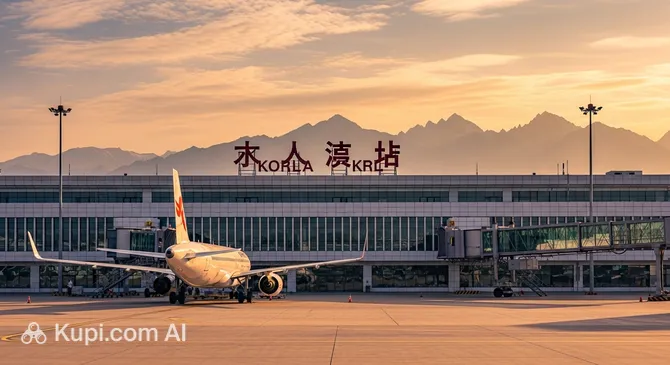
Korla Airport. Source: Kupi.com Binoculars

Korla Airport (Licheng Airport) is more than just a transit point; it is a true gateway to the famous "City of Pears" and the picturesque oases of Xinjiang. Located at the junction of desert landscapes and mountain ranges, it serves as a key hub for travellers setting out to explore the ancient routes of the Silk Road. The modern airport terminal combines Eastern hospitality with advanced technology, ensuring a comfortable start for any adventure in this unique region.

IATA Code KRL
ICAO Code ZWKL
City Korla
Distance to City Centre 17 km
Status Domestic (Regional Hub)
Annual Passenger Traffic Over 2.5 million people
Schedule Regular daily flights

Airport Features and Highlights:

Korla Airport plays the role of an important regional hub, relieving pressure on the main transport node in Urumqi. It connects the city not only with the megalopolises of China (Beijing, Chengdu, Xi'an) but also with smaller local airports, making it an ideal transfer point for journeys through the region's interior.

Passengers appreciate the modern and spacious Terminal 2, which was opened relatively recently. Thanks to thoughtful navigation and compact dimensions, completing pre-flight formalities here takes minimal time, and the waiting lounges are equipped with everything necessary for relaxation.

Transport accessibility is also a strong point of this air hub. Covering the 17 kilometres to the city centre is quick and affordable: tourists can use official taxis and shuttle buses that run to the railway station and main city locations.

Contact Information

Below are the contact details and useful information for passengers at Korla Airport (KRL).

  • Official Website: Korla Airport is managed by the Xinjiang Airport Group. Up-to-date information can be found on their official portal: www.xjairport.com.
  • Inquiry Service Phone: For information regarding flights, services, and airport operations, you can call the unified inquiry number: +86-996-96556.
  • Airport Address: Korla Airport (KRL), Korla City, Bayingolin Mongol Autonomous Prefecture, Xinjiang Uygur Autonomous Region, China.
  • Email: A dedicated email address for general inquiries is usually not provided. It is recommended to contact the airport by phone or via the feedback forms on the official website.
  • Social Media: Official pages of the airport or the management company may be available on platforms popular in China (such as WeChat). Links to these are usually posted on the official website.
  • Lost and Found Information: If your luggage has been lost or damaged, first contact your airline's Lost & Found service directly at the airport. You can also seek assistance at the general airport inquiry desk.
  • Passenger Support Contacts: For all questions related to your stay at the airport, please contact the information service at +86-996-96556.

How to Get to the Airport

Korla Airport (KRL) is located approximately 17 kilometres southwest of the city centre of Korla, making it easily accessible for travellers. There are several ways to reach the airport from the city, suitable for different budgets and preferences. The journey from the city centre to the airport usually takes between 20 to 40 minutes depending on the chosen transport and traffic conditions.

Public Transport

The most budget-friendly way to get to the airport is the dedicated shuttle bus. These buses connect the airport with key points in downtown Korla, including major hotels and bus stations. The route and schedule are often coordinated with flight arrivals and departures. Although this is the most affordable option, it is worth allowing extra time for the trip, as the bus makes stops along the way. This is an excellent choice for solo travellers with light luggage.

Taxi and Transfer

The fastest and most comfortable method is a taxi ride. Official taxi stands are located directly outside the terminal exit. The trip to the city centre will take about 20-30 minutes. It is recommended to ensure the driver turns on the meter, or agree on a fixed price in advance to avoid misunderstandings. For greater convenience, you can book a private transfer in advance — in this case, the driver will meet you with a name sign right in the arrival hall.

Car Rental and Parking

For those who prefer maximum freedom of movement, car rental services are available at Korla Airport. By renting a car, you can not only drive comfortably to your hotel but also explore the picturesque surroundings of the region on your own. If you are arriving at the airport in your own or a rented vehicle, parking is available next to the terminal. There are zones for both short-term and long-term parking.

Terminals and Map

Korla Airport (KRL) is a modern and relatively small aviation hub, making it very convenient for passengers. All airport operations are concentrated in one passenger terminal, which handles domestic flights and potentially a few charter or regional flights. Thanks to this compact structure, you do not have to worry about long transfers between buildings — everything is under one roof.

The terminal layout is intuitive and logical. Typically, the departure zone with check-in counters and security screening is located on the upper level, while the arrival zone with baggage claim is on the lower level. Navigation is significantly simplified thanks to clear signage, which in most cases is duplicated in Chinese and English. Since there is only one terminal, transitions between various functional zones (check-in, security, boarding) take minimal time.

Departure and arrival zones are clearly separated. Upon arriving at the airport for departure, you enter a general hall with check-in counters, after which you pass through security control and find yourself in the "airside" area with boarding gates. The arrival zone includes the baggage claim hall and the exit to the city towards the taxi and bus stands. Check-in and screening procedures at airports of this size usually proceed quite quickly. It is recommended to arrive at the airport 1.5–2 hours before a domestic flight departure to complete all formalities without rushing.

The terminal offers passengers basic amenities for a comfortable wait. Here you can find several cafes serving snacks and beverages, small shops with travel goods and souvenirs, as well as comfortable waiting lounges. The main recommendation for navigation is to carefully watch the signs and information on the flight screens. Even if you do not know the language, thanks to the compactness and clear logistics, getting lost at Korla Airport is practically impossible.

Airport History

The history of Korla Airport (KRL) is a clear example of the rapid development and modernisation of the region. Initially, the city had an old airport built back in 1958, which served both military and civil purposes for many years. However, with the growth of Korla's economic significance as an important centre for the oil and gas industry and a transport hub in southern Xinjiang, an acute need arose for a more modern and larger air harbour.

A key moment in the airport's history was the project for its complete relocation and construction from scratch. Work began in 2005, and as early as December 2007, the new Korla Airport was ceremoniously opened. This was not just an expansion, but the creation of a completely new facility, located further away from the urban area and designed according to modern standards. The old airport ceased servicing civil flights, completely ceding its place to its successor.

The new complex was built with the capacity to accommodate larger aircraft, such as the Boeing 757, which significantly expanded the flight geography and increased passenger traffic. Modernisation allowed the airport to become a full-fledged gateway to the Bayingolin Mongol Autonomous Prefecture, opening it up for business and tourism. Today, Korla Airport is an important link in the transport system of western China, ensuring connections with the country's largest cities and facilitating the development of the Taklamakan Desert.

Services and Facilities

Korla Airport (KRL) offers passengers all necessary services for a comfortable wait before their flight. Despite its relatively small size, the terminal is designed to ensure convenience for both domestic and international travellers.

Dining and Shopping. At the airport, you will find several cafes and eateries where you can have a snack before departure. Dishes from both local Xinjiang cuisine and general Chinese cuisine are served here. There are also shops where you can purchase souvenirs, press, snacks, and travel essentials.

Lounges and Connectivity. Comfortable waiting areas are equipped for all passengers. Typically, free Wi-Fi is available in the terminal, and charging stations for mobile devices are installed in the departure halls. For business class passengers and loyalty programme members, VIP lounges with a higher level of comfort may be available.

Financial Services. ATMs for cash withdrawal are located within the terminal. There is also usually a currency exchange point where major world currencies can be exchanged for Chinese Yuan.

Additional Services. A medical point operates around the clock at the airport to provide first aid. Passengers travelling with small children can use the mother and child room. The airport is also equipped to serve passengers with reduced mobility — ramps and specially equipped toilets are available. It is recommended to contact your airline representative in advance for assistance.

Accommodation and Business. There are no hotels within the airport territory itself, however, many accommodation options can be found in the city of Korla, which is a few minutes' drive away. Specialised conference halls may not be available at the airport, but basic business services, such as faxing or document copying, are often provided in the VIP lounges.

Where to Eat

At Korla Airport (KRL), travellers can find several convenient options to have a snack before departure or a full lunch. Although the choice of establishments here is not as vast as in the megalopolises of China, the available options allow for satisfying the basic needs of passengers.

Most cafes and restaurants are concentrated in the main hall of the terminal (before passing security control), where the selection is generally wider. Here you can find establishments offering both national Chinese dishes and more familiar European snacks. In the departure zone (after screening), there are also several points where you can drink coffee or tea and buy light snacks or sandwiches.

This is an excellent opportunity to try authentic dishes of Xinjiang cuisine. Pay attention to specialties such as fragrant pilaf, hearty lagman (pulled noodles with meat and vegetables), or lamb kebabs. For a quick snack, steamed buns, noodles, or dumplings are perfect. Prices at the airport are expectedly higher than in city establishments.

The opening hours of most catering establishments are tied to the flight schedule, so they are open to serve passengers of morning and evening flights. Regarding special dietary needs, finding certified vegan or gluten-free dishes may be difficult. However, many restaurant menus feature vegetarian options based on rice and vegetables. It is recommended to clarify the ingredients with the staff before ordering.

Travel Tips

To ensure your journey through the airport of Korla city goes smoothly and without unnecessary hassle, take advantage of our tips. These simple recommendations will help save time, money, and nerves, making the start and end of your trip as comfortable as possible.

Arrival Time at the Airport. We recommend arriving at the airport at least 2–2.5 hours before the departure of a domestic flight. This time will be sufficient to check in, drop off luggage, and pass security control without rushing. For international flights (if they are on the schedule), it is better to allow at least 3 hours.

Check-in and Security Control. To avoid queues, use online check-in on your airline's website if such an option is available. At the security checkpoint, be ready to take all electronic devices out of your hand luggage in advance, as well as liquids in a transparent bag. This will significantly speed up the screening process.

Seat Selection on the Plane. Window seats will give you the opportunity to enjoy the views during take-off and landing. Aisle seats are convenient if you plan to get up during the flight. Seats in the front of the cabin allow you to exit the plane faster upon arrival, while emergency exit seats usually offer more legroom but may have restrictions.

Hand Luggage. Standard rules of most airlines prohibit carrying sharp objects, flammable substances, and liquids in containers larger than 100 ml in hand luggage. All liquids must be packed in one transparent bag. Be sure to check the exact requirements of your airline before leaving for the airport.

Passengers with Transfers. If you have a connecting flight, follow the "Transfer" signs. Clarify at check-in whether you will need to collect and re-check your luggage. Sometimes this is required, especially when transferring from an international flight to a domestic one.

Customs Control. Upon arrival in China from another country, you will have to pass customs control. Have your passport, visa (if required), and completed arrival card ready. If you are carrying goods subject to declaration, use the "Red Channel".

Saving Time and Money. To save on food and drinks, take an empty water bottle with you, which can be filled after passing security control, and light snacks. Study transfer options from the airport in advance: public transport or shuttles can be significantly cheaper than taxis.

Flight Delays. In case of a flight delay or cancellation, first contact your airline's counter for information. Learn about your rights: depending on the length of the delay, you may be provided with beverages, meals, or even hotel accommodation. Keep all receipts for unforeseen expenses.

Reached the end of the page?

That means the route is fully explored