Source: Kupi.com AI
| Characteristic | Value |
|---|---|
| IATA code | LXA |
| ICAO code | ZULS |
| City | Lhasa |
| Country | China |
| Time zone | Asia/Shanghai |
| Popular airlines | Air China, China Eastern, Sichuan Airlines, Himalaya Airlines UO |
| Schedule | Online timetable |
| Characteristic | Value |
|---|---|
| IATA code | LXA |
| ICAO code | ZULS |
| City | Lhasa |
| Country | China |
| Time zone | Asia/Shanghai |
| Popular airlines | Air China, China Eastern, Sichuan Airlines, Himalaya Airlines UO |
| Schedule | Online timetable |
For your convenience, we have gathered the main contact information for Gonggar Airport. Please note that the most reliable way to obtain prompt information is via a phone call, as specialised websites and English-language online services for many regional airports in China may be unavailable.
Gonggar Airport (LXA) is located at a significant distance from the centre of Lhasa — approximately 65 kilometres — so travel should be planned in advance. There are several ways to reach it, each with its own features.
Public Transport: The most common and economical option is the specialised shuttle buses. They run between the airport and the city centre, usually departing from the Civil Aviation Administration of China (CAAC) building in Lhasa. The journey takes approximately 1.5 hours depending on traffic conditions. This is a convenient and reliable method, with schedules often linked to flight departure and arrival times.
Taxi and Private Transfer: For greater comfort and speed, you can use taxi services. The trip will take about 1 hour, but will cost significantly more than the bus. It is recommended to agree on the fare in advance or ensure the driver uses the meter. An even more convenient option is to book a private transfer through your hotel or an online service. This guarantees a fixed price and a meet-and-greet at the appointed time, which is particularly relevant for groups or families travelling with large luggage.
Car Rental and Parking: Renting a car for self-driving can be difficult for foreign nationals without a Chinese driving licence. A more realistic option is renting a car with a local driver. For those arriving at the airport in their own vehicle, Gonggar Airport has paid parking where cars can be left for short or long periods.
Recommendations: The choice of transport depends on your budget and preferences. The shuttle bus is an excellent choice for budget travellers, while a taxi or private transfer ensures maximum convenience and saves time, which can be critical for early departures or late arrivals.
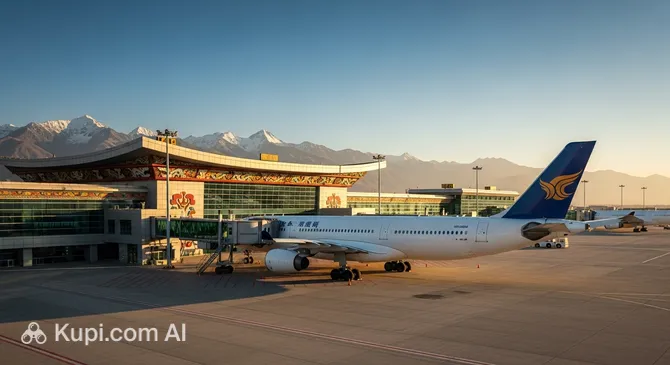
Gonggar Airport in Lhasa consists of three terminals, however, the vast majority of passenger traffic is handled in the newest and most modern one. Terminals T1 and T2 are older buildings which, following the opening of the new complex, are used for auxiliary purposes, charter flights, or VIP services. The main building is Terminal 3 (T3), opened in 2021. It is a large and technologically advanced structure that serves both domestic and international flights.
Terminal 3 is designed with the region's cultural features in mind and resembles a lotus flower in shape. Thanks to its modern and logical layout, navigation inside is quite simple. Signs are in Tibetan, Chinese, and English, making orientation easier. The departure area with check-in counters and security checkpoints is located on the upper level, while the arrival area with baggage claim is on the lower level. Moving between the old and new terminals, should the need arise, can be done on foot or via a special shuttle, but most tourists will only require Terminal 3.
Considering the airport's location in the Tibet Autonomous Region of China and the special document requirements for visiting, as well as the high-altitude climate, it is recommended to allow more time than usual for all procedures. Arrive at the airport at least 2.5–3 hours before a domestic flight. This will be enough time to check in, drop off luggage, and pass through security screening, which may be more thorough than elsewhere, without rushing.
For easy navigation, follow the signs and information boards. The space in Terminal 3 is vast, so be prepared for walking between the security area and the gates. The most important advice for travellers at Gonggar Airport is to move slowly. Due to the high altitude (about 3,600 metres), walking fast can cause shortness of breath and discomfort. Move calmly, drink plenty of water, and give your body time to acclimatise.
The history of Gonggar Airport (LXA) is a chronicle of the development and opening of Tibet to the wider world. Officially opened on 1 March 1965, it became one of the first modern airports in this high-altitude region of China. Initially built for dual purposes, it quickly proved its indispensability for civil aviation, significantly reducing travel time to Lhasa, which was previously measured in weeks.
Located at an altitude of about 3,570 metres above sea level, Gonggar Airport is one of the highest in the world. This imposed and continues to impose special requirements on both equipment and pilots. The first decades of its operation were dedicated to gradual adaptation to accommodate increasingly larger aircraft and growing passenger numbers. The runway has been repeatedly lengthened and strengthened to meet international standards.
A key moment in its development was a massive reconstruction completed in 2004. At that time, a new terminal, the second in its history, was built, allowing capacity to increase to 1.1 million passengers per year. This gave a powerful boost to tourism development in the region, making the journey to the heart of Tibet more comfortable and accessible.
The most ambitious project in the airport's history was the construction and launch of the new Terminal 3, which opened its doors to passengers in August 2021. This huge modern building covering 88,000 square metres, designed in traditional Tibetan style, was built to handle up to 9 million passengers and 80,000 tonnes of cargo annually. Together with a new runway, this project transformed Gonggar into a modern and powerful transport hub.
Among interesting facts, it is worth noting that due to the thin air, aircraft require a longer runway and higher speed for take-off and landing at Gonggar. Pilots flying here undergo special training. Unofficially, the airport is called the "Golden Bridge," highlighting its colossal importance for the economic and cultural connection of Tibet with the rest of the world.
Gonggar Airport in Lhasa offers passengers all necessary services for a comfortable wait for their flight. Despite its remote location, the terminal is equipped with modern infrastructure so that your journey through China begins or ends without unnecessary hassle.
While waiting for departure, you can have a snack in one of the cafes or restaurants offering both local Tibetan and Chinese cuisine. In the shops, you can purchase souvenirs, handicrafts, as well as travel essentials. This is an excellent opportunity to buy Tibetan jewellery, incense, or tea as a keepsake.
For passenger convenience, free Wi-Fi is available throughout the terminal, and charging stations for electronic devices are installed in the waiting halls. Passengers preferring enhanced comfort can utilise the business lounges, where one can relax or work in a quiet environment. Additionally, bank branches, ATMs, and currency exchange points operate at the airport, allowing you to settle financial matters right upon arrival or before departure.
Special attention is paid to the needs of different categories of passengers. The airport has a medical centre, which is extremely important given the region's high-altitude location. Mother and child rooms are equipped for travellers with children. Passengers with reduced mobility are provided with necessary assistance, and the terminal infrastructure, including ramps and special restrooms, is adapted for their convenience.
Although there are no hotels directly within the airport premises, several hotels are located in the immediate vicinity, offering comfortable accommodation for transit passengers or those with early flights. For business travellers, conference rooms or business centres may be available where meetings can be held or work can be done in silence.
Gonggar Airport (LXA) in Lhasa offers passengers several options for a snack or a full meal, allowing you to experience local cuisine right before departure. The selection of establishments here is not as large as in major metropolises, but it is quite sufficient to spend time comfortably while waiting for a flight.
Most dining outlets are concentrated in the main terminal. Both in the public area (before security) and in the departure area (after security), you will find cafes and small restaurants. The menus are dominated by dishes of Chinese and, of course, Tibetan cuisine. This is a great chance to try local specialities one last time, such as hearty thukpa noodle soup or dishes with yak meat. For a quick bite, snack bars selling sandwiches, pastries, and beverages are suitable.
The price range at the airport is generally higher than the city average. A full lunch in a restaurant will cost more than a cup of tea with a bun in a cafe. Regarding special dietary needs, finding vegetarian dishes (for example, rice with vegetables or vegetable noodles) is usually not difficult. However, specialised vegan, gluten-free, or Halal options may be limited, so it is recommended to clarify the ingredients of dishes with the staff.
The opening hours of most cafes and restaurants are tied to the flight schedule: they open early in the morning and serve passengers until the last departure. If you are in a hurry, it is better to choose one of the establishments in the departure area offering ready-made meals or fast food. If you have enough time, you can dine leisurely in one of the restaurants in the public area of the terminal, enjoying the unique atmosphere of one of the highest airports in China.
Travelling through Gonggar Airport, located in a unique high-altitude region, requires a little preparation. Following these tips will make your trip more comfortable and predictable.
Arrival Time at the Airport. Gonggar Airport serves not only Lhasa but the entire surrounding region. Considering possible heightened security measures and the characteristics of high altitude, which may slow down your movements, it is recommended to arrive at the airport at least 3 hours before departure for domestic flights and 4 hours before international flights. This will give you enough time to complete all formalities without rushing.
Check-in and Security. Security procedures at airports in China can be very thorough. Be prepared to be asked to switch on electronic devices, and power banks will be checked for clear capacity markings. Move calmly and do not rush — at an altitude of about 3,600 metres above sea level, even ordinary actions require more effort.
Seat Selection. If you are flying into or out of Lhasa, choosing a window seat is a mandatory condition for unforgettable impressions. Try to select a seat with a view of the Himalayan range during online check-in. These panoramas will become one of the most vivid moments of your journey.
Hand Luggage. In addition to standard restrictions on liquids and sharp objects, please note that in China it is often forbidden to bring lighters and matches on board. They will most likely be confiscated at security. All external batteries (power banks) must have clearly visible markings of the manufacturer and capacity.
Transfer Passengers. If you have a connecting flight, check with your airline in advance whether your luggage will be checked through automatically or if you need to collect it and check it in again. Leave a sufficient buffer of time between flights, especially if you have to pass through border and customs control.
Customs Control. When departing on an international flight, be prepared for questions about souvenirs. The export of antiques and items of cultural value is strictly regulated and requires special permits. Keep receipts for all major purchases.
Saving Time and Money. Check in for your flight online to save time at the airport. Prices for food and drinks at Gonggar can be high, so it makes sense to bring a light snack and an empty water bottle, which can be filled after passing security.
In Case of Flight Delay. Weather in the mountains is unpredictable, and flight delays or cancellations due to meteorological conditions are not uncommon. In the event of a delay, first contact your airline representative to find out about the flight status and your rights regarding the provision of meals or accommodation.
Have you reached the end of the page?
So the route has been studied inside and out