Support

Mudanjiang Airport

About the Airport

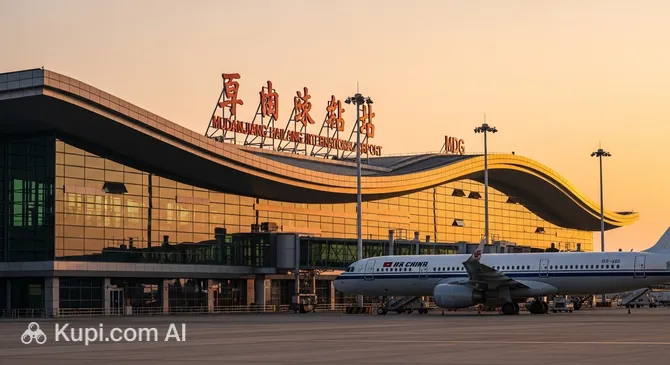
Mudanjiang Airport. Source: Kupi.com Binoculars

Mudanjiang Hailang International Airport is not merely the air gateway to the city of the same name, but a vital transport hub in the northeast of China. Located in Heilongjiang Province, it serves as a starting point for journeys throughout a region renowned for its scenic lakes, dense forests, and the unique "Snow City". Despite its relatively small size, the airport connects Mudanjiang with the country's largest metropolises and operates international flights, playing a key role in the economic and tourism life of the province.

IATA Code MDG
ICAO Code ZYMD
City Mudanjiang
Distance to Centre approx. 9 km
Status International
Annual Passengers over 1 million (2019)
Popular Airlines China Southern Airlines, China Eastern Airlines, Air China
Schedule Mudanjiang Airport online schedule

The main feature of Mudanjiang Airport is its strategic location, making it the second-largest international airport in Heilongjiang Province. From here, travellers can easily reach major cities such as Beijing, Shanghai, and Guangzhou, as well as visit the capital of South Korea — Seoul. The airport is a dual-use facility, serving both civil and military flights. For passenger convenience, the terminal features VIP lounges and special rest rooms for passengers with specific needs, while transport connections to the city are provided by buses and taxis.

Contact Information

To obtain the most accurate and up-to-date information about Mudanjiang Hailang Airport (MDG), it is recommended to use official channels. Below are the main contact details that may be useful for travellers.

  • Official Website: Mudanjiang Airport is part of the Heilongjiang Airport Management Group. Information about flights and services can often be found on the group's general portal (www.hljairport.com.cn), which is primarily presented in Chinese.
  • Inquiry Service Phone: For information regarding flight schedules, airport services, and other general queries, you can call: +86 453 622 3552. Please note that knowledge of the Chinese language may be required for communication.
  • Airport Address: The airport is located at: Xi'an District, Mudanjiang, Heilongjiang, China.
  • Email: A dedicated email address for general inquiries is rarely published. It is recommended to use the telephone for communication.
  • Social Media: Official pages of the airport, if they exist, are most likely maintained on Chinese platforms such as WeChat or Weibo.
  • Lost Luggage Information: For issues regarding lost or damaged luggage, you should contact your airline's representative at the airport or the main inquiry service phone, where you can be redirected to the appropriate department.
  • Passenger Support Contacts: General passenger support is provided through the airport inquiry service.

How to Get to the Airport

Mudanjiang Hailang Airport (MDG) is conveniently located just a few kilometres from the city centre of Mudanjiang, making the journey to the terminal quick and simple. Depending on your budget, amount of luggage, and preferences, you can choose one of several ways to reach the airport.

Public Transport is the most economical option. Generally, city buses run to the airport, connecting it with key points in the city. This is an excellent choice for those travelling light. The fare usually costs only 2–5 Yuan (CNY), making the bus the most budget-friendly method. The journey may take a little longer than by taxi and be less convenient with bulky luggage. It is recommended to check route numbers and current schedules on site.

Taxi or Transfer is the most comfortable and fastest method. The trip from the city centre to the airport usually takes about 20–30 minutes and, depending on traffic conditions, will cost approximately 30–50 Yuan (CNY). It is recommended to use official taxis and ensure the driver switches on the meter. For maximum convenience, you can book a private transfer in advance: the driver will meet you at your hotel at the specified time, and the trip cost will be fixed, helping to avoid surprises.

If you plan to travel actively around the region, you might consider car rental. Rental company counters operate within the airport territory. However, please note that to drive in China, foreigners usually require a special permit or a temporary local driving license. For those arriving at the airport in their own or rented vehicle, parking is available with zones for short-term and long-term stays.

When planning a complex itinerary across the northeast of the country, it is also worth considering other air hubs in the region. For example, the airports in Jixi and Yanji are within a few hours' drive and may offer convenient flights for your destination.

Terminals and Map

Mudanjiang Hailang Airport (MDG) is a modern and compact aviation hub with one passenger terminal that serves both domestic and select international flights. Thanks to its well-thought-out structure, navigation through the airport is intuitive and presents no difficulties even for first-time visitors.

The terminal layout is quite simple and logical. Generally, the building has two main levels:

  • The Departure Zone is located on the second floor. Here you will find airline check-in counters, security control points, and boarding gates.
  • The Arrival Zone is located on the ground floor. After disembarking from the aircraft, passengers proceed to the baggage claim hall, and then to the general meeting area where taxis and other public transport are available.
Since all services are located within a single building, transfers between zones are not required — everything is within walking distance.

Registration and screening procedures at Mudanjiang Airport usually proceed quite quickly due to moderate passenger traffic. Nevertheless, it is recommended to arrive at the airport in advance: approximately 1.5-2 hours before a domestic flight and 2.5-3 hours before an international one. This time will be sufficient to complete all formalities without rushing.

For passenger convenience, signs in the terminal are in Chinese and English, which significantly facilitates navigation. The compact size of the airport makes it extremely convenient: you won't have to walk long distances from the check-in counter to the boarding gate, and getting lost here is practically impossible. All infrastructure is concentrated in one place, creating comfortable conditions for travellers.

Airport History

The history of Mudanjiang Hailang International Airport (MDG) begins long before its transformation into a modern passenger hub. Its roots go back to 1942, when a military airfield was built on this site. For decades, it served exclusively military purposes, and only in the second half of the 20th century did its transformation into a civil facility begin, marking an important milestone for the development of the city of Mudanjiang and the entire region.

Officially, the airport opened for civil aviation in September 1985, starting a new chapter in its history. Initially, it served only domestic flights, connecting the city with key points in China. However, as the economic importance of the region grew, a need for modernisation and expansion arose. A key moment was the airport being granted international status in 2000, which opened up opportunities for direct flights to neighbouring countries.

The most large-scale reconstruction in the airport's history began in 2014 and was completed in 2017. Within the framework of this project, a new, modern terminal was built, the runway was significantly extended, and the entire infrastructure was upgraded. This allowed the airport to accept larger aircraft and serve the growing passenger flow, which by that time had already exceeded one million people per year. Today, Hailang Airport is an important transport node in the northeast of the country, playing a significant role in the economic and cultural ties of the region.

Services and Amenities

Mudanjiang Airport (MDG) offers passengers all necessary services for a comfortable wait for their flight. In the terminal, you will find several cafes and restaurants where you can have a quick snack or a full meal, trying dishes of local and international cuisine. For those wishing to buy gifts or travel essentials, there are shops selling souvenirs, press, and Duty-Free products.

Comfortable waiting areas are provided for rest before departure. Passengers preferring enhanced comfort can utilise the services of VIP lounges, offering a quieter atmosphere, snacks, and beverages. Free Wi-Fi is available throughout the terminal, and numerous charging stations for electronic devices will allow you to stay connected.

Financial matters can be settled at bank branches, via ATMs, and at currency exchange points located in the airport building. In case of need, a medical station operates in the terminal, where qualified staff are ready to provide first aid.

The airport has also taken care of passengers with special needs. Mother and child rooms are equipped for travellers with small children. Passengers with reduced mobility are provided with all necessary assistance: from special equipment (ramps, lifts) to accompaniment by airport staff upon prior request.

Although there are no hotels directly on the airport grounds, numerous accommodation options are located within a few minutes' drive. For business travellers, basic business services such as work zones or the possibility of holding small meetings may be available in the VIP lounges, making the flight wait in this corner of China even more productive.

Where to Eat

Mudanjiang Airport (MDG), being a regional air hub, offers passengers a basic but sufficient selection of establishments for a snack or a full lunch. Most cafes and restaurants are concentrated in the main terminal building, both in the public area and in the departure zone after passing security control.

For those who want a quick snack, small cafes are perfectly suitable. Here you can order coffee, tea, soft drinks, as well as pastries, sandwiches, and packaged snacks. This is a convenient option if you do not have much time before boarding. If you have time for a full meal, pay attention to restaurants offering Chinese cuisine. The menu usually features popular items: noodle soup, rice with various toppings, dumplings (jiaozi), and simple meat or vegetable dishes.

Prices in airport establishments are generally higher than in the city, which is standard practice for air hubs. The opening hours of most food outlets are tied to the flight schedule: they open a few hours before the first departure and close after the last aircraft has departed. Thus, you will always be able to find an open cafe during the airport's operating hours.

Passengers with specific dietary needs (vegetarianism, gluten-free diet) should note that the selection may be limited. Although vegetable and rice dishes can often be found in Chinese restaurants, specialised menus are rare. If you have strict dietary restrictions or require Halal options, it is recommended to bring suitable snacks with you to avoid inconvenience.

Travel Tips

To ensure your journey through Mudanjiang Airport goes as smoothly as possible, take advantage of these useful tips. They will help save time and stress, making the wait for your flight more comfortable.

Arrival Time at the Airport. For domestic flights within China, it is recommended to arrive at the airport 1.5-2 hours before departure. If you have an international flight, it is better to allocate more time — arrive 2.5-3 hours in advance. This gives you a sufficient margin in case of queues at check-in and security.

Check-in and Security Control. If possible, complete online check-in for your flight — this saves time. Have your passport and ticket ready at the check-in counters. Security services in Chinese airports operate very thoroughly. Be prepared to remove outer clothing, take all metal items out of your pockets, and remove laptops and portable power banks from your hand luggage for separate scanning.

Choosing a Seat on the Plane. If you want to admire the views, choose a window seat. For those who value the ability to stand up freely and stretch their legs, an aisle seat is better. When flying east or west, you can choose the side to enjoy the sunrise or sunset.

Hand Luggage. Standard rules prohibit carrying liquids in containers exceeding 100 ml, as well as sharp objects. Particular attention in China is paid to portable batteries (power banks) — they can be carried only in hand luggage, and the capacity must be clearly marked on them. Lighters and matches are generally confiscated at security checks.

Passengers with Connections. If you have a connecting flight, clarify when buying the ticket whether you will need to collect and re-check your luggage. Leave enough time between flights — at least 2 hours for domestic and 3-4 hours for international connections, to calmly pass all formalities.

Customs Control. When entering or leaving the country, you will need to pass through customs. If you are not carrying goods subject to declaration (large sums of cash, expensive items), go through the "Green Channel". Keep your passport and boarding pass at hand, as you may be asked to present them.

Saving Time and Money. To avoid overpaying, bring an empty water bottle with you and fill it at drinking fountains after passing security. Prices for food and drinks at the airport are traditionally higher, so a light snack can be brought along. Use public transport or official taxis to get to or from the city.

Flight Delays. In case of a delay, first contact your airline representative for information about the new departure time and possible compensation (meals, hotel). Have a book, a charged phone, or a laptop with you to pass the waiting time.
Reached the end of the page?

That means the route is fully explored