Support

Qingdao Jiaodong International Airport

About the Airport

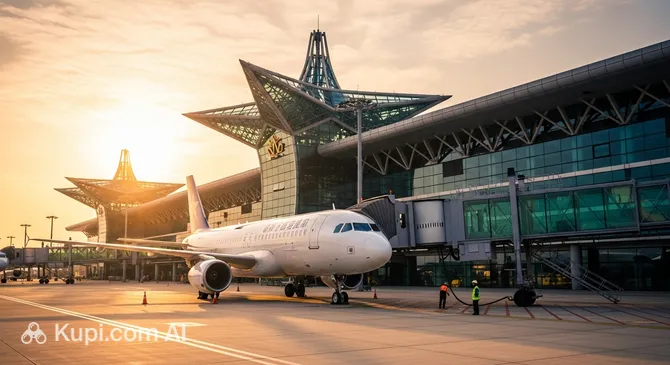
Qingdao Jiaodong International Airport. Source: Kupi.com Binoculars
Qingdao Jiaodong International Airport is not merely a transport hub, but a true architectural masterpiece in the shape of a giant starfish, spread across the coast of the Yellow Sea. This ultra-modern 4F-class aviation hub, opened in 2021, replaced the old Liuting Airport and immediately became a symbol of the region's technological progress. Thanks to its unique radial layout, the journey from the central hall to the furthest gate takes just a few minutes, turning navigation through the immense terminal into an easy stroll.
IATA Code TAO
ICAO Code ZSQD
City Qingdao
Distance to Centre ~39 km
Status International
Annual Passengers over 26 million (2024)

Airport Features and Advantages:

Unique "Starfish" Design. The five-arm terminal layout not only looks spectacular from the air but is also maximally functional. This architecture reduces walking distances: a passenger needs to walk no more than 600 metres from the security checkpoint to the furthest boarding gate.

Integrated Ground Transport Centre (GTC). The airport is designed on the "zero transfer" principle. Metro stations (Line 8) and high-speed railway platforms are located directly beneath the terminal, allowing travellers to reach the city centre or neighbouring regions in minimal time without stepping outside.

Sustainability and Technology. Jiaodong is known as a "Sponge Airport" thanks to its advanced rainwater collection and recycling system. Additionally, the terminal roof is made of ultra-thin stainless steel, just 0.5 mm thick — the largest continuous roof of this type in the world.

Contact Information

For the most up-to-date information on flights, services, and airport regulations, it is recommended to contact official channels directly. Below are the main contact details for Qingdao Jiaodong International Airport (TAO).

  • Official Website: www.qdairport.com (the site may be available in Chinese and English).
  • Inquiry Service Phone: +86-532-96567. This is the main number for flight information, services, and general enquiries.
  • Address: Jiaodong, Jiaozhou, Qingdao, Shandong Province, China.
  • Email: A direct email address for general inquiries is usually not published. It is recommended to use the contact form on the official website or the telephone service for communication.
  • Social Media: The airport may maintain official pages on popular Chinese social networks such as WeChat or Weibo. Links can usually be found on the official website.
  • Lost & Found: For issues related to items lost or found within the terminal, please contact the airport's Lost & Found service. Contact phone: +86-532-67895315. If your luggage was lost by the airline, you must contact your carrier's representative directly.
  • Passenger Support Service: For most issues, including assistance for passengers with reduced mobility, please use the main inquiry service phone number.

How to Get to the Airport

There are several convenient ways to get to Qingdao Jiaodong International Airport (TAO). The airport is located at a significant distance from the centre of Qingdao, so it is important to plan your route in advance. The transport infrastructure of China offers options for every taste and budget — from high-speed metro to comfortable taxis.

Public Transport

Metro: The fastest and most reliable way to reach the airport is to use Metro Line 8. It directly connects the city centre with the airport complex. The metro station is located right inside the terminal, making the transfer maximally convenient. The journey from the central districts of the city will take about 60-70 minutes. This is an economical option that allows you to avoid traffic jams.

High-Speed Train: The "Qingdao Airport" railway station is located at the airport and is integrated into the high-speed rail network. This is an ideal option for travellers arriving at the airport from other cities in Shandong province, such as Jinan or Weifang.

Shuttle Buses: An extensive network of bus routes connects the airport with key points in the city and neighbouring localities. This is the most budget-friendly way to travel, but the trip may take longer due to stops and traffic conditions. Schedules and routes can be checked on the official airport website or at bus stops.

Taxi and Transfer

Taking a taxi or booking a car via popular apps (such as DiDi) is the most comfortable option, especially if you are travelling with a lot of luggage or with family. The cost will be significantly higher than public transport. Travel time from the city centre will be approximately 1-1.5 hours depending on traffic. It is recommended to allow extra time in case of congestion.

Car Rental and Parking

For those who value independence and plan to travel extensively around the region, counters for international and local rental companies operate at the airport. You can rent a car upon arrival or book it online in advance. Both short-term and long-term parking for private vehicles is available on the airport grounds.

Other Regional Airports

If your final destination is in another city within the province, it is worth considering alternative airports. Located not far from Qingdao are Weifang Airport (WEF) and Rizhao Shanzihe Airport (RIZ). Also within reach are larger air hubs, such as Yantai Penglai International Airport (YNT) and Weihai Dashuibo Airport (WEH).

Terminals and Map

Qingdao Jiaodong International Airport (TAO) is a modern and massive aviation hub, designed with maximum passenger convenience in mind. Currently, the airport operates one large terminal (T1), which serves both domestic and international flights. This saves travellers from the need to move between different buildings.

The architectural concept of the terminal resembles a starfish. The main service area is located in the centre, from which five piers (concourses) with boarding gates radiate outwards. This structure is intuitive: all key procedures — check-in, baggage drop, passport control, and security screening — are concentrated in the central part. Arrival zones are traditionally located on the lower floors, and departure zones on the upper floors.

Navigation inside the terminal is well thought out. After completing check-in in the spacious departure hall, passengers proceed to security screening, after which they enter the general "airside" zone. From here, you can walk to one of the five piers. Signs in Chinese and English will help you orient yourself on which gate to head towards. Despite there being only one terminal, distances to distant gates can be significant, so moving walkways (travelators) are provided for passenger convenience.

The time required to complete all formalities depends on the flight destination. For domestic flights, it is recommended to arrive at the airport 1.5–2 hours before departure. For international flights, it is worth allowing more time — about 2.5–3 hours, to calmly pass through check-in, customs, and passport control, as well as security screening, especially during peak hours.

To easily orient yourself at Jiaodong Airport, follow simple advice: carefully study the information on your boarding pass and the departure boards to determine the number of your pier and gate. Do not underestimate the time it may take to walk to the required boarding gate, and feel free to use the travelators to save energy before your flight.

Airport History

The history of Qingdao Jiaodong International Airport (TAO) is a story of modern engineering and rapid development. Unlike airports with many years of history, Jiaodong is an ultra-modern transport hub built from scratch to meet the growing needs of the city of Qingdao and the region. Its official opening took place on August 12, 2021, and on that day, it completely replaced the old Qingdao Liuting Airport, which ceased operations.

The design and construction of Jiaodong Airport became one of the key infrastructure projects in China. Work began in 2015 with an ambitious goal — to create not just an airport, but a major international hub for Northeast Asia. The airport has been assigned the highest class 4F, allowing it to accommodate the world's largest passenger aircraft, including the Airbus A380. This highlights its strategic importance for international and domestic air travel.

One of the most significant events in its short history is the transfer of operations itself. On the night of August 11 to 12, 2021, a massive and coordinated "relocation" took place: all flights, equipment, and personnel were transferred from the old Liuting Airport to the new Jiaodong without interrupting air traffic. This process became an example of outstanding logistics and planning.

An interesting fact from the airport's "biography" is its unique design. The main terminal is designed in the shape of a starfish. This is not only a striking architectural solution but also a practical approach: such a shape reduces the distance from the central hall to the furthest boarding gates, making movement through the huge terminal more convenient for passengers. Thus, despite its youth, Jiaodong Airport is already an important milestone in the history of modern aviation and a symbol of the future.

Services and Amenities

Qingdao Jiaodong International Airport (TAO) in Qingdao is a modern and well-equipped aviation hub offering passengers a full range of services for a comfortable wait for their flight. As one of the key hubs in China, it is designed considering the needs of various categories of travellers.

The terminal features a wide selection of dining establishments: from restaurants offering local and Asian cuisine to international fast-food chains and cosy coffee shops. For shopping enthusiasts, there are numerous stores, including Duty Free, where you can purchase perfumes, cosmetics, souvenirs, confectionery, and products from famous global brands.

For a comfortable wait, passengers can use the services of several premium lounges and VIP halls, offering a secluded atmosphere, snacks, beverages, and press. Free Wi-Fi is available throughout the airport, and numerous charging stations for mobile devices allow you to stay connected at all times. Business centres and conference rooms are provided for business travellers.

The airport pays great attention to passengers with special needs. There are specially equipped restrooms, ramps, and elevators for people with disabilities. Medical points operate to provide first aid. Families with young children will appreciate the presence of mother and baby rooms, where you can feed and change your baby in a quiet environment.

Bank branches, ATMs, and currency exchange points are also available to passengers, allowing financial matters to be resolved easily right upon arrival or before departure. For those needing rest between flights, several hotels offering convenient accommodation are located in the immediate vicinity of the airport.

Dining

Qingdao Jiaodong International Airport (TAO) offers passengers a wide choice of venues for every taste and budget. Here you will find both fast-food outlets and full-service restaurants offering local and international cuisine. Most cafes and restaurants are concentrated in the main terminal, both in the public area (landside) and in the secure area (airside).

For those wishing to experience the gastronomic traditions of the region, the airport is an excellent opportunity to try authentic dishes. Qingdao is famous for its seafood, so pay attention to restaurants offering fresh marine delicacies. Also, traditional noodles, dumplings (jiaozi), and other popular dishes of China can be found on many menus. Do not miss the chance to enjoy a cup of authentic Chinese tea in one of the tea houses.

If you are short on time, a quick snack would be the ideal choice. The airport features well-known international fast-food chains, coffee shops like Starbucks and Costa Coffee, as well as local eateries. They are perfect for grabbing a coffee with pastries or taking a sandwich with you. For a more substantial lunch or dinner, head to one of the full-service restaurants where you can enjoy a meal in a relaxed atmosphere before your flight. Such establishments are located primarily in the departure zone after passport control.

Regarding special dietary needs, vegetarian dishes based on vegetables and tofu can be found in most Chinese restaurants. However, finding certified vegan, Halal, or gluten-free options may be challenging. To ensure dietary compliance, it is better to choose establishments from large international chains where menus are more standardised. It is recommended to carefully study the ingredients or carry a card with a translation of your dietary restrictions.

Food prices at the airport are generally higher than in the city. A quick snack will cost a budget-friendly amount, whereas lunch in a restaurant will be more expensive. Most establishments operate according to the flight schedule, opening early in the morning and closing late at night. Some coffee shops and stores in the departure zone may work around the clock or nearly 24/7 to serve passengers on night flights.

Travel Tips

To ensure your journey through Qingdao Jiaodong International Airport goes as smoothly as possible, use these tips. This modern aviation hub in the city of Qingdao, China, is well-organised, but knowing a few nuances will help save time and stress.

Arrival Time and Check-in. For international flights, it is recommended to arrive at the airport 3-4 hours before departure, and for domestic flights — 2 hours prior. This will give you enough time in case of queues. If possible, complete online check-in in advance to save time at airline counters. Security services at airports in China can be very thorough, so be prepared to remove electronics and liquids from your carry-on luggage beforehand.

Seat Selection and Carry-on Luggage. When choosing a seat on the plane, be guided by your preferences: a window seat for beautiful views, an aisle seat for freedom of movement. Pay special attention to carry-on luggage rules. Liquids are permitted in containers up to 100 ml, packed in a transparent bag. Critically important: portable chargers (power banks) are permitted only in carry-on luggage; their carriage in checked baggage is strictly prohibited. Ensure that the capacity is clearly marked on them.

Transfer Passengers and Customs. If you have a connecting flight, check with the airline whether you need to collect and re-check your luggage. Follow the "Transfers" signs to reach the correct zone. When passing through customs control upon entry, be prepared to complete a health declaration and customs form. Have your passport and boarding pass ready in advance.

Saving Time and Money. To avoid unnecessary expenses, bring an empty water bottle with you — after passing security control, you can fill it at drinking fountains. Prices for food and souvenirs at the airport are traditionally higher, so to save money, it is better to have a snack before arriving at the airport or bring permitted snacks with you.

In Case of Flight Delay. If your flight is delayed, first contact your airline representative for information on the flight status and your rights (for example, provision of drinks, food, or a hotel during long delays). Use this time to rest: the airport has cafes, shops, and free Wi-Fi.

Reached the end of the page?

That means the route is fully explored