Support

Shennongjia

About the Airport

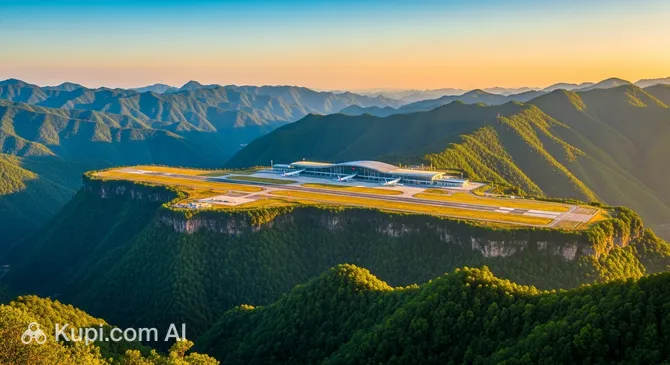
Shennongjia. Illustration.
Source: Kupi.com AI

Welcome to a "celestial harbour" located closer to the clouds than many other airports in the world. Shennongjia Hongping Airport (HPG) is an impressive example of engineering art, built at an altitude of 2,580 metres by slicing through mountain peaks and filling gorges. It serves as the main aerial gateway to the mysterious forest district of Shennongjia, allowing travellers to enjoy breathtaking views of mountain ranges even before landing.

PropertyValue
IATA CodeHPG
ICAO CodeZHSN
CityShennongjia
CountryChina
TimezoneAsia/Shanghai
ScheduleOnline Timetable

This high-altitude airport boasts a number of unique features that make it a vital point on the map for any tourist heading to Hubei Province. The main advantage of the air harbour is the colossal saving of time. Previously, the journey from major cities such as Wuhan took over 9 hours by car on difficult mountain roads. Now, the flight takes less than an hour, transforming a tiring trip into a quick and comfortable transfer to the heart of the reserve.

The terminal's architecture is designed in a style that harmonises with the surrounding nature, reminiscent of traditional Chinese structures with curved roofs. Thanks to the compactness of the airport, all procedures—from check-in to baggage claim—are incredibly fast and free from the queues typical of metropolises. However, it is worth noting that due to its location at a high altitude ("airport in the clouds"), flights may depend on weather conditions and fog, so travellers are advised to monitor the weather forecast.

Contact Information

Below you will find contact information for Shennongjia Hongping Airport (HPG), serving the forest district of Shennongjia. Please note that for small regional airports in China, a full range of contacts in English is not always provided.

  • Official Website: The airport is part of the Hubei Airports Group. Current information on flights and services can be found on the group's general portal: www.hbairport.com. A separate website for Shennongjia Airport may not be available.
  • Information Desk Phone: You can try contacting the number: +86-719-331-2888. Please consider that operators may speak predominantly Mandarin Chinese.
  • Airport Address: Hongping Town, Shennongjia Forestry District, Hubei Province, China.
  • Email: A specialised email address for general passenger enquiries is not publicly provided. It is recommended to use telephone communication.
  • Social Media: The airport does not have its own official pages on international social networks. News may be published on Hubei Airports Group accounts in Chinese social networks (e.g., Weibo).
  • Lost Luggage Information: For issues regarding lost or damaged luggage, you should primarily contact your airline representative. Airline staff will provide you with all necessary assistance and instructions.
  • Passenger Support Contacts: For general questions and passenger support, it is recommended to use the main airport information desk phone number.

How to Get to the Airport

Shennongjia Hongping Airport (HPG) is located in a mountainous area, so transport connections have specific characteristics. The main tourist centre of the region is Muyu Town, which is approximately 50-60 kilometres from the airport. Travel time to reach it usually takes from 1 to 1.5 hours depending on the chosen transport and road conditions.

The most accessible way to reach the main settlements of the forest district of Shennongjia is via special shuttle buses. They run between the airport and key points, including Muyu Town and the Songbai administrative centre. This is the most budget-friendly option: the cost of the trip is usually around 40–60 Chinese Yuan (CNY). We recommend checking the schedule in advance, as the number of trips may be limited, especially for evening arrivals. There is no direct railway or metro connection to the airport due to its remoteness and mountainous terrain.

For greater comfort, you can use taxi services, the rank for which is easily found at the terminal exit. The trip will cost significantly more than the bus but will save time and allow you to reach your hotel without transfers. The estimated cost of a trip to Muyu Town is 200–300 CNY. It is recommended to agree on the price with the driver in advance or ensure they have switched on the meter. An even more convenient option is to book a private transfer through your hotel or travel company.

You can rent a car at the airport, which gives maximum freedom of movement around the picturesque region. However, it is important to remember that to drive in China, foreign tourists need a Chinese driving licence—an International Driving Permit is generally not valid here. For those arriving in their own or rented vehicle, there is parking at the terminal where you can leave your car for both short and long periods.

Many travellers also reach Shennongjia via larger neighbouring airports. For example, you can fly into Yichang Sanxia Airport (YIH) or Shiyan Wudangshan (WDS), and continue the journey from there by intercity bus. Such a land trip will take several hours but may be more convenient due to the greater number of flights to these airports.

Terminals and Map

Shennongjia Hongping Airport (HPG) is a modern and compact aviation hub designed with passenger convenience in mind. It consists of one passenger terminal serving all domestic flights. Thanks to its small size, the airport offers fast and simple navigation, which is a great advantage for tourists arriving in the protected zone of Shennongjia.

The terminal layout is intuitive. The building is divided into two main parts: the departure zone and the arrival zone. You will not have to worry about transfers between terminals or long walks to gates—everything is located within one small building. Signs in Chinese and English will help you orient yourself easily, even if it is your first time here. The terminal features a clean and functional design, reflecting the region's status as an important natural site of China.

In the departure zone, check-in counters are located, followed by the security checkpoint. After passing through inspection, you enter a cosy waiting hall with several boarding gates. The arrival zone is just as simple: after disembarking from the aircraft, passengers head immediately to the baggage claim hall, and from there to the terminal exit, where taxis and buses await them.

The main asset of HPG airport is the minimal time required for all procedures. Flight check-in and security checks rarely take much time. As a rule, it is sufficient to arrive at the airport 1.5–2 hours before departure. This allows you to avoid the stress typical of major international hubs and makes the start or end of your journey as comfortable as possible. Moving through the terminal takes mere minutes, so getting lost here is practically impossible.

Airport History

Shennongjia Hongping Airport (HPG) is one of the youngest and most impressive high-altitude airports in China. Its history does not span decades, but it serves as a vivid example of a modern engineering miracle created to develop tourism in a remote region. The airport was officially opened on 17 May 2014, marking the beginning of a new era of accessibility for the unique forest district of Shennongjia, a UNESCO World Heritage site.

The most interesting fact in the airport's history is its construction. To create a runway and terminal at an altitude of over 2,580 metres above sea level, engineers literally had to shear off the tops of several mountains and fill the resulting gorges. This ambitious project lasted about five years and became one of the most complex in the history of the country's civil aviation. Before its appearance, reaching the reserve zone was only possible via winding mountain roads, which took a whole day.

Since its opening, Shennongjia Airport has played a key role in the development of the region. It connected this remote corner with major metropolises such as Wuhan, Shanghai, and Chongqing, cutting travel time to a couple of hours. Due to its novelty and narrow specialisation, the airport has not undergone significant renovations nor set records for passenger traffic. Its main achievement is the very fact of its existence, which has opened the beauties of Shennongjia's wild nature to a wide circle of travellers.

Thus, the history of the airport is not so much a story of expansions and modernisations, but rather a tale of overcoming natural barriers for the sake of uniting man with nature. Every flight landing here is a continuation of this grandiose engineering project and a contribution to the future of regional tourism.

Services and Amenities

Shennongjia Airport (HPG) is a modern yet compact aviation hub oriented towards tourists arriving at the eponymous forest reserve. Despite its size, it offers all necessary amenities for a comfortable wait for your flight. In the passenger terminal, you will find several cafes and snack bars where you can try local cuisine or simply have a cup of tea. Souvenir shops are also open, where you can purchase memorable gifts and regional products.

For the convenience of passengers, free Wi-Fi is available throughout the terminal. Waiting areas are equipped with zones featuring power outlets and USB ports for charging mobile devices. Although the airport does not have large business lounges, separate waiting areas of increased comfort may be provided for first and business class passengers—it is best to check this information with your airline.

A medical point operates at the airport to provide first aid. Banking services and currency exchange points may be limited, so it is recommended to exchange money in advance. For travellers with small children, mother and child rooms are provided. Passengers with reduced mobility are provided with the necessary assistance during boarding and disembarking; to receive this service, it is advisable to notify the air carrier of your needs 48 hours before departure.

Since the airport mainly serves tourist traffic, there are no dedicated conference halls or business centres here. The nearest hotels and guesthouses are not located on the airport territory but in nearby towns, for example, in Muyu, which can be reached by bus or taxi. This allows you to immerse yourself in the atmosphere of this unique corner of China immediately after arrival.

Where to Eat

Shennongjia Airport (HPG) is a small regional airport serving primarily tourists heading to the eponymous forest district. Due to its size and specific nature, the choice of catering establishments here is limited, so passengers with special dietary requirements are advised to carry a supply of food with them. The airport consists of one terminal, and all food outlets are located within it.

In the main public area (landside), accessible to all visitors, there is usually a small cafe or snack bar. Here you can find basic options for a snack or a full lunch. The assortment typically includes simple Chinese dishes such as instant noodles, dumplings, or steamed buns (baozi). You can also buy beverages, including tea, coffee, and bottled water, as well as various packaged snacks (crisps, biscuits).

After passing security control (airside), in the departure waiting area, the choice is even more modest. Most often, this is a small kiosk or vending machine where you can purchase drinks and light snacks. Do not count on a full-service restaurant or cafe in this zone.

As for local cuisine, you are unlikely to find complex authentic dishes at the airport. However, souvenir shops or cafes may sell packaged local delicacies, for example, dried mushrooms, local honey, or herbal teas, which you can take with you. Prices at the airport are traditionally higher than in the city but remain moderate. Establishments operate in accordance with the flight schedule—opening a few hours before the first departure and closing after the last one leaves.

Specialised menus (vegetarian, gluten-free, Halal) are practically non-existent at Shennongjia Airport. Travellers adhering to a strict diet are strongly advised to arrange their meals in advance. Packaged snacks are suitable for a quick bite, while a portion of hot noodles in the cafe in the public zone is an option for a more substantial meal.

Travel Tips

To ensure your journey through Shennongjia Airport (HPG), the gateway to a unique forest district in China, goes smoothly, make use of these tips. Planning ahead will help avoid stress and allow you to enjoy the anticipation of your trip to the amazing Shennongjia.

Arrival Time and Check-in: Shennongjia Airport is not very large, but it is better not to take risks. Arrive at the airport at least 2 hours before your domestic flight departure. This will give you enough time to complete check-in, baggage drop, and security control without rushing. To save time, complete online check-in if your airline provides such an option.

Security Control and Hand Luggage: Security procedures at Chinese airports can be quite strict. Pack liquids in containers up to 100 ml in a transparent bag. Power banks and lithium batteries are permitted only in hand luggage. Be prepared to remove laptops and other large electronic devices for separate scanning.

Seat Selection and Transfers: The airport is located in a picturesque mountainous area. If you want to enjoy stunning views during take-off or landing, choose a window seat. An aisle seat is more convenient if you need to get up during the flight. For passengers with transfers, it is important to check whether you need to collect and re-check your luggage at the intermediate airport—usually, this information is indicated on your itinerary receipt.

Customs Control and Arrival: Since Shennongjia Airport serves mainly domestic flights, upon arrival you will most likely not have to go through customs control. You will simply proceed to the baggage claim area. Customs is only relevant for passengers arriving on international (usually charter) flights, where it is necessary to declare goods exceeding established limits.

Saving Time and Money: To save money, weigh your luggage at home and ensure it does not exceed the airline's allowance to avoid extra charges. Take an empty water bottle with you, which can be filled after passing security control. It is also wise to book a transfer from the airport in advance, as it is located at a distance from the main settlements.

If the Flight is Delayed: In case of a flight delay, first contact your airline representative to obtain information about the new departure time and possible compensation (e.g., food vouchers). Use this time to rest, charge your devices, or have a snack in the airport's few cafes. Always keep important contacts and documents close at hand.

Reached the end of the page?

That means the route is fully explored