Support

Tacheng

About the Airport

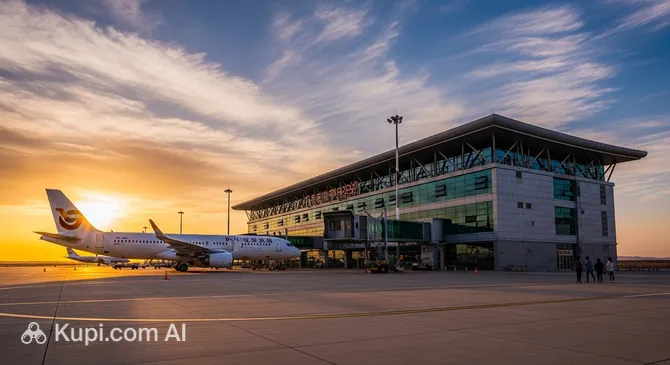
Tacheng. Illustration.
Source: Kupi.com AI

Tacheng Airport (TCG), also known as Chuguchak, is the air gateway to the county-level city of the same name in the Xinjiang Uygur Autonomous Region of China. Located in a picturesque border area, this airport serves as a convenient starting point for travellers eager to explore the unique culture and breathtaking landscapes of the country's northwest. Despite its compact size, the airport plays a key role in the region's transport infrastructure, ensuring reliable connections with major cities in China.

PropertyValue
IATA CodeTCG
ICAO CodeZWTC
CityTacheng
CountryChina
TimezoneAsia/Shanghai
Top AirlinesChina Southern
ScheduleOnline Timetable

Tacheng Airport specialises in handling domestic flights, making the check-in and pre-flight security process quick and convenient, sparing passengers the hustle and bustle of large international hubs. Generally, flight check-in opens 2 hours before and closes 40 minutes prior to departure. The terminal is certified to handle popular medium-haul aircraft such as the Boeing 737 and Airbus A320, guaranteeing comfort and safety on your journey to this amazing corner of China.

Contact Information

Finding direct and up-to-date contact details for small regional airports like Tacheng Airport (TCG) can be challenging. It is recommended to resolve most flight-related issues directly through your airline. However, here is the basic contact information that may be useful.

  • Official website: Generally, Tacheng Airport does not have a separate official website. It is best to check flight information on your airline's website or on flight tracking aggregator sites.
  • Inquiry desk phone: The main number for inquiries at the airport is: +86-901-6223118. Please note that communication will most likely be conducted in Chinese.
  • Airport address: The airport is located approximately 28 kilometres east of the city of Tacheng, in the Xinjiang Uygur Autonomous Region, China.
  • Email and social media: There are no official public email addresses or international social media pages for Tacheng Airport.
  • Lost luggage information: In case of loss or damage to luggage, you should first contact your airline's Lost & Found service. Their counter is usually located in the arrivals area.
  • Passenger support service: For all questions related to tickets, check-in, special assistance, or flight status, your airline will be the most reliable source of information. Within the terminal building, you can approach the information desk.

How to Get to the Airport

Getting to Tacheng Airport (TCG) from the city of the same name is quite simple. The air hub is located close to the centre, and several convenient transport options are available to travellers. The choice depends on your budget, amount of luggage, and personal preferences. Whether you are looking for the most economical or the most comfortable method, you will easily find a suitable solution for your trip to the airport in Tacheng, located in China.

Public transport is the most budget-friendly way to reach the airport. Usually, a dedicated shuttle bus runs between the city centre and the terminal. This is an excellent option for solo travellers with light luggage. The trip cost is generally around 15-20 CNY. Although the bus ride takes a bit longer than a taxi, it allows for significant savings. It is recommended to check the schedule and route in advance, as they may change.

Taxi or private transfer is the fastest and most convenient method. The journey from the centre of Tacheng to the airport will take approximately 25-35 minutes depending on traffic, and the cost will be roughly 60-80 CNY. This is the ideal choice for families with children, large groups, or those carrying a lot of luggage. Taxis can be found at designated stands in the city or ordered via local apps. For maximum convenience, a transfer can be booked in advance.

For those who prefer maximum freedom of movement, car rental is an excellent solution. This option is particularly convenient if you plan not only a trip to the airport but also independent exploration of the surroundings. Car rental points can be found both in the city and at the airport. For travellers arriving in their own or rented vehicle, parking is available on the airport grounds, where cars can be left for short or long periods.

Terminals and Map

Tacheng Airport (TCG) is a small and modern regional air hub distinguished by its compactness and simplicity. The airport has just one passenger terminal serving all domestic flights — both departures and arrivals. This structure makes it very convenient for passengers, eliminating the need for complex transfers between buildings.

The terminal layout is intuitively clear. The building has a logical and simple design. The departure area is located in one part of the terminal: immediately at the entrance are the check-in counters, followed by the security checkpoint. After this, passengers enter a small but comfortable waiting hall with boarding gates. The arrival area is organised just as efficiently: passengers from the aircraft enter the baggage claim hall, and from there — into the general meeting area.

Since there is only one terminal, transitions between zones are made on foot and take just a few minutes. All necessary services are within walking distance. Navigation will not cause difficulties: there are clear signs in Chinese and English everywhere. It is practically impossible to get lost here, even if you are flying through Tacheng for the first time.

Thanks to the low passenger flow and efficient operation of services, check-in and pre-flight screening usually take very little time — on average about 20-30 minutes. Nevertheless, it is recommended to arrive at the airport 1.5-2 hours before departure to avoid any surprises and go through all procedures calmly. This airport is an excellent example of how a small air hub can be maximally convenient and functional for travellers.

Airport History

The history of Tacheng Airport (TCG) began long before it started accepting civilian travellers. Its foundation dates back to 1965, when it was built as a military airfield in northwest China. For nearly three decades, it performed exclusively defensive functions, serving the needs of the air force in this strategically important region.

A turning point in the history of the air harbour was 1993, when the government approved a plan to transform it into a dual-use airport. Construction of civil infrastructure started in May 1995, and already in July 1996, Tacheng Airport officially opened for commercial flights. This event became key for the economic development of the city and the entire prefecture, significantly simplifying transport connections with the rest of the country.

Over time, with the growth of passenger traffic, the need for radical modernisation arose. In 2011, the airport was temporarily closed for a large-scale reconstruction costing about 496 million CNY. During the works, a new runway 3000 metres long and a modern terminal with an area of 5400 square metres were built. The renovated airport reopened its doors to passengers on June 25, 2015, offering a higher level of comfort and safety.

Today, Tacheng Airport is a modern transport hub that continues to play an important role in the life of the region. Its history is a vivid example of how a military facility can successfully transform into civil infrastructure, promoting the development of tourism and business ties.

Services and Amenities

Tacheng Airport (TCG) offers passengers all necessary services for a comfortable wait for their flight. Despite its relatively small size, the terminal is designed to make your journey through China as convenient as possible from the very beginning.

Inside the terminal, you will find several cafes and eateries where you can have a coffee or a full meal before departure. There are also shops selling souvenirs, daily essentials, and press. Shared lounges are equipped for comfortable waiting, and for passengers preferring privacy and quiet, VIP lounges with a higher level of service are available.

Free Wi-Fi is available throughout the airport, allowing you to stay connected or work. The waiting halls are provided with power outlets and special stands for charging mobile devices. For financial operations, ATMs are installed in the terminal, and there is a currency exchange point. In case of necessity, passengers can contact the medical post for first aid.

The airport cares for all categories of travellers. A mother and child room is equipped for families with small children. Passengers with reduced mobility are provided with staff assistance, and the terminal infrastructure, including ramps and specially equipped toilets, ensures a barrier-free environment.

Although there are no hotels directly in the terminal building, travellers can easily find many accommodation options in the city of Tacheng itself, which can be quickly reached by taxi or bus. For business travellers, conditions for work or meetings can be created in the VIP lounges.

Where to Eat

Tacheng Airport (TCG) is a regional air hub, so the choice of dining establishments here is quite modest and focused on basic passenger needs. Do not expect a large variety of restaurants as found in major international airports, however, grabbing a bite before departure is certainly possible.

Generally, the main dining points are located in the public hall before security control (landside). Here you can find a small café offering simple Chinese dishes, such as noodles, rice with toppings, and dumplings, as well as sandwiches, pastries, and beverages. After passing through security, in the departure area (airside), the selection is usually even more limited and may consist of a small buffet or vending machines with drinks and snacks.

If you want to try something local, pay attention to the hot dishes in the café — this is the easiest way to get acquainted with regional cuisine. Regarding special dietary requirements (vegetarian, vegan, gluten-free), finding suitable options will be extremely difficult. Passengers with strict dietary restrictions are strongly advised to bring food with them.

The price range at the airport is moderate, but as in most air hubs, slightly higher than in the city. Opening hours are usually tied to the flight schedule: they open a few hours before the first departure and close after the last aircraft leaves. For a quick snack, packaged snacks or pastries are suitable, while for a more substantial lunch, it is better to rely on the main café in the public hall.

Travel Tips

To ensure your journey through the airport of Tacheng goes smoothly and without hassle, make use of our tips. These recommendations will help you save time, money, and stress, making the start and end of your trip as comfortable as possible.

Arrival time at the airport. Even at small regional airports, it is better to have a time buffer. We recommend arriving 1.5–2 hours before a domestic flight and 2.5–3 hours before an international one. This will allow you to calmly go through all formalities, even if small queues arise.

Check-in and security. The fastest way to save time is to complete online check-in, if your airline provides this option. At the airport, keep your passport and boarding pass ready. During security screening, be prepared to remove laptops and other large gadgets from your hand luggage, as well as liquids in a special bag.

Seat selection on the plane. If you want to admire the clouds, choose a window seat. If you prefer to move freely into the aisle and have more legroom, your choice is an aisle seat. For the most comfortable flights, look for seats by the emergency exits (often for an additional fee), but avoid the last rows and seats near the toilets if you value quiet.

Hand luggage rules. Standard rules for most airlines: liquids can be carried in containers up to 100 ml, packed in a transparent bag. Sharp objects, weapons, and flammable substances are prohibited. Power banks must be carried in hand luggage only.

For passengers with transfers. If you have a connecting flight, clarify at check-in whether your luggage will be transferred automatically to the final destination. Study the airport map in advance to quickly find the necessary gate. Ensure you have enough time for the transfer, especially if re-screening is required.

Customs control. When entering China or leaving the country, be prepared for customs inspection. Familiarise yourself in advance with the list of goods subject to declaration, and restrictions on the import and export of currency, food products, and cultural valuables. Fill out the declaration honestly to avoid fines.

How to save money. To save money, bring an empty water bottle with you and fill it after passing security. Prices for food and drinks at airports are always higher, so a light snack can be brought along. Explore transfer options to the city — public transport or shuttles are often significantly cheaper than taxis.

If the flight is delayed. First of all, contact your airline representative for information. Depending on the length of the delay, you may be provided with drinks, meals, or even hotel accommodation. Keep the essentials in your hand luggage: chargers, medication, a book, or a tablet to pass the waiting time.
Reached the end of the page?

That means the route is fully explored