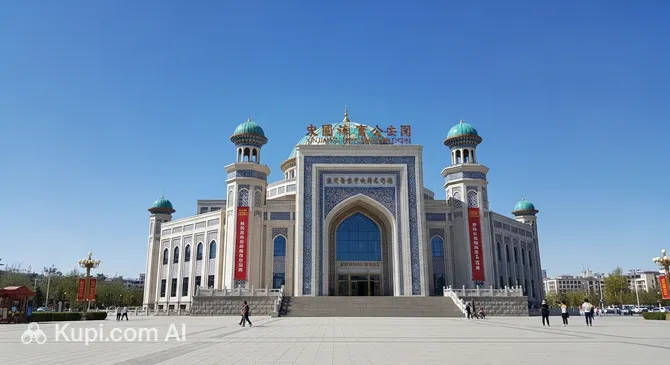
Immersing yourself in the multifaceted culture of Central Asia is unthinkable without visiting one of the region's main treasure houses. The Xinjiang Uyghur Autonomous Region Museum is the largest local history institution in Urumqi, serving as a true bridge between ancient civilizations and the modern world. The museum building, harmoniously blending traditional national elements with modern design, covers an area of about 8,000 square meters.
Xinjiang Uygur Autonomous Region Museum. Illustration.
Source: Kupi.com AI
Traveller photos:
Its collection holds over 50,000 exhibits telling the story of the rich heritage that China and its western frontiers have given the world. Here you will find rare samples of silk fabrics, medieval trade items, and unique archaeological finds discovered along the legendary caravan routes of the Great Silk Road.
The "crown jewel" of the collection and a true scientific sensation are the famous Tarim mummies, which are up to 4,000 years old. The excellent preservation of the bodies found in the Taklamakan Desert allows visitors to see in detail the clothing and facial features of the people who inhabited these lands during the Bronze Age, making a visit to the museum an unforgettable experience for every traveler.
Contacts
To find out the latest information about special exhibitions or to book a guided tour, visitors can use the official contact details. It is recommended to book group tours in advance, especially during the peak tourist season.
Below are the main contacts for reaching the administration:
Inside the museum, an exciting introduction to the life and art of the numerous peoples of Xinjiang awaits you. Be sure to visit the Mummy Hall, where the "singing dead of the Taklamakan" are on display, including the famous "Loulan Beauty." Seeing these remarkably preserved witnesses of history allows you to literally touch the mysteries of ancient civilizations.
Applied arts enthusiasts should spend time in the ethnographic departments. Here you can see exquisite jade products, traditional clothing of the region's ethnic groups, and ancient ceramics. The exhibition dedicated to the history of the Silk Road clearly demonstrates how silk fabrics, jewelry, and ideas traveled between East and West, changing the world.
For the convenience of international guests, many descriptions are supplemented with English signage. Visitors can also use audio guides or join a tour group to learn hidden details about the artifacts. Modern interactive displays and well-thought-out infrastructure make viewing the collections comfortable and educational for people of all ages.
Getting There
You can reach this iconic cultural site in Urumqi in several convenient ways. The museum is located in the Saybagh District at 581 Xi Bei Lu, making it easily accessible for both organized groups and independent travelers. A taxi ride from the city center or popular hotels will take very little time, and using the Didi mobile app will significantly simplify calling a car.
If you prefer public transport, city buses (e.g., route No. 110) stop nearby, and metro lines pass through the area. For those arriving from Diwopu International Airport (URC), a taxi ride will take about 20–30 minutes depending on traffic. Public transport in the region is considered budget-friendly and intuitive for tourists.
Nearest city: Urumqi
History & Facts
The history of this research center began in 1953 when it first opened to the public in the People's Park. A major milestone was 1962, when the museum moved to a specially designed building whose appearance combines modern architectural solutions with a classic Uyghur style, featuring its recognizable green dome.
The museum's collections gained worldwide fame thanks to unique archaeological finds in the Taklamakan Desert. The dry and hot climate of the region allowed the bodies of ancient people to be preserved for several millennia. Discoveries made in the 20th century, including the famous "Loulan Beauty," overturned historians' ideas about human migration and the cultural composition of ancient East Turkestan.
The museum's exhibitions also cover the periods of the Han and Tang dynasties, when Xinjiang played a key role as a link between East and West. Each renovation of the building and update of the collections aims to clearly show how the traditions of dozens of different ethnicities have intertwined here over the centuries.
Time Needed
To explore all the thematic halls without rushing and delve into the details of the rich collection, an average visitor is recommended to set aside 2 to 3 hours. This is enough time to carefully examine the Silk Road artifacts and give proper attention to the mummy hall, which traditionally attracts the most interest.
For those deeply interested in archaeology or ethnography, it may take half a day. Given the scale of the exhibition, which covers thousands of years of history, it is better to plan your visit for the first half of the day to leave time for reflecting on what you've seen and resting in one of the nearby cafes.
Working Hours
When planning your visit, keep in mind that the museum is usually open daily, except for Monday, which is a day off. The exhibition halls are open from 10:00 AM to 6:00 PM. Please note that entry for visitors stops one hour before the official closing time, so it is best to arrive no later than 4:30 PM.
On public holidays, the schedule may change, so it is recommended to check the current schedule on-site or through tourist information centers before your trip.
Nearby
Continuing your walk around Urumqi will allow you to deeper experience the atmosphere of this modern metropolis with a rich history. Within a few kilometers of the museum, you'll find cozy bars and restaurants where you can relax after exploring the exhibits, as well as interesting venues for family leisure.
Below is a list of notable places located nearby:
Reached the bottom of the page?
Looks like you know this route inside out
Popular routes
Where travelers fly most — pick a route and check prices