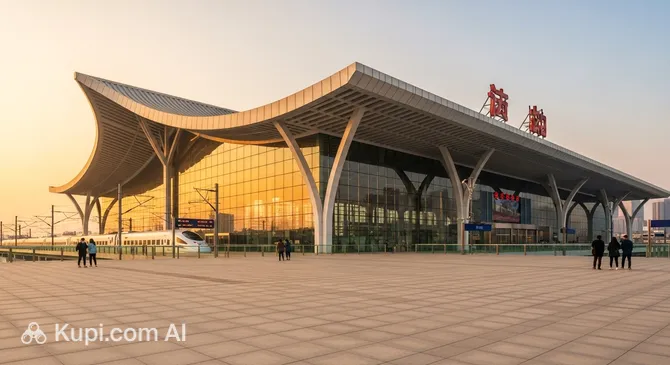
Wuhan Railway Station is not merely a major transport hub, but a true architectural masterpiece located in Hubei Province. The building, designed in the shape of a yellow crane spreading its wings, symbolises the region's rapid development and serves as a key point for China's high-speed trains. Opened in 2009, this modern terminal impresses with its scale and sophisticated logistics, connecting the north and south of the country.
It is important for passengers to note that the station features a vertical structure, which simplifies navigation. The main Departure Hall is located on the upper level, the platforms are on the ground floor, and the Arrivals area and Metro exits are on the basement level. Orienting yourself inside the building is easy thanks to numerous signs in English and Chinese, whilst escalators and lifts are provided for moving between floors.
Contact Information
Official Website: 12306.cn (China's unified railway portal)
Enquiry Phone: +86 27 12306 (general hotline)
Address: Wuhan Railway Station, Hongshan District, Wuhan, Hubei Province, China
Opening Hours: 24 hours (ticket counters and waiting halls operate according to the train schedule)
Luggage Storage: Available in departure and arrival zones (paid service, passport required)
Accessibility: The station is equipped with ramps, lifts, and special toilets for passengers with reduced mobility; an assistance service is available.
Getting There
The most convenient and predictable way to reach the station is by using the Wuhan Metro. Wuhan Railway Station is the terminus for Line 4 (Green Line), which connects the station with another important hub — Wuchang Station, as well as the city centre. A journey from the central districts will take approximately 40–50 minutes.
If you prefer a taxi, the trip from the city centre or the Yangtze River embankment will take between 30 to 60 minutes, depending on traffic. Taxi fares vary, but you should always insist on using the meter. Numerous city buses and airport express coaches also run to the station; however, for tourists with luggage, this option may be less comfortable due to the language barrier and heavy traffic.
Services and Amenities
The infrastructure of Wuhan station meets the highest service standards. In the vast waiting halls, passengers will find ample seating, as well as special VIP zones for business class travellers. For purchasing and exchanging tickets, there are both automatic terminals (often requiring a Chinese ID) and traditional ticket counters, where foreigners are served upon presentation of their passports.
Among other amenities, it is worth noting the availability of free hot water dispensers (boiling water) — a traditional and very popular service in China, so many passengers carry thermos flasks or instant noodles. The premises include toilets (both Western-style and Asian squat type), mobile device charging points, and luggage storage. Wi-Fi is available, though connecting often requires a Chinese phone number to receive an SMS code.
Where to Eat
It is impossible to stay hungry at the station: a wide selection of dining establishments is available here. On the upper level (in the departure zone), you will find popular international fast-food chains such as KFC and McDonald's, which is convenient for those who prefer familiar food. The average price here is standard for the city.
For those wishing to try local cuisine, there are many Chinese eateries offering the famous Wuhan noodles Reganmian (hot dry noodles) and rice dishes. This is an excellent option for a quick and inexpensive meal. There are also many shops at the station where you can buy snacks, drinks, fruit, and ready-made meals for the journey.
Station History
The history of the modern Wuhan station began in the mid-2000s, when China embarked on the massive construction of a high-speed railway network. Construction was completed in December 2009, and at that time, it became one of the largest and most beautiful stations in the world.
The station played a key role in the launch of the Wuhan — Guangzhou high-speed line, which reduced travel time between these metropolises from 10 hours to just 3 hours. Today, it is a vital hub connecting central China with Beijing, Shanghai, and Hong Kong, symbolising technological progress and a new era in the region's transport system.
Passenger Tips
The main advice for passengers is to arrive early. It is recommended to arrive at the station at least 60–90 minutes before your train departs. This is due to thorough luggage screening and document checks at the entrance, which can create queues, especially during public holidays.
Be sure to keep your passport with you: it will be needed not only to collect a paper ticket at the counter but also to pass through the turnstiles (use the lanes with staff, as automatic gates often only read Chinese ID cards). Pay close attention to your train number and boarding gate on the electronic display boards. Boarding usually closes 5 minutes before departure.