Support

Zhangjiajie National Forest Park

About

Imagine a place where giant stone pillars soar above the ground, shrouded in thick mist—this is Zhangjiajie National Forest Park, a true natural wonder located in the city of Zhangjiajie. This nature reserve in Hunan Province gained worldwide fame thanks to its unique quartzite sandstone peaks, which served as the inspiration for the famous "floating mountains" in the cinematic masterpiece Avatar.
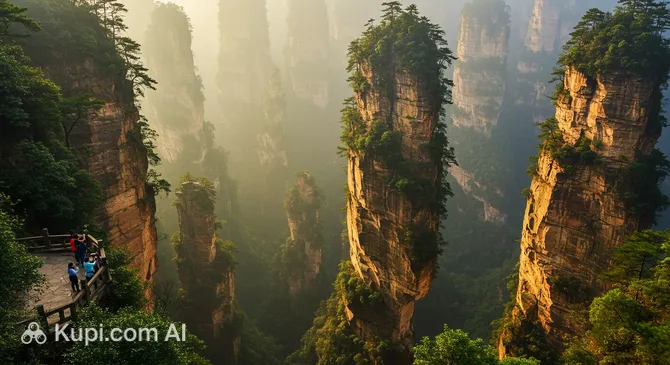
Zhangjiajie National Forest Park. Illustration.
Source: Kupi.com AI

Traveler photos:

Founded in 1982, it became the first park of its kind in China. Covering an area of about 480 km², it is almost entirely covered by relic forests, where ancient plants such as Ginkgo biloba grow. The park is the jewel of the Wulingyuan scenic area and is rightfully included in the UNESCO World Heritage list, featuring more than 3,000 pointed peaks and hundreds of mountain bodies of water.

The landscape of Zhangjiajie was formed over millions of years by erosion, creating vertical columns that sometimes reach hundreds of meters in height. It is not just a forest, but an entire ecosystem inhabited by rare animal species and featuring crystal-clear streams like Golden Whip Stream (Jinbianxi), creating an atmosphere of a primordial world untouched by time.

Contacts

For the latest information on park operations and ticket prices, visitors can use official resources or visit the administrative office in the Wulingyuan District.

Below are the main contact details for inquiries and navigation:

How to contactContact
AddressWulingyuan District, Zhangjiajie, Hunan, China, 427403
Websitewww.hnzjj.com

What to Do

One of the most thrilling experiences in the park is ascending the Bailong Elevator. This 326-meter-high engineering marvel is recognized as the tallest outdoor elevator in the world. In just a minute and a half, you will be at the top, offering a dizzying view of the stone pillars in the Yuanjiajie area. This is where the "Avatar Hallelujah Mountain" is located, which inspired James Cameron's vision of Pandora.

For those who prefer walking at high altitudes, the Tianzi Mountains are a must-visit. Having climbed to a height of 1,262 meters, you can see an infinite forest of peaks, often shrouded in mystical fog. No less impressive is Yellow Stone Village (Huangshizhai)—a vast plateau with panoramic glass platforms where you can learn about the culture of local peoples in the Liugie pavilion.

If you are looking for tranquility, head down to Golden Whip Stream (Jinbianxi). The walking trail, nearly 6 kilometers long, winds along the water among sheer cliffs and dense greenery. Here you can see rare giant salamanders and try your hand at photographing wild monkeys. Thrill-seekers should head to the nearby Glass Bridge across the Grand Canyon—it is 430 meters long, with a 300-meter abyss yawning beneath your feet.

The best way to conclude your visit to the park is on one of the cable cars. Flying over the tops of peaks reaching 200 meters in height, you will feel the true scale of this place. Every season offers its own perks: spring mists add mystery, while winter landscapes offer peace and quiet without the crowds among the snow-capped mountains.

Getting There

Reaching this natural wonder is easy if you are already in the city of Zhangjiajie. The main entrance to the park is located in the Wulingyuan district. Buses and taxis depart regularly from the local airport, which is about 30 kilometers away, or from the railway station. The trip usually takes 1 to 1.5 hours depending on traffic and the chosen park entrance.

Once inside, getting around is very convenient for tourists. Free ecological shuttle buses run between the main areas, such as Yuanjiajie and Huangshizhai. For navigation, it is recommended to use Google Maps, using the address: Wulingyuan District, Zhangjiajie, Hunan, China, 427403.

When planning your route, keep in mind that tickets for cable cars, the famous elevator, and the glass bridge are usually purchased separately. It is best to arrive at opening time to avoid long queues and enjoy the morning mountain air before the main tour groups arrive.

Nearest city: Zhangjiajie

History & Facts

The name of this place is steeped in ancient legends. "Zhangjiajie" literally translates as "Zhang Family Boundary." According to legend, in the 3rd century BC, a high-ranking official of the Han Dynasty named Zhang Liang left the imperial court and hid in these forests to master the wisdom of Tao. For many centuries, these lands remained inaccessible, becoming home to the Tujia and Miao peoples, who believed that spirits and dragons inhabited the misty peaks.

From a geological perspective, the park's history is even more impressive. Hundreds of millions of years ago, during the Devonian period, an ancient ocean stretched across this area. Over time, due to tectonic plate movement, the seabed rose, and the quartzite sandstones were subjected to intense erosion by wind and water. This is how these incredible stone pillars we see today were formed.

The modern history of the park began in 1982, when it officially became the first national forest park established by China to protect its unique resources. A decade later, in 1992, UNESCO included the area on the World Heritage list. Interestingly, one of the peaks is named after Xiang Dakun—a leader of a peasant uprising whom the locals revere as the "Son of Heaven" (Tianzi).

Today, the park not only protects rare plant species such as Ginkgo biloba but also serves as a living reminder of how fragile and majestic nature is. Every rock here has its own name and a legend passed down from generation to generation by local residents.

Time Needed

The scale of the park is so vast that visiting all its key areas will take more than one day. Most experienced travelers agree that 3 full days is the necessary minimum to see the main sights and enjoy the views of the canyons and cliffs at a relaxed pace.

If you are a true hiking enthusiast and want to explore remote trails, look into grottos, or observe rare animals in their natural habitat, it is worth setting aside 4–5 days for the trip. For those with limited time, a one-day express visit is possible, focusing on the Yuanjiajie area and the Bailong Elevator, but be prepared for a very intense pace.

Working Hours

Zhangjiajie National Forest Park usually welcomes visitors daily from 7:00 AM. However, it is worth noting that different functional zones, such as the cable cars, Bailong Elevator, or the glass bridge, may have their own operating schedules, which sometimes shift depending on daylight hours and weather conditions.

The administration recommends that tourists check the current schedule on the official website before visiting, as access to certain facilities may be restricted during the winter period or during maintenance work.

Nearby

After walking along the sky-high trails of the national park, many travelers prefer to change pace and get acquainted with the modern life of the region. Exploring the surroundings of Wulingyuan allows you to see the city from a different perspective—from vibrant entertainment centers to cozy, atmospheric bars where you can discuss your impressions of the landscapes you've seen.

There are several interesting places for relaxation and leisure in the immediate vicinity of the park areas and in the city itself:

NameDistance
Yuanjiajie Scenic Area10.7 km
Tianmen Mountain Cableway23.1 km

Reached the end of the page?

That means the route is fully explored