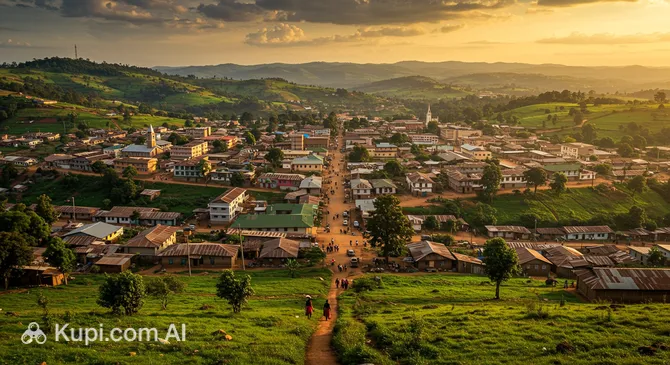
Bunia is a dynamic and vibrant administrative center of the Ituri province, located in the eastern part of Congo (DRC). The city is situated on a picturesque plateau at an altitude of over 1,300 meters above sea level, which gives it a milder and more pleasant climate compared to the sweltering lowlands of the Congo River basin. Bunia serves as an important crossroads for trade routes connecting the country's interior with neighboring Uganda.
Bunia. Illustration.
Source: Kupi.com AI
The rich history of Bunia began in 1946, when the city started developing as a strategic hub to serve the famous Kilo-Moto gold mines. Today, it is a major economic center with a population estimated by various sources to reach 900,000 people. The multinational composition of its residents and the lively atmosphere of the markets create a unique cultural layer that is fascinating to explore while walking through the city streets.
For travelers, Bunia is attractive primarily for its proximity to the majestic Lake Albert and the fertile lands of the East African Rift Valley. This is a place where the natural beauty of the African plateau meets the energy of a developing city, inviting explorers to experience the authentic rhythm of life in Eastern Congo.
Weather Overview
The city of Bunia is located in the equatorial zone; however, thanks to its position on a high mountain plateau, its climate is noticeably milder than in other tropical regions. Typical weather here is characterized by the absence of exhausting heat: average temperatures throughout the year fluctuate in a comfortable range from 20°C to 28°C. To find out the current forecast, it's worth checking the city climate before your trip.
In the annual cycle, two main periods stand out: the wet season (from October to May) and the dry season (from June to September). During the rainy months, especially in November and December, heavy downpours are possible, though they often give way to clear skies. The most favorable time to visit is considered the dry period, when precipitation is minimal, and moderate humidity and sunny days create ideal conditions for exploring the surroundings of Bunia.
Average monthly temperature
Average monthly precipitation
Interesting Facts
Bunia was founded in 1946 specifically as an administrative center to coordinate the operation of one of the largest gold mines in Africa — Kilo-Moto.
The city is located at an altitude of 1,332 meters above sea level, which creates a climate of "eternal spring" with moderate temperatures, unlike the hot jungles.
Just 20 kilometers from the city limits flows the Ituri River, which gave its name to the entire province and is an important natural artery of the region.
In recent decades, the city's population has nearly tripled, transforming it from a small settlement into a massive metropolis of about 900,000 people.
Due to its location, Bunia is considered a key "land port" connecting the eastern borders of Congo with transit routes to Uganda and onwards to the Indian Ocean.
How to Get There
The transport accessibility of Bunia is largely determined by its strategic position in the east of the country. Main transport flows connect the city with major centers of the Democratic Republic of the Congo and neighboring East African nations. To better plan your route, it is worth studying detailed information on how to get to the city in the most convenient way.
Air travel is the fastest and most reliable option. The primary gateway is Bunia Airport (IATA: BUX), which is located directly within the city limits. It regularly handles domestic flights from Kinshasa, Goma, and Kisangani. The airport provides convenient access to the center, which can be reached quickly by taxi.
Ground communication is carried out via roads connecting Bunia with Kisangani to the west and Kampala (Uganda) to the east. These routes are actively used by trade caravans and intercity buses. Railway service in this region is currently not developed, so travelers should rely on aviation or private motor transport.
The main natural treasure drawing attention to the outskirts of Bunia is Lake Albert. Located just 30 kilometers from the city, it is part of the African Great Lakes system and offers stunning panoramas of the Rift Valley. A trip to its shores allows you to enjoy views of the endless water surface and observe the traditional daily life of local fishermen.
For those interested in the industrial heritage and resources of the region, the history of the Kilo-Moto gold mines is noteworthy. Although these are industrial sites, their influence on the development of Bunia has been immense. Through local guides, you can learn about how the extraction of precious metal shaped the city's appearance and its economic significance in Africa.
No less interesting are the central markets of Bunia. These are not just places for trade, but true cultural hubs where the air is filled with the aroma of spices and the stalls are bright with colorful fabrics. A walk through the market provides an opportunity to feel the city's role as an important trading hub where the traditions of different ethnic groups meet.
Local Cuisine
The gastronomic face of Bunia is a vibrant blend of Congolese traditions and fresh products abundant on the local plateau. The diet here is based on cassava, yams, and plantains. Be sure to try the local version of fufu — a thick porridge made from root vegetables, traditionally served with various sauces and meat gravies.
One of the region's main delicacies is fish caught in Lake Albert. It is often grilled over charcoal or stewed in the famous moambe sauce, which is made from oil palm fruit pulp with added spices and nuts. This dish has a rich flavor and is a signature of Congolese cuisine.
As for drinks, freshly squeezed tropical fruit juices and local tea grown in the fertile lands of the Ituri province are popular in Bunia. Traditional palm wine can also be found. Locals and tourists most often dine in small family-run restaurants near the markets, where food is prepared from the freshest ingredients in a welcoming, home-like atmosphere.
Travel Tips
A trip to Bunia promises to be a vibrant adventure, and to ensure your visit goes as smoothly as possible, we have prepared some practical tips for planning your journey.
Clothing and Essentials: Choose light clothing made from natural fabrics, but be sure to bring a light jacket or sweater, as the altitude can make evenings cool. Don't forget comfortable closed-toed shoes and sun protection accessories.
Transport: The most convenient way to move around is by moto-taxi. Always negotiate the fare in advance. For longer trips, it is better to rent a car with a local driver.
Finances: The main method of payment is cash. Cards are rarely accepted, so keep a supply of bills in local currency or US dollars (new series). It is best to exchange currency at official points or banks in Bunia.
Health: Before your trip, be sure to consult a doctor regarding yellow fever vaccination and malaria prophylaxis. Use repellents and drink only bottled water.
Communication: The official language is French, and Swahili is also widely spoken. Learning a few basic greeting phrases in French will help you win over the locals. Wi-Fi is available in some hotels, but it is better to buy a local SIM card for connectivity.
Etiquette: In Bunia, politeness and a leisurely greeting are valued. Always ask for permission before photographing local residents or their property.
What to Avoid: You should not display expensive equipment or large sums of money in crowded places. Avoid walking alone in unfamiliar neighborhoods after dark.
Best Time: Try to plan your visit during the dry season (June to September) when roads are in better condition and the climate is most comfortable for walking.
Following these simple rules will allow you to focus on exploring the amazing culture and nature of Congo, making your vacation safe and memorable.
Entertainment & Nightlife
Entertainment life in Bunia is predominantly informal and community-based. The main centers of activity in the evening are small venues with live music, where locals gather to enjoy the rhythms of traditional Congolese rumba or modern African tunes. The atmosphere in such places is very sincere and welcoming.
The city has no large entertainment complexes or chain nightclubs; however, evening gatherings in casual cafes near busy market squares allow you to immerse yourself in the city's daily life. The main crowd here consists of active youth and traders, and there is practically no dress code, making for a very relaxed experience.
For daytime leisure, visitors often choose walks around the plateau's outskirts, which offer excellent opportunities for nature observation and landscape photography. For safety reasons, it is recommended to always use the services of trusted taxis for nighttime travel and to avoid unlit peripheral areas.
Parks & Museums
In Bunia, there are no large classical museums with massive halls; however, the role of history keepers is fulfilled by local cultural communities and markets. Here you can find unique items of decorative and applied arts that tell the story of the daily life of the Ituri province's ethnic groups. The history of the region's gold mining and the colonial period is best studied accompanied by local guides who will lead you through the city's landmark sites.
The main "parks" for residents and visitors are the natural areas on the outskirts. The surroundings of the Ituri River offer natural spots for relaxation and walks, where you can see the typical flora of the high mountain plateau. These are excellent places for outdoor picnics away from the city bustle.
Proximity to Lake Albert also provides opportunities for eco-tourism. Although this requires a short trip outside the city, the natural landscapes of the Rift Valley with their picturesque slopes and water panoramas more than replace man-made gardens and city parks, offering guests the pristine beauty of Congo.
Getting Around
The public transport system in Bunia is geared toward maximum mobility in a rapidly growing city. The most popular and fastest way to get around is the moto-taxi, known locally as "boda-boda." They are maneuverable, inexpensive, and can take you to any point in the city or to nearby suburban sites. It is advisable to agree on the fare in advance.
For group trips, minibuses and minivans are used, circulating between the main districts and markets. This is the most budget-friendly option, although these buses can be very crowded during peak hours. The main transport hubs are concentrated around the market squares, from where routes depart toward the airport and Lake Albert.
Traditional taxis (cars) are also available, and it is better to call them through hotel administrators to ensure safety and a fixed price. Payment for all types of transport is made exclusively in cash. There are no subways or trams in Bunia, so all logistics rely on the roads that connect the center with the outskirts and the scenic areas on the plateau.
Accommodation
The accommodation options in Bunia consist predominantly of small mid-range hotels and guesthouses. Most lodging choices are concentrated in the central part of the city and the area adjacent to the airport, which is convenient for transit travelers. Conditions in such hotels are usually basic but provide the necessary comfort for a short stay.
For those looking to save money, budget hotels in the areas of major markets are suitable, offering accommodation with local flavor. If you are looking for more modern amenities, consider the newer private hotels that offer gated grounds and improved service. During peak periods of business activity in the region, rooms in the best hotels can fill up quickly.
We recommend booking your stay in advance through specialized online platforms or directly, as the hotel market in the city is actively developing, but demand from business travelers and employees of international organizations remains high. Always confirm the availability of services such as stable power supply and Wi-Fi access before checking in.
Nearby Cities
The city of Bunia is an excellent starting point for exploring the country's eastern regions and border territories. Thanks to its location on a trade route, trips can be organized from here to small neighboring settlements, each possessing its own unique character and rhythm of life.
Interesting destinations include Mangai and Nioki, which offer a deeper look into the province. Another curious route could be a trip to Businga. Travel to these places is usually done by private transport or moto-taxi, which is an adventure in itself amidst the picturesque landscapes of the plateau.
City
Population
Distance
Mangai
37 188
1 km
Nioki
42 000
1 km
Businga
34 247
1 km
Watsa
24 516
1 km
Bulungu
57 168
3 km
Although the infrastructure for classic day trips is still developing here, inquisitive tourists can head toward the town of Watsa or explore routes leading to the shores of Lake Albert. Such trips allow you to see the real, non-touristy life of the region and enjoy the beauty of African nature.
Shopping & Souvenirs
Shopping in Bunia is primarily about visiting the bustling and colorful markets that are the heart of the city's economy. There are no giant shopping malls with glass storefronts here, but there is an opportunity to find truly unique items. The main shopping areas are located in the central part of the city, where rows stretch for hundreds of meters, offering everything from household trifles to exotic products.
Tourists should pay special attention to local textiles. Congolese fabrics with bright wax prints (African kanga and kitenge) are famous for their quality and incredible patterns. Also popular as souvenirs are handmade items made of wood and bone, reflecting the traditions of the masters of the Ituri plateau. At the markets, you can also find famous Congolese coffee or tea, which makes an excellent gift.
Shops usually operate from early morning until sunset, and payment is predominantly in cash using local currency. The culture of bargaining at the markets is encouraged and is an integral part of the buying process. For those seeking an authentic experience, a visit to Bunia's central market will be one of the most vivid impressions of the trip.