Support

Aitutaki Airport

About the Airport

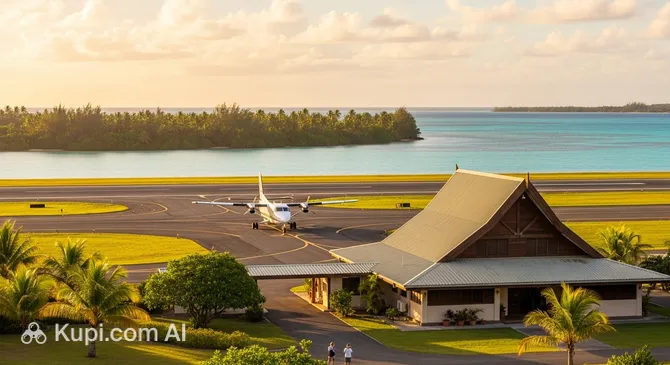
Aitutaki Airport. Source: Kupi.com Binoculars

Landing at Aitutaki Airport is not merely the end of a flight, but the beginning of an immersion into the atmosphere of true Polynesia. There is no hustle of giant aviation hubs, no long queues, or enclosed glass corridors here: the terminal is a cosy building with open walls, where a warm tropical breeze greets guests literally at the aircraft steps. Many travellers call this airport one of the most beautiful in the world, as the descent takes place over an incredible turquoise lagoon, a view that remains in one's memory forever.

Although the airport is small, it is a vital artery for the island, providing a link to the outside world and a flow of tourists to famous resorts. The atmosphere here is so relaxed that even waiting for a flight becomes part of the holiday. Instead of strict controls and noise, you are likely to be met by the smiles of locals and perhaps even chickens roaming nearby, which only adds to the place's special rustic charm.

IATA Code AIT
ICAO Code NCAI
City Arutanga (Aitutaki Island)
Distance to Centre ~7 km
Status Domestic
Passengers per Year About 65,000

Features and Advantages of the Airport

The main feature of Aitutaki Airport is its unique open-air design. The terminal has almost no solid walls, which ensures natural ventilation and allows you to enjoy the scents of tropical flowers and the ocean without leaving the building. This creates the feeling that you are not in a transport hub, but on the terrace of a large bungalow. Check-in and baggage claim are as simple and quick as possible here, without unnecessary bureaucracy.

The history of this place also deserves attention. The runway was built by American and New Zealand military forces back in 1942, during World War II. Today, this strip serves peaceful purposes, accepting flights from the only regular carrier — Air Rarotonga, whose aircraft (usually SAAB 340) make several flights a day, connecting the island with the capital, Rarotonga.

Another undeniable advantage is the picturesque approach for landing. The flight over the Aitutaki lagoon is considered one of the most spectacular routes in the South Pacific. Passengers try to take window seats to photograph the incredible shades of water and coral reefs from above. Due to the compactness of the island, the transfer from the airport to most hotels in the Arutanga area or Ootu Beach takes only 10–20 minutes.

Contact Information

Aitutaki Airport (AIT) is a small regional airport serving the island of the same name. Most services and communications are handled through the main airline flying to the island, Air Rarotonga. Direct contacts for the airport itself are difficult to find, so for most inquiries, it is recommended to contact representatives of the air carrier.

  • Official Website: The airport does not have its own separate website. Current flight schedules, ticket booking, and carriage rules are available on the official website of the airline Air Rarotonga.
  • Inquiry Service Phone: For information on flights, luggage, and other matters, it is recommended to call the Air Rarotonga office directly.
  • Airport Address: The airport is located on the island of Aitutaki, Cook Islands.
  • Email: There is no specialised email address for passengers. Contact can be made via feedback forms on the airline's website.
  • Social Media: The airport does not maintain official pages on social networks. News and updates can be tracked on the pages of the airline or the tourism authority of the Cook Islands.
  • Lost Luggage Information: All issues related to lost or damaged luggage are handled by the Lost & Found service of the airline you flew with. Please contact the carrier's counter immediately upon arrival.
  • Passenger Support Contacts: Passenger support, including assistance for people with disabilities, is provided by airline staff at the check-in counters and in the arrival zone.

How to Get to the Airport

Getting to Aitutaki Airport (AIT) on the beautiful island of Aitutaki, part of the Cook Islands, is quite simple thanks to its compact size. Distances here are short, and a trip from any point on the island rarely takes more than 15-20 minutes. It is worth noting that there is no public transport system on the island in the usual sense, such as scheduled buses or trains.

The most popular and convenient way to get to the airport is a transfer, organised in advance by your hotel or guest house. Most accommodation venues offer to meet guests upon arrival, often including this service in the cost of the stay. This eliminates the hassle of finding transport. There are also several taxi services on the island, but it is recommended to book them in advance, especially during the high tourist season. A taxi ride will cost more than other options but ensures comfort and "door-to-door" delivery.

For independent travellers, renting a scooter or car is an excellent choice. A scooter is the most popular means of transport on Aitutaki, allowing you to freely explore the island. You can rent it for the entire duration of your stay and drive yourself to the airport for your flight. Rental points are located near the airport and in the area of the main settlement, Arutanga. Car rental is also possible, which is more convenient for families with children or travellers with a large amount of luggage.

If you arrive at the airport by rented transport, there will be no problems with parking. There is a free parking zone next to the small terminal. Due to the small number of flights and the compactness of the airport, finding a free space is usually not difficult. Many tourists simply leave rented scooters in a special parking area before departure by agreement with the rental company.

Terminals and Map

Aitutaki Airport (AIT) is a prime example of a compact and cosy island airport where everything is designed for the convenience of travellers. Its structure is extremely simple and intuitive, allowing you to avoid the stress typical of large aviation hubs. The airport consists of one small terminal that serves all flights — both arriving and departing. It is built in a traditional Polynesian style, partially open, which immediately immerses you in the atmosphere of a tropical paradise.

The terminal layout is very simple. All necessary zones are located in one building. Upon entering, you will immediately see several check-in counters. The check-in and baggage drop-off process usually takes mere minutes. The departure and arrival zones are essentially parts of one large hall. After check-in, passengers pass through a small security check and enter a cosy waiting area. For arriving passengers, the process is even simpler: they enter the terminal directly from the airfield and collect their luggage almost immediately. There are no transfers between terminals, as there is only one.

Thanks to the airport's small size and the low number of flights, all procedures are very quick. It is recommended to arrive at the airport approximately 60 minutes before the departure of a domestic flight, but check-in and security rarely take more than 10–15 minutes. Navigating the terminal will not cause any difficulties — it is practically impossible to get lost here. This is one of the advantages of travelling through such paradisiacal places as the Cook Islands, where even the airport contributes to a relaxed start to your holiday.

Airport History

The history of Aitutaki Airport (AIT) is a fascinating journey from a strategic military object to a gateway to one of the most picturesque corners of Polynesia. The airfield was built in 1942 during World War II through the joint efforts of US Marines and New Zealand military forces. Its initial task was to serve as a forward airbase for the Allies in the Pacific Ocean.

After the war ended, the airfield's military past gave way to a peaceful mission. It became a key link in the development of civil aviation in the Cook Islands. The most romantic and famous period in the airport's history was its participation in the legendary "Coral Route", operated by TEAL (the predecessor of Air New Zealand) from 1952 to 1960. Although the luxurious Short Solent flying boats landed directly in the turquoise lagoon, the airfield itself played an important role in ground handling and supporting this exotic route connecting Fiji, Samoa, Tahiti, and the Cook Islands.

With the development of tourism, the runway and terminal have been modernized repeatedly to accommodate modern turboprop aircraft, such as those used by the local airline Air Rarotonga. These updates have allowed Aitutaki to transform from a remote island into one of the world's most desirable tourist destinations. Today, the airport, built for military needs, serves as a symbol of peace and hospitality, daily welcoming travellers eager to see the famous lagoon.

Services and Facilities

Aitutaki Airport (AIT) is a small and cosy air hub serving domestic flights in the Cook Islands. Given its compact size, the range of services here is basic but sufficient for a comfortable wait for a flight. The terminal is an open building in Polynesian style, which immediately immerses you in the atmosphere of a tropical holiday. There is a small café where you can buy refreshing drinks, snacks, and coffee, as well as a souvenir shop with products from local craftsmen.

The airport does not have specialised VIP halls or business lounges. A general waiting area with seats is provided for all passengers. Opportunities for charging electronic devices are limited, so it is recommended to charge gadgets in advance. Wi-Fi access is generally absent or provided for a fee through local telecom operators. There are no bank branches or full-service currency exchange points in the terminal building; these operations are best done in advance in town or at your hotel.

The airport is adapted to serve passengers with limited mobility, as the terminal is single-level and has no stairs. Staff are always ready to provide necessary assistance during boarding and disembarking, however, it is recommended to inform the airline in advance about the need for special services. There are no special play areas for passengers with small children, but basic amenities are available in the restrooms. Medical assistance is limited to first aid; the nearest hospital is a few minutes' drive away.

There are no hotels, conference halls, or business centres on the airport territory. However, the island of Aitutaki is famous for its resorts and bungalows, most of which are located 5-15 minutes by car from the airport. Many hotels organise transfers for their guests, meeting tourists directly at the terminal exit.

Where to Eat

When planning a snack at Aitutaki Airport (AIT), it is important to remember that this is a very small and cosy regional airport, serving mainly domestic flights. There is no division into terminals or large food courts here, as seen in international hubs. However, you will certainly have the opportunity to have a snack and drink coffee before departure.

In the main and only hall of the airport, accessible before security control (landside), a small café or kiosk usually operates. Its opening hours are directly linked to the flight schedule — the establishment opens to serve passengers of arriving and departing aircraft and may be closed in the intervals between them.

The assortment typically includes basic options for a quick snack. Here you can buy:

  • Coffee, tea, bottled water, and soft drinks.
  • Light snacks such as crisps, sandwiches, and pastries.
  • Sometimes local delicacies are on sale, for example, fresh tropical juices or pastries with coconut — a great way to enjoy the flavours of the islands one last time.

Prices at the airport may be slightly higher than in cafés in the city, which is standard practice for air terminals. Regarding special dietary requirements (Halal, vegetarian, gluten-free, and others), the choice will be extremely limited or non-existent. If you have strict dietary restrictions, it is strongly recommended to bring food with you. For a full lunch or dinner, it is better to choose one of the establishments in Arutanga or near your hotel before arriving at the airport.

Tips for Travellers

To ensure your journey through Aitutaki Airport goes as smoothly as possible, take advantage of our tips. Despite the modest size of the terminal, proper preparation will help avoid unnecessary stress and allow you to fully enjoy the atmosphere of this paradisiacal corner of the Cook Islands.

Arrival Time Recommendations: We advise arriving at the airport at least 1.5 hours before the departure of a domestic flight. This time will be enough to check in without rushing, drop off luggage, and take the best seats to wait for boarding while admiring the tropical landscapes.

Check-in and Security: The check-in and security control process at Aitutaki Airport usually proceeds very quickly and in a relaxed atmosphere. There are no long queues or bustle inherent in large airports. The staff are friendly and always ready to help.

Seat Selection on the Plane: A surefire tip for flights to Aitutaki is to choose a window seat. The views of the turquoise lagoon, coral reefs, and tiny islets (motu) from the air are simply unforgettable. This is your first and last chance to see the famous lagoon in all its glory from a bird's-eye view.

Hand Luggage: Place all valuables, documents, medicines, and chargers in your hand luggage. Remember the strict biosecurity rules: it is forbidden to bring fresh fruit, vegetables, plants, and certain food products onto the island without declaration. This is done to protect the unique ecosystem of Aitutaki.

Connecting Passengers: Most travellers arrive in Aitutaki via the main international airport in Rarotonga. Ensure you have enough time for the transfer (at least 2-3 hours is recommended), and check with the airline if your luggage will be checked through automatically.

Customs Control: Since the airport serves domestic flights, there is no customs control as such. However, be prepared for luggage checks regarding compliance with biosecurity rules.

Saving Time and Money: Book flight tickets in advance to get the best price. To avoid paying for excess weight, carefully study the baggage allowance rules of your airline (they are usually quite strict on local flights). There is only a small café at the airport, so bringing a bottle of water and a light snack is a good idea.

In Case of Flight Delay: Flight delays can happen due to weather conditions. In this case, remain calm. Leisure opportunities at the airport are limited, so have a book, headphones, or a charged tablet with you. Airline representatives will provide information about the new departure time. Treat this as an additional opportunity to enjoy the leisurely rhythm of island life.

Airports in nearby cities

Reached the end of the page?

That means the route is fully explored