Support

Bata Airport

About the Airport

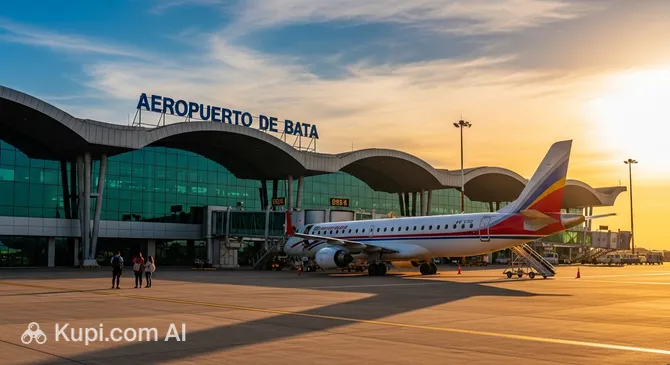
Bata Airport. Source: Kupi.com Binoculars

Bata Airport is the key aerial gateway to the continental part of Equatorial Guinea, opening the way for travellers to the colourful region of Rio Muni. This aviation hub serves as a vital bridge connecting the mainland with the island capital of Malabo and impresses with its strategic importance for the entire country. Located just a few minutes' drive from the Atlantic coast, it welcomes guests with a tropical atmosphere and serves as a starting point for exploring the natural beauty and business centre of the region.

IATA Code BSG
ICAO Code FGBT
City Bata
Distance to Centre ~7 km
Status International
Annual Passengers About 250,000

Airport Features and Advantages

One of the main technical points of pride for the airport is its runway. Its length is over 3 kilometres, which allows it to accommodate almost all types of modern aircraft, including wide-body liners. This makes Bata Airport an important reserve and strategic hub in Central Africa.

The airport is characterised by exceptional transport accessibility. Due to its proximity to the city, the transfer to most hotels and business centres takes minimal time, which is particularly appreciated by business travellers. The compactness of the terminal eliminates long walks, making navigation inside intuitively clear and simple.

The air harbour plays the role of the main connecting link between Bioko Island and the mainland. The "Bata — Malabo" route is considered one of the busiest and most frequent in the country, operating as an "air bridge". Additionally, the airport serves international flights to neighbouring countries such as Gabon and Cameroon, strengthening the city's status as an important regional centre.

Contact Information

Finding direct and up-to-date contact details for Bata Airport can be challenging. Most issues related to flights, luggage, and service are most effectively resolved through your airline.

  • Official Website: Bata Airport does not have a dedicated official website. For information on flights, check-in, and carriage regulations, it is recommended to consult your airline's website.
  • Information Desk Phone: It is difficult to find a reliable and publicly available phone number for the airport information desk. For all urgent matters, call your airline's representative office directly.
  • Airport Address: The airport is located in the city of Bata, Litoral Province, Equatorial Guinea.
  • Email and Social Media: The airport does not have official pages on social networks or a public email address.
  • Lost Luggage Information: In case of loss or damage to luggage, you should immediately contact the Lost & Found service of your airline at the arrival airport. The airport does not process such requests directly.
  • Passenger Support Contacts: For questions related to tickets, flight cancellations or delays, as well as special needs, please contact the customer support service of the airline you are flying with.

How to Get to the Airport

Bata Airport (BSG) is located in close proximity to the city of the same name, making the transfer to it quick and simple. The trip from the centre of Bata to the terminal usually takes no more than 15-20 minutes, depending on the traffic situation.

Taxi or Private Transfer is the most reliable and convenient way to get to the airport. Cars can be found in the city or booked in advance through your hotel. The cost of the trip is usually low, however, it is strongly recommended to agree on the price with the driver before setting off, as not all cars are equipped with taximeters. This option guarantees comfort and arrival exactly in time for departure.

There is no direct public transport, such as regular buses or trains to the airport, in the city. Nevertheless, locals often use the services of shared taxis (minibuses), which run along the main roads. This is a more economical but less predictable option, which may require transfers and knowledge of routes. It is suitable more for experienced travellers wishing to immerse themselves in the local atmosphere.

For those who value independence, an excellent solution would be car rental. There are several rental companies in Bata. With a rented car, you can not only drive comfortably to the airport but also travel freely around the continental part of Equatorial Guinea. The airport has parking where you can leave a car for a short or long term.

Terminals and Map

Bata Airport (BSG) is a modern and compact aviation hub serving the continental part of Equatorial Guinea. Its structure is extremely simple and understandable for travellers, which makes orientation on-site an easy task. The airport complex consists of one passenger terminal, which serves both domestic and international flights. This eliminates the need for transfers between buildings and minimises the risk of getting lost.

The terminal layout is intuitive. Typically, the first level houses the check-in zone with several counters, the baggage handling and claim area, as well as the arrivals hall with customs control. The departure zone is located here as well; after completing check-in, passengers proceed to pre-flight security screening, followed by a comfortable waiting hall with boarding gates. Thanks to the small size of the airport, all key points — from the entrance to the gate — are within walking distance of each other.

A feature of Bata Airport is its relative novelty and simplicity. There is no complex multi-level navigation here, unlike in major global hubs. The check-in and screening process usually proceeds quite quickly, however, as in any airport, waiting times may increase during peak hours or before the departure of popular flights. It is recommended to arrive at the airport at least 2 hours before the departure of a domestic flight and 3 hours before an international one, to complete all formalities without haste.

For comfortable navigation through the terminal, simply follow the standard signs, which are duplicated in several languages (mainly Spanish and French). Since all services are concentrated in one building, finding the information desk, a café, or the boarding gate will not be difficult. Airport staff are always ready to assist if you have any questions. The main advice is to prepare all necessary documents in advance and follow the signs, and your stay at Bata Airport will be as calm as possible.

Airport History

Bata Airport (BSG) is not just the air gateway to the largest city in the continental part of Equatorial Guinea, but also a vivid symbol of the country's rapid modernisation. Its history traces the path from a modest colonial-era airfield, opened in 1964, to a modern international transport hub capable of handling large passenger flows and long-haul flights.

Originally built in the final years of Spanish rule, the first airfield in Bata was a modest facility with a short runway. After the country gained independence in 1968, its development was slow, and for decades it served primarily domestic and regional flights, unable to accommodate large aircraft.

A radical transformation occurred in the early 2000s against the backdrop of the country's economic growth. As part of a large-scale infrastructure modernisation programme, the old airport was almost completely rebuilt. A new runway with a length of about 3,300 metres was constructed, and in 2008, a new, spacious passenger terminal was ceremoniously opened. This reconstruction, carried out with the participation of international contractors, fundamentally changed the capabilities of the air harbour.

A real test for the updated infrastructure was the hosting of the African Cup of Nations. The city of Bata was one of the key venues for the tournament in 2012 and 2015. The airport successfully coped with the colossal load, accepting numerous charter flights with sports teams, official delegations, and thousands of fans, which clearly demonstrated its new international status.

Today, Bata Airport is a modern and well-equipped transport hub. It plays a key role in the economic and social life of the region, ensuring reliable communication not only with the capital Malabo but also with other international destinations, promoting the development of business and tourism in the continental part of Equatorial Guinea.

Services and Amenities

Bata Airport (BSG), one of the key air hubs of Equatorial Guinea, provides passengers with a set of basic services and amenities for a comfortable wait for their flight. Although the terminal infrastructure is not comparable to major international hubs, everything necessary for travellers is available here.

At the airport, you will find several cafés where you can have a snack before departure, drink coffee, or enjoy refreshments. The assortment typically includes sandwiches, pastries, and local snacks. Small shops are also operating, where you can purchase souvenirs, press, and essential goods. The Duty-Free zone offers a standard selection of perfumes, beverages, and tobacco products.

For a comfortable wait for the flight, general halls are equipped in the airport. Business class passengers and loyalty programme members can use the VIP Lounge, which offers a more secluded atmosphere and additional services. Regarding connectivity, Wi-Fi is available in the terminal, however, the conditions of its provision (paid or free) should be checked on-site. Special stands and sockets are provided in waiting areas for charging gadgets.

Currency exchange points and ATMs operate in the terminal building, allowing passengers to resolve financial matters upon arrival or before departure. A medical point is available for first aid. Families with small children and passengers with reduced mobility are recommended to notify their airline in advance about the need for special assistance to organise accompaniment upon arrival or before departure.

There are no hotels within the airport building itself. The nearest hotels are located in the city of Bata, which can be reached by taxi. Specialised conference rooms or business centres are not provided at the airport. For business meetings, it is better to use the services of hotels in the city.

Dining

When planning a flight from the airport of Bata (BSG), it is worth considering that this is a small regional airport, and the choice of dining establishments here is quite limited. Passengers have access to basic options for a snack before departure, but one should not count on a variety of restaurants, as in large international hubs.

The main dining infrastructure is generally concentrated in the main hall of the airport. Here you can find a small café or snack bar. The menu usually features simple and quick dishes: sandwiches, pastries, crisps, as well as hot and cold beverages, including coffee, tea, and bottled water. For a full lunch or dinner, it is recommended to eat at one of the city's restaurants before arriving at the airport. Sometimes in local cafés, you can find simplified versions of Equatorial Guinea cuisine, for example, snacks with fish or fried plantains, which gives an opportunity to experience the local flavour one last time.

Passengers with specific dietary needs (vegetarians, vegans) or dietary restrictions (gluten-free, Halal meals) are strongly advised to bring food with them. It is difficult to guarantee the availability of special dishes at the airport. Prices in airport cafés are generally higher than in the city. The opening hours of establishments are usually tied to the flight schedule — they are open during waiting hours for departures and may be closed at other times.

Most often, one or two cafés are located in the public zone (landside), before passing security control. After screening, in the departure zone (airside), there may be a small kiosk with drinks and packaged snacks. These options are ideal for a quick snack, but not for a long wait in comfort.

Travel Tips

Planning a trip through Bata Airport (BSG) will be easier if you take into account a few local peculiarities. Here are some tips that will help you orient yourself and make your journey more comfortable.

Arrival Time at the Airport: For international flights, it is recommended to arrive at the airport at least 2.5-3 hours before departure, and for domestic flights — 1.5-2 hours. Registration and control procedures may take longer than expected, so a buffer of time will not be superfluous.

Check-in and Security: Ensure you have all necessary documents at hand: passport, visa (if required), and ticket. Procedures at Bata Airport are standard but may not proceed as quickly as in major international hubs. Be prepared for standard screening of hand luggage and personal belongings. Staff speak mainly Spanish and French; knowing basic phrases in these languages may be useful.

Choosing a Seat on the Plane: Standard recommendations apply here too. Choose a window seat for beautiful views of the Atlantic Ocean coast or the dense jungles of Equatorial Guinea. If the ability to stand up freely is important to you, your choice is an aisle seat.

Hand Luggage: You can take electronics, documents, valuables, and medicines in your hand luggage. Liquids are permitted in containers up to 100 ml, packed in a transparent bag. It is strictly forbidden to carry weapons, explosives, and sharp objects. Always check baggage allowance rules with your airline before departure.

Transit Passengers: If you have a connecting flight, check in advance whether you will need to collect and re-register your luggage. The airport is not very large, but it is better to ask airline staff for transit instructions immediately upon arrival.

Customs Control: Upon arrival in Equatorial Guinea, be prepared to fill out a migration card and possibly a customs declaration. Customs officers may inquire about the purpose of your visit and the contents of your luggage. There are restrictions on the import and export of local currency and certain goods, so familiarise yourself with current regulations in advance.

Saving Time and Money: If possible, complete online check-in for your flight. Exchanging currency is more favourable in the city, not at the airport. If you take a taxi, agree on the trip price with the driver before you get into the car to avoid misunderstandings.

Flight Delays: In case of a flight delay or cancellation, first contact your airline representative at the airport. Depending on the length of the wait and the carrier's policy, you may be offered drinks, meals, or even hotel accommodation. Keep all receipts for unforeseen expenses.

Reached the end of the page?

That means the route is fully explored