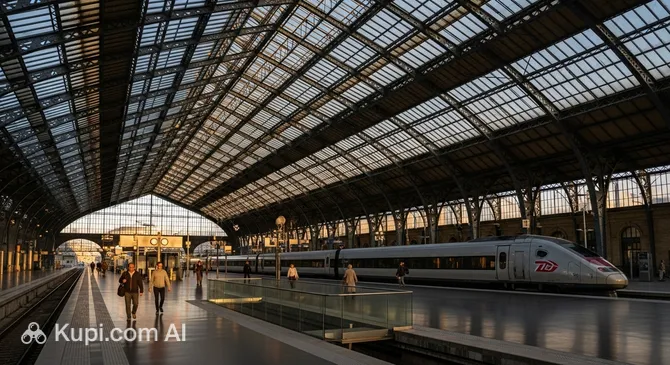
Bordeaux Saint-Jean Station (Gare de Bordeaux-Saint-Jean) is the largest railway hub in the Nouvelle-Aquitaine region and one of the most beautiful stations in France. Located south of the historic centre, it welcomes millions of passengers annually, connecting Bordeaux with Paris, Toulouse, and the Spanish border via high-speed TGV trains. The station building impresses with its monumental architecture and a huge metal train hall covering the tracks, creating a sense of spaciousness and light.
It is important for passengers to know that the station consists of three main zones: Hall 1 and Hall 2 are located in the historic building and handle most departures, whilst the new Hall 3 (Belcier), opened on the Rue des Terres de Borde side, provides convenient access to car parks and office districts. All halls and platforms are connected by a wide underground passage equipped with escalators and lifts. The main entrance with the tram stop is located on the side of Hall 1 and 2, offering a view of the city.
Contact Information
Official website: gares-sncf.com (Bordeaux Saint-Jean section)
Information phone: 3635 (single SNCF number)
Address: Rue Charles Domercq, 33800 Bordeaux, France
Opening hours: Daily from 04:30 to 01:00 (Fridays until 01:30)
Luggage storage: Located in Hall 1 (Espace Services), open daily, baggage X-ray screening available
Accessibility:Accès Plus service to assist passengers with reduced mobility (booking 48 hours in advance is recommended)
How to Get There
Getting to Bordeaux Saint-Jean Station is very simple thanks to a well-developed public transport network. The most popular method is the tram. Line Tram C and line Tram D stop right in front of the main entrance (stop Gare Saint-Jean). The trip from the central Place des Quinconces takes about 10–15 minutes.
For those travelling from Bordeaux-Mérignac Airport, there is a direct shuttle bus (Navette 30') that will take you to the station in approximately 30–40 minutes depending on traffic. City bus routes are also available (for example, lines 1, 9, 31), with stops located around the station complex.
If you prefer a taxi, ranks are located at the exits of Hall 1 and the new Hall 3 (Belcier). A walk from the historic centre (Saint-Michel district) takes about 20 minutes, though this may be tiring with heavy luggage. By car, you can use one of the two multi-level car parks (P1 and P2) located in the immediate vicinity.
Services and Amenities
Bordeaux Saint-Jean Station provides a full range of services for a comfortable wait. Free and unlimited Wi-Fi is available within the building (network _SNCF GARE_GRATUIT). Charging stations with sockets and USB ports are provided for gadgets in waiting halls and on platforms. Tickets can be purchased at automatic kiosks (which accept cards) or at long-distance ticket counters in Hall 1.
For the convenience of travellers, there are paid restrooms (clean and modern), automatic luggage lockers, and a lost and found office. A piano is often placed in the main hall, available for anyone to play. Special attention is paid to passengers with reduced mobility: there are ramps, lifts to the passage, and a dedicated waiting area for the assistance service.
Where to Eat
It is difficult to stay hungry at the station. Several popular chain establishments for a quick bite are located inside the complex, such as McDonald’s, Brioche Dorée, and Paul, where you can buy sandwiches and pastries. For coffee lovers, there is a Starbucks and small coffee points. The average bill for a coffee and a croissant is around 5–7 Euros.
If you have time for a full meal, consider the restaurants in the immediate vicinity of the station on Rue Charles Domercq. There you can find classic French brasseries offering a daily lunch menu (plat du jour) for 15–20 Euros. There is also a small Carrefour Express supermarket and a Relay newsstand at the station itself, where you can buy water and snacks for your journey.
Station History
The history of Bordeaux Saint-Jean Station began in the mid-19th century, but it acquired its current majestic appearance after a massive reconstruction completed in 1898. The main jewel is the huge metal roof (train hall) spanning 56 metres, built by the firm Daydé & Pillé, which allowed steam trains to be serviced comfortably under cover.
A crucial stage in modern history was the arrival of the high-speed LGV line in 2017, which reduced the travel time to Paris to 2 hours. For this event, the station was completely renovated: the historic façade was restored, the new Belcier terminal was built, and passenger services were modernised, turning the station into a contemporary multimodal hub that preserves the spirit of the industrial era.
Passenger Tips
Arrive at the station at least 20–30 minutes before your train departs, especially if you need to find the correct platform and carriage — TGV trains can be very long (double sets). Boarding for high-speed trains usually closes 2 minutes before departure. Watch the information screens closely: the platform is announced approximately 20 minutes before the train arrives.
An important detail: if you have an old-style paper ticket (without a full-page QR code), it must be validated (stamped) in the yellow machines at the entrance to the platform. Electronic tickets on a smartphone do not need to be validated; simply show the barcode to the conductor or scan it at the gate. Be vigilant with personal belongings in crowded places. The station closes for several hours at night, so staying inside overnight is not possible.