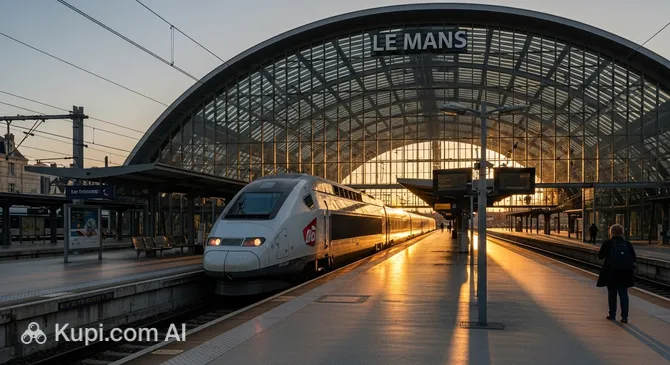
Le Mans Railway Station (Gare du Mans) is a key transport hub for the Pays de la Loire region, connecting western France with Paris. This modern and spacious terminal serves both high-speed TGV trains and regional TER expresses, ensuring a comfortable journey for thousands of passengers daily. The station building successfully combines functionality with convenient access to urban infrastructure, serving as an important gateway to the historic city of Le Mans.
It is important for passengers to know that the station has two main exits: the North Exit (Gare Nord), leading to the city centre and tram lines, and the South Exit (Gare Sud), where parking facilities and office buildings are located. Navigation inside is intuitive thanks to clear signage, and transitions between platforms are equipped with escalators and elevators.
Official website: garesetconnexions.sncf (Gare du Mans section)
Helpline: 3635 (unified SNCF line, call charges depend on the operator)
Address: Place du 8 Mai 1945, 72000 Le Mans, France
Opening Hours: Daily from 04:30 to 00:15 (until 00:45 on Fridays)
Luggage Storage: The availability of automatic lockers should be checked on-site, as security regulations frequently change; a manual left luggage service is often available.
Accessibility: The Accès Plus service operates to assist passengers with reduced mobility (booking 48 hours in advance is recommended).
How to Get There
Getting to Le Mans station is very simple thanks to its central location and integration into the city's transport network.
Public Transport: A tram stop (Gares) is located right at the North Exit. Lines T1 (Université — Antarès) and T2 (Bellevue — Espal) pass through here, connecting the station with key districts of the city. Numerous bus routes of the SETRAM network also stop here.
Taxi and Car: Taxi ranks are located at both exits (Nord and Sud). For private vehicles, there are quick drop-off zones (dépose-minute) and paid parking lots, including a multi-level car park on the south side.
On Foot: You can walk from the station to the central Place de la République in approximately 15–20 minutes via Avenue du Général Leclerc. A walk to the historic Cité Plantagenêt district will take about 25 minutes.
Services and Amenities
Le Mans station offers a wide range of services for a comfortable wait before your journey. The main hall houses ticket counters and automatic ticket terminals (yellow for SNCF and blue for regional lines). Free unlimited Wi-Fi is available throughout the premises (login via the portal is required).
For the convenience of travellers, the following are provided:
Spacious waiting areas with seating.
Zones for charging mobile devices ("Power & Station").
Paid restrooms, maintained in a clean condition.
Photo booths and vending machines for newspapers and magazines.
A piano for free use, creating a cosy atmosphere.
The station is fully adapted for people with disabilities: there are elevators, ramps, and special restroom facilities.
Dining Options
There are several options within the station and in the immediate vicinity to satisfy your hunger before your journey.
Quick Bites: Inside the terminal, chain bakeries (such as Brioche Dorée or Paul) and Relay shops usually operate, where you can buy sandwiches, salads, pastries, and beverages. This is an ideal option for taking food with you onto the train.
Coffee and Beverages: Vending machines with coffee and snacks are placed throughout the station. The average cost of a cup of coffee is around 2–3 Euros.
Full Meal: If you have time, it is worth exiting via the North Exit to Place du 8 Mai 1945. There you will find a range of classic French brasseries and cafes where you can order a hot lunch. The average bill in such establishments is between 15–25 Euros.
Station History
The history of railway communication in Le Mans began in the mid-19th century. The first trains arrived here in 1854, when the line connecting Paris and Rennes was opened. Since then, the station has become a vital hub contributing to the economic development of the region.
A key stage in modern history was the arrival of the high-speed TGV Atlantique line in 1989. This event radically reduced travel time to Paris (to just 55 minutes) and required a massive reconstruction of the station. The station was modernised, receiving new glass facades and expanded infrastructure to cope with increased passenger traffic while preserving elements of its historical heritage.
Travel Tips
Arrival Time: It is recommended to arrive at the station at least 20 minutes before the train departs. Boarding for TGV trains usually closes 2 minutes before departure, and the doors lock automatically.
Tickets and Validation: If you have an older-style paper ticket without a reserved seat, do not forget to validate (stamp) it in the yellow machine before entering the platform. Electronic tickets and printouts with a QR code do not need to be validated.
Luggage: Be sure to attach a tag with your name and contact details to all pieces of luggage — this is a security requirement in France. Do not leave belongings unattended, as this may lead to the evacuation of the station.
Overnight Stay: The station closes for the night after the arrival of the last train. It is not permitted to remain inside the building until opening time in the morning, so please arrange accommodation in advance if you have a long overnight layover.
We use cookies and services to collect user information. This is essential for the functioning of the site and for marketing purposes. You can find out more in .
Other popular routes
Where travelers fly most — pick a route and check prices