Support

Mont-de-Marsan

About the Airport

The Mont-de-Marsan Airport, also known as Air Base 118 "Colonel Constantin Rozanoff," is not merely an air gateway but the true aviation heart of the Nouvelle-Aquitaine region in France. Its uniqueness lies in its dual purpose: it is one of the key facilities for the country's Air and Space Force and, simultaneously, a platform for general civil aviation. Although you will not find regular commercial flights here, the airport plays a vital role in the life of the city and attracts aviation enthusiasts from all over Europe.
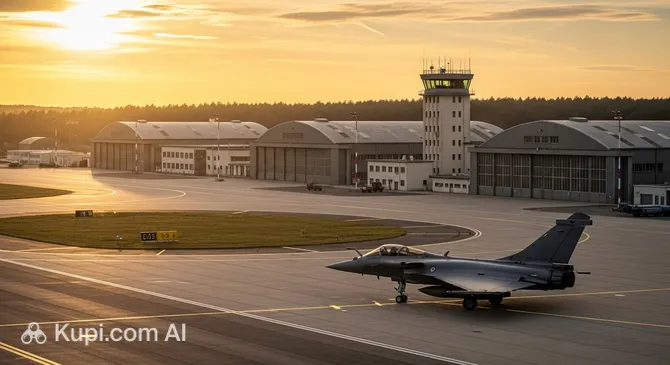
Mont-de-Marsan. Illustration.
Source: Kupi.com AI
PropertyValue
IATA CodeXMJ
ICAO CodeLFBM
CityMont-de-Marsan
CountryFrance
TimezoneEurope/Paris
ScheduleOnline Timetable

Features and Advantages of the Airport

The main feature of Mont-de-Marsan Airport is its military status. The famous Dassault Rafale fighter jets are based here, and exercises and tests of new aviation equipment take place regularly. Periodically, the airbase hosts open days and air shows, which become grand events for the entire region and attract thousands of spectators.

For civil needs, the airport is used by flying clubs, private pilots, and business aviation. This makes it an important hub for light aviation enthusiasts. Thanks to its location just a couple of kilometers from the city center, getting there is effortless. Although for most tourists this airport will not be an arrival point, it is undoubtedly a significant landmark and a symbol of France's aviation power.

Contact Information

The Mont-de-Marsan Airport (XMJ) is primarily an active military airbase (Base Aérienne 118) that does not serve regular commercial passenger flights. Consequently, most standard airport services for civil passengers are unavailable here. Below is the main contact information related to the airbase.

  • Official Website: There is no specialized website for commercial passengers. Information about the airbase can be found on the resources of the Ministry of Defence of France.
  • Information Desk Phone: As regular civil flights are not operated, there is no separate information service for passengers. The general phone number for the airbase is: +33 5 58 46 72 00.
  • Address: Avenue du Colonel K. W. Rozanoff, 40118 Mont-de-Marsan, France.
  • Email: There is no public email address for general or passenger inquiries.
  • Social Media: Official social media accounts for informing passengers are not maintained.
  • Lost Luggage Information: Baggage tracing services are not relevant as the airport does not accept commercial flights with checked luggage.
  • Passenger Support Contacts: Due to the military status of the facility and the absence of civil transport, a passenger support service has not been established.

How to Get to the Airport

If you need to get to the airfield in the city of Mont-de-Marsan, it is important to understand its specific nature. The Mont-de-Marsan Aerodrome (Aérodrome de Mont-de-Marsan) is primarily an active military airbase (Base aérienne 118), which does not serve regular commercial passenger flights. Access to the territory may be restricted. Nevertheless, you can reach it from the city center in several ways.

Public Transport is the most economical option. The Tma (Transports Marsan Agglomération) city bus network serves the agglomeration area. Some routes pass near the airbase, but you will likely need to walk some distance from the nearest stop. There is no direct rail or metro connection to the airfield. A bus trip from the city center will take about 15-20 minutes, excluding waiting time and walking.

Taxi or Private Transfer is the most convenient and fastest method. A trip from the center of Mont-de-Marsan to the airbase will take just 5-10 minutes, as the distance is only a few kilometers. This is a time-predictable and comfortable option, especially if you are carrying luggage. The cost of the trip will be reasonable due to the short distance.

Car Rental offers maximum flexibility, especially if you plan to travel around the region. Several rental agencies operate in Mont-de-Marsan. You can easily reach the airbase by car via the D824 road. Regarding parking, its availability and rules should be clarified in advance depending on the purpose of your visit, as there are no standard parking zones for passengers here like in civil airports.

For most tourists traveling to this part of France, the main air gateways are the large commercial airports located nearby. From there, you can reach Mont-de-Marsan by train, bus, or rental car. The nearest options include:

  • Pau Pyrénées Airport (PUF) — approximately 60 km away.
  • Tarbes-Lourdes-Pyrénées Airport (LDE) — approximately 90 km away.
  • Biarritz – Anglet – Bayonne Airport (BIQ) — approximately 96 km away.
  • Bordeaux Airport (BOD) — the largest airport in the region, approximately 103 km away.
  • San Sebastián Airport (EAS) in neighboring Spain — approximately 120 km away.

Terminals and Map

When planning your trip, it is important to know that Mont-de-Marsan Airport (XMJ) is primarily an active military airbase (Base Aérienne 118) and does not serve regular commercial passenger flights. This fact defines its entire structure and features.

Due to its primary military purpose, Mont-de-Marsan Airport lacks civil passenger terminals in the traditional sense. There is no standard infrastructure for tourists here: no check-in counters, waiting lounges, departure and arrival zones for commercial flights, nor security checkpoints for the general public. Consequently, questions about navigation between terminals, passenger airport maps, and procedure times are not relevant for this facility.

Travelers heading to Mont-de-Marsan or the Nouvelle-Aquitaine region are advised to consider the nearest international civil airports. The most convenient options are Bordeaux-Mérignac Airport (BOD) or Pau Pyrénées Airport (PUF), which offer a full range of services for passengers and have regular flight connections.

Airport History

The history of Mont-de-Marsan Airport (XMJ) is unique, as it is not an ordinary civil hub but one of the most significant airbases in FranceAir Base 118 "Colonel Rozanoff" (Base aérienne 118 "Colonel Rozanoff"). Its history dates back to the dawn of aviation: the airfield was founded in 1911-1912 as one of the country's first training centers for military pilots.

A key moment in the base's history was in 1945, when the Military Air Experiment Centre (CEAM) was transferred here. Since then, Mont-de-Marsan has transformed into the main proving ground for testing and evaluating all new aircraft entering service with the French Air Force. It was here that the legendary Mirage fighters were tested, and in our days — the ultra-modern Rafale. This defined the base's main vector of development: constant technological improvement and infrastructure modernization to work with advanced equipment.

The base is named after Constantin "Kostia" Rozanoff, an outstanding French test pilot of Russian origin, who tragically died during a test flight in 1954. Throughout its long history, the airfield has not set records in civil transport, but its achievements lie in the military-technical sphere, playing a decisive role in maintaining the combat readiness and technological superiority of the Air Force of France.

Thus, the history of the airport in Mont-de-Marsan is, above all, a history of innovation, bold trials, and service to national defence. For tourists, it is an interesting example of how a military facility can be an integral part of the identity and pride of an entire city.

Services and Amenities

Mont-de-Marsan Airport (XMJ) has its own unique features that are important for travelers to consider when planning a trip. Since this air hub functions primarily as a military base and accepts a limited number of civil flights or business aviation, it lacks the extensive infrastructure typical of large commercial airports.

Passengers should not expect to find restaurants, cafes, or Duty Free shops inside the terminal. It is recommended to arrange for snacks and water in advance or visit dining establishments in the city of Mont-de-Marsan itself, located in the immediate vicinity of the airfield.

Specialized VIP lounges, business centers, or conference rooms are not provided on the airport territory. Access to Wi-Fi and charging stations may be limited or non-existent, so travelers should carry charged mobile devices and have their own internet access.

Regarding medical services and facilities for passengers with children, the infrastructure here is minimal and limited to basic first aid supplies. For passengers with reduced mobility, service is usually organized individually upon prior request when booking a private aviation flight.

There are no hotels directly on the airport grounds. However, the convenient location allows for quick access to the city center, where various accommodation options are available — from small guest houses to comfortable city hotels.

Where to Eat

When planning a trip through Mont-de-Marsan Airport (XMJ), travelers should take its specifics into account. This is a small airfield used primarily for military and private aviation, so passenger infrastructure here is minimally developed. There are absolutely no restaurants, cafes, or dining areas on the airport territory.

In this regard, it is not possible to provide information on specific dishes, prices, opening hours, or the availability of special menus (vegetarian, gluten-free, halal, etc.) for the airport. Passengers should not count on a full meal or even a quick snack while waiting for a flight. At best, vending machines with drinks and snacks might be available, but their presence and assortment are not guaranteed.

We strongly recommend taking care of meals in advance. The best solution would be to visit one of the numerous establishments in the city of Mont-de-Marsan itself. This is a wonderful opportunity to experience the gastronomic traditions of the Gascony region, known for its exquisite cuisine throughout France, and enjoy local delicacies before your departure.

Travel Tips

Traveling through Mont-de-Marsan Airport requires a special approach to planning, given its specific nature as a joint-use facility. To ensure your departure goes smoothly, we have prepared a number of useful recommendations.

Arrival Time and Check-in. Since the airport does not serve a mass flow of passengers, long queues are rare here. Nevertheless, it is recommended to arrive 1–1.5 hours before departure. This time will be sufficient to complete all formalities without rushing. Please note that due to its status as a military base, security checks may be more thorough and strict than in civil airports. Keep your documents ready and ensure they are in perfect order.

Seat Selection. If your carrier provides the option to select a seat, try to occupy a window seat. Take-off and landing over the Landes region reveal stunning views of endless pine forests and the picturesque landscapes of southwestern France. This is an excellent opportunity to take beautiful aerial photos.

Hand Luggage. Carry-on rules are standard for the European Union but may vary depending on the type of aircraft (private jet or charter). It is prohibited to carry sharp or cutting objects, as well as liquids in containers larger than 100 ml, in hand luggage. We recommend packing electronics (laptops, tablets) so that they can be easily removed for scanning at the security checkpoint.

Recommendations for Transit Passengers. Mont-de-Marsan Airport is not a transfer hub. If you have a complex connection planned, you will most likely have to travel to major hubs (for example, in Bordeaux or Pau) by ground transport. Allow a sufficient time buffer for the transfer, taking possible traffic jams into account.

Customs Control. Standard French customs rules apply. If you are arriving from outside the EU, be prepared to declare cash amounts exceeding 10,000 euros, and observe limits on the import of tobacco and other restricted goods. The procedure usually passes quickly due to the small number of passengers.

Saving Time and Money. The main advice for this airport is autonomy. There are no shops or cafes here, so to avoid unnecessary expense and stress, take care of snacks and water in advance (an empty bottle can be brought in and filled after security if drinking water is accessible). Do not count on buying souvenirs or goods at the last minute.

In Case of Flight Delay. Since the infrastructure for rest is minimal here, waiting can be tiring. Be sure to bring a power bank to charge your gadgets, and download movies or books in advance, as Wi-Fi may be unavailable. Having warm clothing or a light blanket with you would also be useful for comfortable waiting.

Reached the end of the page?

That means the route is fully explored