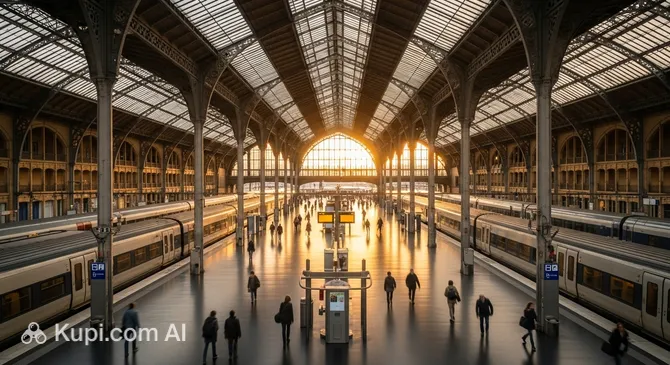
Gare du Nord (North Station) is not merely a transport hub, but a true gateway connecting Paris with northern France, the United Kingdom, Belgium, the Netherlands, and Germany. Gare du Nord Station. Illustration.
Source: Kupi.com AI
As the busiest railway station in Europe, it impresses with its scale and majestic 19th-century architecture. Every day, hundreds of thousands of travellers pass through its halls, rushing to catch high-speed Eurostar, Thalys, and TGV trains.
It is important for passengers to know that the station has a complex structure. Long-distance platforms (Grandes Lignes) are located on the main ground level, while suburban trains and the metro are situated underground. For those travelling to London via Eurostar, a separate terminal is provided on the upper level (mezzanine) featuring a customs control zone. The station has direct connections to metro lines 4 and 5, as well as RER lines B, D, and E, making transfers quick, although navigation during peak hours can be challenging.
Contact Information
Official Website: Current schedules and tickets are available on the SNCF Gares & Connexions website.
Address: 18 Rue de Dunkerque, 75010 Paris, France.
Opening Hours: The station is open daily, approximately from 04:30 to 01:00 (schedule may vary slightly on public holidays).
Information Phone: 3635 (general SNCF number, charges depend on the operator).
Luggage Storage: Automatic lockers (Consignes) are located on level -1, near platform 3 (this is a paid service).
Accessibility: The Accès Plus service provides assistance to passengers with reduced mobility; the meeting point can be found in the main hall.
How to Get There
Getting to Gare du Nord is very simple, as it is one of the key transport hubs in Paris. The fastest way is by metro (lines 4 and 5) or RER trains. The RER B line directly connects the station with Charles de Gaulle Airport (travel time is about 30–40 minutes) and Orly Airport (via transfer to OrlyVal).
RER trains on lines D and E also stop here. On the surface, in front of the main facade, there is a large bus station and a taxi rank. If you are at the nearby East Station (Gare de l'Est), you can walk there in just 7–10 minutes along Rue de Dunkerque.
Services and Amenities
A full range of services for travellers is available at Gare du Nord. In the main hall, you will find numerous ticket counters and self-service kiosks (yellow for TGV/Intercités, blue-green for regional trains). Free Wi-Fi is available throughout the premises (registration required).
For comfortable waiting, there are rest areas, as well as the Grand Voyageur VIP lounge for premium passengers. On the underground level (-1), there are paid restrooms, automatic luggage lockers, and a lost and found office. The station also features currency exchange points, ATMs, a pharmacy, and mobile device charging stations.
Dining Options
It is impossible to go hungry at Gare du Nord. Inside the terminal, there are many spots for a quick bite: popular bakeries (such as Paul), coffee shops, and fast-food chains. This is an excellent option to grab a sandwich and coffee for the road; the average bill will be around 8–12 Euros.
If time permits, visit the famous Terminus Nord brasserie right opposite the main entrance — this is a classic Parisian establishment with history where you can enjoy a full meal. In the vicinity of the station, there are also many cafes and bistros where prices are often lower than inside the secured zone, and the cuisine is more diverse.
Station History
The first station building opened in 1846, but it soon ceased to cope with the flow of passengers. The current majestic complex was built in the early 1860s based on the design of architect Jacques Ignace Hittorff. The building's facade is decorated with 23 statues symbolizing the cities with which connections are established: Paris crowns the centre, while London, Berlin, Frankfurt, and other capitals are positioned lower.
Over a century and a half, the station has survived many renovations. The most significant stage in recent history was the reconstruction in the 1990s for the launch of high-speed Eurostar trains, which required the creation of completely new infrastructure and customs control zones, turning the station into the main international gateway of Paris.
Passenger Tips
When planning your trip, consider your arrival time. For domestic routes, arriving 20–30 minutes early is sufficient, but for Eurostar passengers, check-in closes 30–45 minutes before departure (it is recommended to arrive 60–90 minutes early to clear passport control).
Be attentive to your belongings: Gare du Nord is a very busy place where, unfortunately, pickpockets can be active. Do not leave luggage unattended. If you have a paper ticket without a specific seat and time (for example, for TER), do not forget to validate it in the yellow machine before entering the platform.