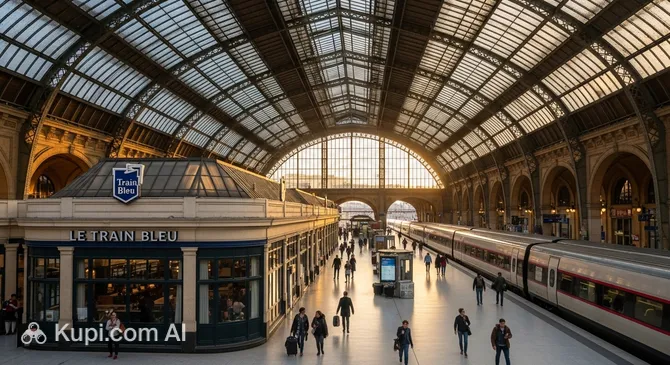
Gare de Lyon is one of Paris's busiest and most beautiful transport hubs, serving destinations in the south and east of France, as well as Switzerland, Italy, and Spain. The station building, constructed for the World Exposition of 1900, is impressive with its architecture and the famous 67-metre clock tower. For tourists, it is not just a departure point but a historical landmark located in the 12th district on the right bank of the Seine.
It is important for passengers to know that the station is divided into three main zones: Hall 1 (the historical part, tracks A-N), Hall 2 (the modern part, tracks 5-23), and Hall 3 (the underground level, often used for low-cost Ouigo trains). Navigation here can be challenging due to the large flow of people, so please pay attention to the coloured signs: blue ones lead to the tracks, while yellow ones lead to exits and transfers. The station has direct connections to the Metro and RER stations, making it a convenient hub for travelling around the capital.
Contact Information
Official website: garesetconnexions.sncf
Information helpline: 3635 (unified SNCF helpline)
Address: Place Louis-Armand, 75012 Paris, France
Opening hours: Daily from 04:45 to 01:30
Luggage storage: Located in Hall 3 (level -1), open daily from 06:15 to 22:00
Accessibility:Accès Plus service for passengers with reduced mobility (meeting point in Hall 1 or Hall 2)
How to Get There
Getting to Gare de Lyon in Paris is very easy thanks to the extensive public transport network. The fastest way is via the Metro: Line 1 (passing through the Louvre and Champs-Élysées) and the automated Line 14 (connecting to Saint-Lazare station and Olympiades) intersect here. The station is also served by the suburban train lines RER A (direction Disneyland Paris) and RER D (connecting to Gare du Nord).
If you prefer surface transport, numerous bus routes serve the station, including 20, 24, 63, and 65. The taxi rank is located on the station square, Place Louis-Armand. A walk from the Place de la Bastille takes about 10–15 minutes. The travel time by taxi from the centre (for example, from the Opera) is approximately 20–30 minutes, depending on traffic.
Services and Amenities
Gare de Lyon offers a full range of services for a comfortable wait. The premises feature ticket counters and numerous self-service machines (yellow for long-distance trains, green for regional ones). Unlimited free Wi-Fi is available for passengers; to connect, select the network _SNCF GARE-GRATUIT. You can charge your devices at special stands or by using power outlets in the waiting halls, although they may be occupied during peak hours.
The station complex has paid restrooms (clean and modern), automatic luggage lockers in Hall 3, and a lost and found office. For citizens with reduced mobility, an escort service and adapted elevators are provided. If you have time, you can play the piano installed in the main hall — a charming tradition of French railway stations.
Where to Eat
The gastronomic jewel of the station is the legendary restaurant Le Train Bleu, located in Hall 1. This is a historic establishment with luxurious Baroque interiors where you can have a full lunch or simply enjoy a coffee while soaking in the atmosphere of the early 20th century. However, please note that the average bill here is higher than average, and it is best to book a table in advance.
For a quick and budget-friendly snack, chain cafés operate within the station: Paul, Brioche Dorée, Starbucks, and Pret A Manger. Here you can purchase sandwiches, pastries, and beverages for your journey. If you wish to save money, there are Monop' supermarkets on Rue de Lyon nearby, where you can buy water and snacks at standard city prices.
Station History
The history of Gare de Lyon began in 1847, but the building we see today was erected specifically for the World Exposition of 1900, designed by architect Marius Toudoire. The main symbol of the station became the majestic Clock Tower (Tour de l'Horloge), 67 metres high, with dials visible from afar. The façade of the building is adorned with statues symbolising the cities to which the trains departed.
An important stage of development was the massive reconstruction in the 1980s for the launch of the high-speed TGV trains to the south-east of France. This required expanding the infrastructure and creating new halls while preserving the historic appearance of the main building. Today, the station is an architectural monument and a key link in the transport system not only of Paris but of all Europe.
Passenger Tips
Arrive at the station at least 20–30 minutes before your train departs, especially if you need to find your way to Hall 3, which is located quite far from the main entrance. Boarding for TGV trains usually closes 2 minutes before departure. Be sure to keep your tickets handy: automatic turnstiles are installed at the entrance to the platforms, where you need to scan the barcode.
Please be vigilant: as with any major station, pickpockets may operate here, so do not leave your luggage unattended. If you have a long overnight transfer, bear in mind that the station closes for several hours at night (from 01:30 to 04:45), and staying inside during this time is not permitted. It is better to choose nearby hotels for waiting.