Support

Rennes Airport

About the Airport

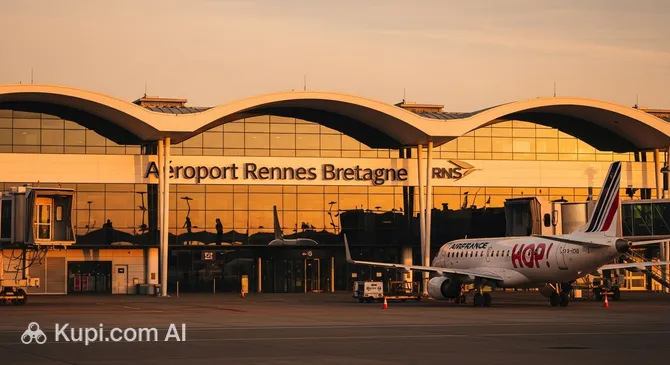
Rennes Airport. Source: Kupi.com Binoculars

Rennes-Saint-Jacques Airport (Rennes-Saint-Jacques), also known as Rennes Brittany Airport, is the air gateway to the heart of one of the most colourful regions of France. Opened back in 1933, today this airport serves as an important transport hub connecting the historic capital of Brittany with major European cities. Despite its modest size, it offers passengers a welcoming atmosphere and a convenient location, making it the ideal starting point for exploring ancient castles, the picturesque coastline, and the rich culture of the region.

IATA Code RNS
ICAO Code LFRN
City Rennes
Distance to centre approx. 6 km
Status International
Passengers per year over 850,000 (2019)
Popular Airlines Air France, easyJet, Volotea
Schedule "Rennes Airport" online flight board

The main advantages of Rennes Airport are its compactness and efficiency. Passengers do not have to spend much time passing through controls or finding their boarding gate, making the journey much calmer. The airport is conveniently linked to the city centre: bus route C6 will take you to the central stop, République, in just 20-30 minutes. The air harbour serves flights to key destinations, including Paris, Lyon, Amsterdam, and London, allowing for easy planning of both business trips and tourist itineraries across Europe.

Contact Information

Below you will find contact information for Rennes-Saint-Jacques Airport (RNS), which will help you plan your trip and resolve any potential queries.

  • Official website: www.rennes.aeroport.fr
  • Information desk phone: +33 2 99 29 60 00
  • Address: Aéroport de Rennes Saint-Jacques, 35136 Saint-Jacques-de-la-Lande, France
  • Email: For general enquiries, you can use the contact form on the official website or the address accueil@rennes.aeroport.fr.
  • Social media: Follow airport news on the official pages on Facebook, X (formerly Twitter), and Instagram.
  • Lost luggage information: If your luggage was lost during the flight, please contact your airline's baggage tracing service first. For items left in the terminal, please contact the airport information desk.
  • Passenger support contacts: For all questions related to your stay at the airport, you can contact the main information desk phone number.

How to Get to the Airport

Rennes-Saint-Jacques Airport (RNS) is conveniently located just a few kilometres southwest of the centre of Rennes, making the journey there quick and simple. Travellers can choose from several ways to get to the terminal, depending on their budget, time, and preferences. Most options will take you from the heart of the city to the airport in less than half an hour.

Public Transport: The most budget-friendly and popular method is the city bus. Route C6 of the STAR transport network runs between the city centre (stop "République", where you can transfer to the metro) and the airport. The trip takes approximately 20-25 minutes. The cost is equal to the price of a standard public transport ticket. This is an excellent choice for those travelling light and wishing to save money.

Taxi and Transfers: For maximum convenience, especially when travelling with children or a large amount of luggage, you can use taxi services. A trip from the centre of Rennes to the airport will take about 15-20 minutes, depending on traffic. The estimated cost is 20–30 Euros. You can also book a private transfer in advance so that a driver meets you at a designated location at the required time.

Car and Parking: If you are travelling in your own or a rented car, getting to the airport is very easy via the ring road (Rocade), following signs for "Porte de St-Nazaire". Rennes Airport has several car parks: from short-term P2, ideal for quick drop-offs or picking up passengers, to long-term P5 and P6 for those leaving their car for several days. To get the best rates for long-term parking, it is recommended to book a space online in advance.

Terminals and Map

Rennes-Saint-Jacques Airport (RNS) is a modern and compact airport complex distinguished by a simple and clear structure. All passenger infrastructure is concentrated in one terminal, serving both domestic and international flights.

The structure of the terminal is intuitive. The building consists of two main levels. On the ground floor (Level 0), you will find the arrivals area, airline check-in counters, and car rental desks. The main hall, where greeters can wait for passengers, is also located here.

Escalators and lifts lead to the first floor (Level 1). The departures area is located here. After passing through security control, passengers enter the waiting lounge with boarding gates. Thanks to the airport's small size, navigation causes no difficulties — all signs are clearly visible, and the path from the entrance to the gate takes minimal time.

Since there is only one terminal in the airport, there is no need for transfers between buildings. Arrival and departure zones are logically separated by floors, making movement around the airport maximally convenient and fast. Even if you are short on time, you will orient yourself easily.

Passing through all formalities usually does not take much time. It is recommended to arrive at the airport 1.5–2 hours before international flights and approximately 1–1.5 hours before domestic ones. During peak seasons and holidays, it is worth allowing a little more time in case of queues at check-in counters and security checks.

The main advice for navigation at Rennes Airport is to simply follow the signs. The compactness of the terminal is its main advantage: everything you need, from cafes to boarding gates, is within walking distance, making waiting for your flight comfortable and eliminating unnecessary rushing.

Airport History

The history of Rennes-Saint-Jacques Airport (RNS) began in 1933, when it was officially opened to serve the capital of the Brittany region. Initially, it was a small airfield intended for civil aviation and postal flights, laying the foundation for future air connections in this part of France.

A key and dramatic period in the airport's history was the Second World War. The airfield was occupied and used by the German Air Force as a base, making it a strategic target. As a result, it was repeatedly subjected to bombing by Allied forces. After the end of hostilities, significant efforts were required to restore the destroyed infrastructure and return the airport to civilian life.

The second half of the 20th century became a time of active growth and modernisation. To accommodate jet aircraft, the runway was extended, and the passenger terminal was expanded multiple times. Significant renovations, especially in the 1990s and in 2010 when a new hall was added, allowed for a significant increase in capacity and improved passenger service quality, turning the airport into a modern transport hub.

Today, Rennes Airport is the main air gateway of Brittany, serving hundreds of thousands of passengers annually and connecting the region with major European cities. Interesting fact: the airport still maintains its multi-functionality by sharing the runway with a military airbase, highlighting the strategic importance it has held throughout its history.

Services and Amenities

Rennes Airport (RNS) offers passengers a wide range of services and amenities to make waiting for a flight as comfortable as possible. Within the terminal, you will find several dining outlets, including cafes and a restaurant where you can have a full meal or a quick snack. For shopping enthusiasts, there is a Duty-Free shop offering a standard assortment of perfumes, cosmetics, beverages, and souvenirs.

For those who value enhanced comfort, the airport has a VIP lounge where you can relax in a quiet environment. Free Wi-Fi is available throughout the terminal, allowing passengers to stay connected or work. Numerous power outlets and USB ports are provided for charging electronic devices.

Financial services are represented by ATMs located in the public area of the terminal. In case of need, passengers can seek first aid at the medical point. For travellers with small children, mother and child rooms equipped with changing tables are available, making travelling with little ones more convenient.

Rennes Airport is fully adapted for passengers with reduced mobility. An accompaniment service (Aelia Access) is provided, which is recommended to be booked in advance through your airline. The terminal is equipped with ramps, lifts, and dedicated washrooms for free movement.

Business travellers can use the services of the business centre, which offers rental of conference halls and meeting rooms equipped with modern technology. Although there are no hotels directly on the airport grounds, several hotels are located in the immediate vicinity, offering a convenient option for rest before an early departure or after a late arrival.

Dining

Rennes Airport (RNS), being a compact regional airport, offers passengers several convenient options for a snack or a full meal. Although the choice here is not as vast as in major international hubs, you will easily find a place to drink coffee before departure or have lunch while waiting for your flight.

The main dining point is located in the general hall of the airport, before the security zone (landside). Here you will find a restaurant-bar that serves both departing and arriving passengers. This is an excellent place for a leisurely breakfast, lunch, or dinner. The menu usually features French cuisine dishes: from classic sandwiches and salads to more substantial hot meals. Be sure to look out for local specialities of the Brittany region — you might be able to try the famous Breton galettes (buckwheat pancakes) or the traditional dessert kouign-amann.

For those short on time, after passing security control (airside) in the departure zone, there is a small snack bar or cafe. This is an ideal option for a quick snack. Here you can buy coffee, tea, soft drinks, as well as fresh pastries, sandwiches, and light snacks. This is convenient if you want to refresh yourself immediately before boarding.

Regarding special dietary needs, basic vegetarian options, such as salads or sandwiches with vegetables, are available in most establishments. Finding certified vegan, gluten-free, or Halal meals may be challenging, so if you have strict restrictions, it is recommended to bring food with you. Prices at Rennes Airport correspond to the average level for European airports — slightly higher than in the city. Opening hours of establishments are generally tied to the flight schedule: they open early in the morning and close after the departure of the last plane.

Travel Tips

Travelling through the airport of Rennes, located in the heart of Brittany, France, usually proceeds smoothly and without unnecessary stress. To ensure your trip begins and ends as comfortably as possible, use these tips.

Arrival time at the airport. Rennes-Saint-Jacques Airport (RNS) is relatively small and efficient. For domestic flights and flights within the Schengen zone, it is recommended to arrive 1.5-2 hours before departure. If your flight is international (outside Schengen), it is better to allow 2-3 hours. This will give you enough time for check-in, baggage drop, and passing through security control without rushing.

Check-in and security control. To save time, complete online check-in for your flight on your airline's website. This will allow you to head straight to the baggage drop counter or, if you are travelling light, to the security checkpoint. The screening procedure is standard: be prepared to remove liquids in a transparent bag and large electronic devices, such as laptops, from your hand luggage.

Choosing a seat on the plane. Want to enjoy views of picturesque Brittany from above? Choose a window seat. If the ability to stand up freely and stretch your legs during the flight is more important to you, your choice is an aisle seat. Note that on short flights from Rennes, the difference is not as significant.

Hand luggage. Remember the standard rules: all liquids (shampoos, perfumes, creams) must be in containers of no more than 100 ml and packed in one transparent resealable bag with a volume of up to 1 litre. It is forbidden to carry sharp objects, weapons, and flammable substances in hand luggage. Always check the rules of your specific airline, as requirements for the weight and size of hand luggage may differ.

Transfer passengers. Rennes is not a major transfer hub, so there are few transit passengers here. If you have a transfer within the Schengen zone, you will likely not have to go through passport control again. When transferring from an international flight to a domestic one, you will need to pass border control upon arrival.

Customs control. For flights within the EU, there is no customs control as such. If you are arriving from a country outside the EU, follow the "green" and "red" channel system. "Green" — if you have no goods to declare. "Red" — if you are carrying goods, the quantity or value of which exceeds established limits.

Saving time and money. Book airport parking or a transfer to the city online in advance — this is often cheaper. Bring an empty reusable water bottle with you to fill it after passing security control and avoid spending money on expensive drinks. Use public transport (bus C6) for the trip to the centre of Rennes — this is the most budget-friendly option.

In case of flight delay. In the event of a delay or cancellation of a flight by an airline departing from the EU, your rights are protected by EU261 regulation. Contact your airline representative at the airport for information, and vouchers for food or accommodation if applicable. Keep all receipts and documents related to the delay for potential compensation.
Reached the end of the page?

That means the route is fully explored