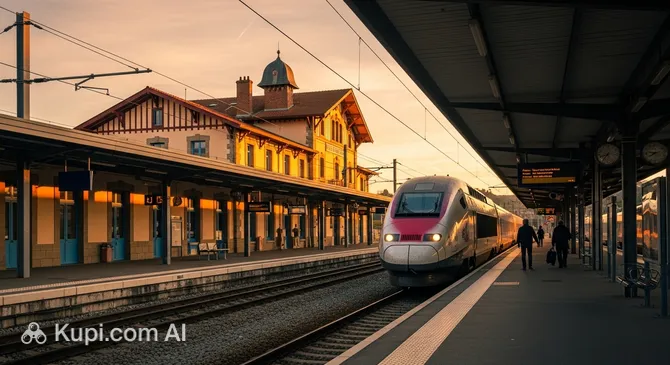
St-Jean-de-Luz-Ciboure Railway Station is a key transport hub located on the picturesque coast of the French Basque Country. The station serves two towns simultaneously: the famous resort of Saint-Jean-de-Luz and the neighbouring historic port of Ciboure, separated by the Nivelle river. The station receives both regional TER trains and high-speed TGV trains connecting the region with Paris and Bordeaux, making it a convenient starting point for travels along the Atlantic.
It is important for passengers to know that the station is compact and easy to navigate. The entrances are located on the city centre side, providing quick access to the platforms. An underpass, equipped for safety, is used to cross between the tracks. Thanks to its central location, you can walk from the platform to the beach and major hotels in just a few minutes.
Contact Information
Official Website: Current schedules and tickets are available on the SNCF Connect portal or the TER Nouvelle-Aquitaine website.
Information Phone: 3635 (unified SNCF support number).
Address: Avenue de Verdun, 64500 Saint-Jean-de-Luz, France.
Opening Hours: The station opens early in the morning (around 05:30) and closes after the arrival of the last train (around 22:30).
Luggage Storage Info: Automatic lockers at the station are often closed for security reasons; it is recommended to use city luggage storage services.
Accessibility Information: The station provides the Accès Plus service to assist passengers with reduced mobility (booking 48 hours in advance is recommended).
How to Get There
Getting to St-Jean-de-Luz-Ciboure station is effortless, as it is located in the very heart of the city.
Public Transport: Directly at the station is the bus station (Halte Routière), which serves as a hub for the Hegobus network buses running through the city and surrounding areas.
Taxi: A taxi rank is located immediately in front of the station building exit, which is convenient for journeys with heavy luggage.
On Foot: From the historic centre of Saint-Jean-de-Luz, Louis XIV Square, or the beach, the walk will take just 5–7 minutes. If you are coming from the town of Ciboure, the route crosses the bridge and takes about 15–20 minutes.
Services and Amenities
The station provides essential services necessary for a traveller to wait comfortably.
Tickets and Waiting: The building features ticket counters (guichet) and 24-hour ticket vending machines. There is a small waiting hall where you can take shelter from the weather.
Connectivity and Facilities: Passengers usually have access to free Wi-Fi. A photo booth and a mailbox are installed on the premises.
Restrooms: Toilets are located within the station building (this service may be subject to a fee).
Accessibility: The station is equipped with ramps and lifts for access to the platforms, making it convenient for citizens with reduced mobility.
Dining Options
Food choices directly inside the station are limited: typically, you can only find vending machines with drinks, coffee, and snacks, or a small newsstand with a minimal selection of products.
However, thanks to its location in the centre, there are excellent options around the station:
For a quick bite: On the adjacent Avenue de Verdun and towards the centre, there are many bakeries (boulangerie) where you can buy fresh sandwiches, quiches, or croissants. The average check is 5–8 Euros.
For a full meal: Within a radius of 200 metres, there are cafés and brasseries where you can enjoy coffee or have lunch featuring local cuisine dishes before your train departs.
Station History
The history of the station began in 1864, when the railway line of the Compagnie du Midi reached the Spanish border, connecting Paris with Madrid. This event became a turning point in the city's destiny.
The arrival of the railway transformed the modest fishing port into a fashionable seaside resort, popular among the European aristocracy. The historic station building has preserved its charm despite numerous renovations.
In recent decades, the station has been modernised to accommodate high-speed TGV trains, which has reduced the travel time to Paris to 4–5 hours while maintaining its role as an important hub in the Aquitaine region's transport system.
Passenger Tips
Arrival Time: Try to arrive at the station 15–20 minutes before departure. Boarding for TGV trains may close 2 minutes prior to departure.
Tickets: If you have an old-style paper ticket (without a specific seat and date), it must be validated in the yellow machine before entering the platform. Electronic tickets do not need to be validated.
Luggage: Be sure to label all your bags and suitcases with tags stating your name and contact phone number — this is a security requirement on French trains.
Security: Do not leave your belongings unattended. The station closes for the night, so overnight waiting inside is not possible.