Support

Maupiti

About the Airport

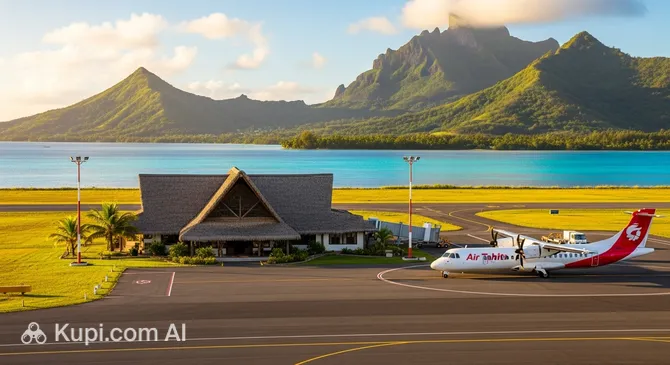
Maupiti. Illustration.
Source: Kupi.com AI

The Maupiti Airport (IATA: MAU) is not merely an air gateway, but the beginning of an unforgettable adventure in the heart of French Polynesia. Located on a picturesque *motu* (coral islet) in the atoll's lagoon, it offers its guests breathtaking views even before landing. Landing here is a unique experience: the aircraft glides over turquoise waters and touches down on a narrow strip of land surrounded by the ocean. Immediately after disembarking, you are enveloped by the atmosphere of a secluded tropical paradise.

PropertyValue
IATA CodeMAU
ICAO CodeNTTP
CityMaupiti
CountryFrench Polynesia
TimezonePacific/Tahiti
Top AirlinesAir Tahiti
ScheduleOnline Timetable

The main feature of Maupiti Airport is its unique location. Since it is situated on a separate *motu*, all arriving passengers are met by a complimentary boat shuttle from Air Tahiti, which transports them to the main island, to the village of Vaiea. This short sea journey across the lagoon becomes the first excursion in itself and sets the tone for the entire holiday on the atoll. The airport serves only domestic flights, connecting Maupiti with islands such as Papeete, Bora Bora, and Raiatea. The terminal infrastructure is very compact and simple, emphasizing the intimate and relaxed atmosphere of the island, far from the hustle and bustle of large tourist centers.

Contact Information

Below you will find the main contact information for Maupiti Airport (MAU), which serves the eponymous island in French Polynesia. Given the small size of the airport, many services are coordinated through the main operator or directly by the airlines.

  • Official Website: The airport is managed by Aéroports de Tahiti (ADT). Current information can be found on the corresponding page of their official website: tahiti-aeroport.pf.
  • Inquiry Service Phone: +689 40 60 15 05
  • Airport Address: Maupiti Airport, 98732 Maupiti, French Polynesia.
  • Email: The airport does not have a direct public email address. For official inquiries, it is recommended to use the contact form on the Aéroports de Tahiti operator's website.
  • Social Media: Maupiti Airport does not have its own social media pages. General news and updates can be tracked on the Aéroports de Tahiti accounts.
  • Lost Luggage Information: For issues related to lost or damaged luggage, please contact the airline you flew with directly (the main carrier on this route is Air Tahiti).
  • Passenger Support Contacts: For flight details, ticket information, and check-in, please contact your airline. For general questions regarding terminal operations, you may call the phone number listed above.

How to Get to the Airport

The Maupiti Airport (MAU) offers one of the most unusual and picturesque arrival methods characteristic of the islands of French Polynesia. It is important to understand that the airport is located on a separate small islet (*motu*), while all guest houses and main life are concentrated on the main island. Therefore, you can reach your accommodation only by water. There are no conventional buses, trains, or taxis at the terminal — your first acquaintance with the island will begin with a boat trip across the turquoise lagoon.

Boat Transfer — Your Main Transport

The only reliable way to get from the airport to your accommodation and back is a boat transfer organized by your pension (guesthouse) or hotel. This is standard practice on Maupiti.

  • Organization: It is extremely important to contact your pension in advance and provide your flight details (flight number and arrival time). Upon arrival, a representative from your accommodation will meet you and escort you to the boat.
  • Travel Time: The trip across the lagoon to your pension usually takes from 15 to 30 minutes, depending on its location on the main island.
  • Cost: Often, the cost of the transfer is already included in the accommodation. In other cases, it is a fixed fee for the trip. Be sure to clarify this point when booking your accommodation.

Taxis, Car Rental, and Public Transport

On the island of Maupiti, services such as taxis, car rentals, and public transport (buses) are completely absent. The island is very small, and the main means of transport for tourists and locals is the bicycle, which can be rented at most pensions. Therefore, do not expect to find any transport at the airport upon arrival without prior arrangement.

Parking at the Airport

Since the airport is located on an isolated *motu* not connected by a road, car parking is unavailable. All transport logistics are built exclusively on boat transfers.

Key Recommendations:

  • Always arrange your transfer in advance. This is the most important step for a comfortable arrival on Maupiti. Inform your pension of your arrival time, and you will certainly be met.
  • Be prepared for an informal setting. The airport is very small, and the process of meeting and boarding the boat takes place in a friendly and relaxed atmosphere.
  • Enjoy the ride. The boat transfer is not just a way to get to the hotel, but your first unforgettable excursion through one of the most beautiful lagoons in the world. Keep your camera ready!

Terminals and Map

Maupiti Airport (MAU) is a charming and very compact airport, typical of the smaller islands of French Polynesia. Its layout is as simple as possible, allowing passengers to avoid the hustle characteristic of major aviation hubs.

The airport has just one small terminal, which serves both arriving and departing flights. Its building is more of a pavilion, often open or semi-open, allowing you to immediately feel the tropical atmosphere. There is no separation into domestic and international sectors, as the airport receives only local flights, mainly from Tahiti and neighboring islands.

The airport map is extremely simple. Departure and Arrival zones are effectively located in the same small hall. Upon arrival, you proceed directly from the airfield to the baggage claim area, where luggage is usually delivered very quickly. For departing passengers, there are one or two check-in counters and a small waiting area under a canopy. Due to such modest dimensions, the concept of "transfer between terminals" does not exist here.

Check-in and security control procedures are very quick. Thanks to the small number of passengers on a single flight, all formalities take no more than 15-20 minutes. Nevertheless, it is recommended to arrive at the airport approximately 45-60 minutes before departure to check in luggage without haste. The main navigation recommendation is to relax; getting lost here is simply impossible. It is important to remember that the airport is located on a separate islet (*motu*), and to reach the main island, you must use a boat transfer.

Airport History

The Maupiti Airport (MAU) is not just a runway, but a true aerial gateway to one of the most secluded and authentic corners of French Polynesia. Its history is relatively short, but it is inextricably linked with the desire to make this paradise island more accessible for both travelers and the islanders themselves.

A key moment in the airport's history was 1997 — the year of its official opening. This event was a turning point in the life of the island. Before this, the only way to reach Maupiti was a long and not always predictable sea voyage. The advent of regular air service radically changed the situation, giving a powerful boost to tourism development and significantly simplifying connections with other islands of the archipelago.

Given the modest size and remoteness of the island, Maupiti Airport has not undergone massive reconstructions or expansions characteristic of large aviation hubs. Its main feature and value lie in its simplicity and harmonious integration into the surrounding landscape. Its entire "development history" is the stable and reliable work of ensuring the island's connection with the outside world, without significant modernizations or restructuring.

One of the most interesting facts related to the airport is its unique location. The runway is built on the narrow coral islet of Motu Tuanai, separate from the main island. Because of this, the journey to Maupiti begins with a small adventure: upon arrival, passengers are met by boats that transport them through the picturesque turquoise lagoon to the main village of Vaiea. This unusual transfer is in itself part of the unique experience, immediately immersing you in the atmosphere of secluded Polynesian life.

Services and Amenities

Maupiti Airport (MAU) is a very small regional airport serving the eponymous island in French Polynesia. It is important to understand that its infrastructure is extremely simple and designed primarily to ensure the takeoff and landing of small aircraft. Services for passengers here are very limited, so it is worth preparing for your visit in advance.

Restaurants, Cafes, and Shops: There are no full-service restaurants, cafes, or shops on the airport grounds. Sometimes a small kiosk may operate, selling drinks and light snacks, but one should not rely on this. It is recommended to bring food and water with you.

Waiting Areas and Wi-Fi: The waiting area consists of a simple room or canopy with basic seating. There are no VIP lounges, business lounges, or special rest zones here. Wi-Fi access is generally unavailable, as are public charging stations for electronic devices. Ensure your gadgets are charged in advance.

Financial and Medical Services: There are no banks, ATMs, or currency exchange points at the airport. All financial transactions are best completed beforehand in larger cities, such as on Tahiti. Specialized medical facilities are also absent.

Passenger Services and Hotels: Special services for passengers with children (such as nursing rooms) or for people with disabilities are not provided, however, airport staff are always ready to offer assistance during boarding and disembarking. There are no hotels directly at the airport. All guesthouses and pensions are located on the main island of Maupiti; since the airport is located on a separate islet (*motu*), you must reach them by boat. Transfers are usually organized in advance with your hotel.

Business Services: Conference rooms, business centers, and other similar services are not provided at Maupiti Airport.

Where to Eat

When planning a trip through Maupiti Airport (MAU), it is important to consider that this is a very small regional airport serving a small and secluded island. Infrastructure here is minimal and corresponds to the relaxed pace of life in French Polynesia. Therefore, one should not expect a variety of restaurants and cafes as found in major international hubs.

Typically, one small snack bar or kiosk operates at Maupiti Airport. Its main task is to offer passengers waiting for their flight basic drinks and light snacks. The assortment usually includes:

  • Refreshing drinks: water, soda, juices.
  • Hot drinks: coffee or tea.
  • Light snacks: chips, cookies, chocolate bars.
  • Sometimes simple sandwiches or pastries may be on sale.

The establishment is located in the general waiting area (landside) and opens shortly before the arrival or departure of a flight, closing almost immediately after. Due to the extremely limited selection, finding options here for strict dietary preferences (vegan, gluten-free, Halal dishes) is practically impossible. Prices may be slightly higher than on the island itself, which is typical for airports.

Our advice: If you require a full lunch or dinner, it is best to eat beforehand at your pension or at one of the local "snacks" on the island. For a quick bite before departure, the most reliable option is to bring food and drinks with you. This will allow you to avoid inconvenience if the kiosk at the airport is closed or its assortment does not suit you.

Travel Tips

Maupiti Airport is the gateway to one of the most secluded and picturesque islands of French Polynesia. It is a small regional airport, and using it is part of the authentic island adventure. Here are a few tips to ensure your journey goes as smoothly as possible.

Arrival at the Airport and Check-in. Maupiti Airport serves only domestic flights, so there are no long queues here. It is recommended to arrive approximately 1–1.5 hours before departure. This time will be more than sufficient for flight check-in and baggage drop-off. The security screening procedure is also very quick and free of the hustle characteristic of large international hubs.

Choosing a Seat on the Plane. Inter-island flights are operated by small propeller aircraft, and the main highlight is the view from the window. Be sure to book or ask for a window seat at check-in. When flying to Maupiti, the best views of the lagoon and Mount Teurafaatiu often open up from the left side of the aircraft, and upon departure — from the right, though this may vary depending on wind direction and route.

Hand Luggage. Standard rules apply: liquids in containers no larger than 100 ml, and no sharp objects. Please note that Air Tahiti flights may have strict weight restrictions for hand luggage. It is important to remember that it is prohibited to take out corals, shells, and certain types of plants from Maupiti, as with other islands. Pack only essentials in your hand luggage: documents, money, medication, and electronics.

Transfers and Customs Control. There is no customs or border control at Maupiti Airport, as it does not receive international flights. You will go through all these procedures at Faa'a International Airport in Papeete (Tahiti). If you have a transfer to another domestic flight, ensure there is enough time between flights (at least 2 hours), as weather can cause schedule adjustments.

Saving Time and Money. To save money, book tickets in advance, especially during the high season (May to October). Travel light to avoid excess baggage fees. There are practically no shops in the airport itself, so it is better to bring food and drinks with you.

Flight Delays. Delays are generally related to weather conditions. The airport has very limited amenities, so in case of a wait, have a book, a charged power bank, and headphones with you. Airline staff on-site will provide all current information. Remain calm and enjoy the unhurried rhythm of Polynesian life — this is also part of the journey.

Reached the end of the page?

That means the route is fully explored