Support

Bonn Hbf Railway Station

Nearby airports

About the Station

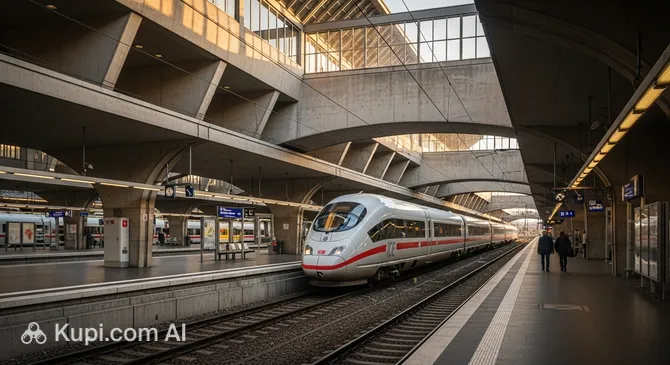
Bonn Hauptbahnhof. Illustration.
Source: Kupi.com AI

Bonn Hauptbahnhof is a strategically important transport hub serving the former capital of Germany and ensuring reliable connections within the Rhine-Ruhr region. Located in the very heart of the city, the station serves as a starting point for numerous routes, including scenic journeys along the Rhine and high-speed lines to major metropolises. The station building combines historical architecture with modern infrastructure, offering travellers a comfortable start to their journey.

PropertyValue
CityCologne
CountryGermany
Typerailway

For passengers, navigation through the station is organised as simply and logically as possible. The main entrance leads directly to the central hall with ticket machines and timetable boards, while access to the platforms is provided via an underground passageway (Unterführung) equipped with lifts. It is important to remember that the station is integrated with the city's transport system: the light rail station (Stadtbahn) is located on the lower level, and a large bus terminal is situated on the station forecourt. Transferring to public transport here takes just a few minutes, which is particularly convenient for transit tourists.

Contact Information

To conveniently plan your trip and navigate on-site, please review the contact details and service information for Bonn Hauptbahnhof:

  • Official Website: Current timetables and news are available on the Deutsche Bahn portal (bahn.de) or on the station's page (bahnhof.de).
  • Information Phone: Unified Deutsche Bahn service line: +49 30 2970 (available 24/7, costs vary by operator).
  • Address: Am Hauptbahnhof 1, 53111 Bonn.
  • Opening Hours: The station building is open 24 hours a day. The Passenger Service Centre (DB Reisezentrum) operates on the following schedule: Mon–Fri from 06:00 to 20:00, Sat–Sun from 09:00 to 18:00.
  • Luggage Storage: Automatic lockers (Schließfächer) are installed at the station. They are available 24/7 and accept coins; the cost depends on the size of the locker and the rental duration.
  • Accessibility: The station offers barrier-free access. All platforms are equipped with lifts, and tactile guidance systems are in place for the visually impaired. To receive assistance with boarding, it is recommended to submit a request to the mobility service (Mobilitätsservice) in advance.

How to Get There

Thanks to its exceptionally convenient location, getting to Bonn Hauptbahnhof is effortless, whether from the historic centre of Bonn or from neighbouring Cologne. The station is located on the edge of the main pedestrian zone and serves as the city's primary transport hub.

Walking from the Centre:

If you are already in the centre of Bonn, the walk to the station will be short and pleasant. From the famous Münsterplatz with the Beethoven monument, you need to walk along the lively shopping street Poststraße. The walk will take just 5–7 minutes. The station building will be clearly visible at the end of the street.

Public Transport:

The station is perfectly integrated into the VRS regional transport system. Stops are located compactly:

  • Light Rail (Stadtbahn): The Bonn Hbf (Tief) station is located on the underground level. Lines 16 and 18 (connecting Bonn with Cologne) stop here, as well as lines 63, 66, 67, and 68. Line 66 is particularly important for tourists, as it connects the city centre with Siegburg/Bonn station, where high-speed ICE trains stop.
  • Buses: The central bus station (ZOB) is located in front of the main entrance. Most city routes arrive here. For travellers, the express bus SB60 (Airport Express) is important, running between the station and Cologne/Bonn Airport (travel time is about 30 minutes).
  • Trains from Cologne: You can reach Bonn Hauptbahnhof from Cologne Central Station (Köln Hbf) on regional express trains (RE 5, RB 26, RB 48). Trains run frequently, and the travel time is 20–30 minutes.

Taxi:

The official taxi stand is located directly on the station square (Bahnhofsvorplatz), near the exit from the main hall. A trip within the central part of the city usually takes 5–10 minutes, and from southern districts (such as Bad Godesberg), it takes about 15–20 minutes.

Services and Amenities

The infrastructure of Bonn Hauptbahnhof ensures travellers have the necessary comfort before their journey. To purchase tickets, passengers can use ticket machines (located in the main hall and passageways) or the services of staff at the Reisezentrum — the customer service centre where they can help plan complex routes. The free WIFI@DB network operates throughout the station, allowing you to stay connected or check timetables online.

For the convenience of transit passengers and tourists, the following amenities are provided at the station:

  • Luggage Storage: Automatic lockers (Schließfächer) are located within the station building. They are available around the clock and accept coins; locker sizes vary from standard to large, suitable for bulky suitcases.
  • Sanitary Zones: Restrooms are located inside the station. Entry generally requires a fee, but the system often issues a voucher that can be used for a discount at local retail outlets.
  • Food and Charging: There are few specialised zones with power outlets in the general waiting area, so it is recommended to visit one of the bakeries or cafes on the station premises to charge your devices.

Special attention is paid to accessibility. The station is fully adapted for passengers with reduced mobility: all platforms are equipped with lifts, which is also convenient for passengers with pushchairs or heavy luggage. There is no separate premium lounge here, but covered pavilions with benches are installed on the platforms to protect against bad weather.

Where to Eat

Hunger won't catch you off guard at Bonn Hauptbahnhof: despite the station's compact size, there are plenty of places here and in the immediate vicinity to grab a snack before the road or have a substantial lunch upon arrival. The dining infrastructure is focused on speed and convenience.

Quick Snacks Inside the Station (On-the-go):

Popular German bakery chains and snack bars are located right in the main hall and passageways. This is an ideal option for breakfast or a snack for the train:

  • Pastries and Sandwiches: Look out for Le Crobag or Kamps outlets. Here you can always find fresh belegte Brötchen (rolls with cheese, cold cuts, or meats), croissants, and hot coffee.
  • Hot Snacks: At Ditsch kiosks, you can buy famous German pretzels (with butter, cheese, or chives) and hot pizza snacks. It is filling and very budget-friendly.
  • Fruits and Drinks: The YORMA’S store offers fresh fruit cups, yogurts, salads, as well as hot sausages (Bratwurst) in a roll.

Cafes and Restaurants Nearby (1–3 minutes walk):

If you have half an hour to spare, it is worth exiting through the main exit to the station square (Bahnhofsvorplatz) or walking to the beginning of Poststraße. The concentration of establishments is higher here:

  • Global Chains: Directly opposite the exit is McDonald’s — a reliable option for those looking for predictable quality and free Wi-Fi; it works late (often 24 hours on Fridays and Saturdays). Nearby, there are also Starbucks and Subway.
  • Asian Cuisine and Döner: In the alleyways near the station, you can find spots serving Asian noodles in boxes (Wok) and traditional Döner Kebab shops. This is an excellent way to have a substantial lunch at a reasonable price.
  • Supermarket: For the most budget-conscious, a mini-market (often in the REWE To Go format) operates in the station building or nearby, where you can buy water, ready-made sandwiches, and snacks at regular store prices, which is significantly cheaper than cafes.

Prices and Opening Hours:

Most bakeries inside the station open very early, around 05:00–06:00 AM, to feed the first passengers, and operate until 21:00–22:00. Finding food at night is more difficult; only the 24-hour fast-food outlets on the square or vending machines are available.

Average Bill:

  • Coffee and a pastry at a bakery: 4–6 EUR.
  • A filling snack (sausage or a slice of pizza with a drink): 5–8 EUR.
  • Lunch at a fast-food or Döner place: 10–15 EUR per person.

Station History

History and Development of the Station:

The history of Bonn Hauptbahnhof is inextricably linked with the era of industrialisation and the development of railways in the Rhineland. The original station was opened back in 1844 by the Bonn-Cölner Eisenbahn-Gesellschaft, becoming the terminus of the first line connecting Bonn with Cologne. However, the building that travellers see today was erected significantly later — between 1883 and 1884. At that time, due to the growth in passenger traffic, a need arose to create a unified, representative station. The building was designed in the Historicist style, giving it a monumental and solemn appearance that has survived to this day and is now protected as an architectural monument.

The station acquired a special, incomparable role after 1949, when Bonn became the "provisional" capital of West Germany. The station effectively turned into the country's main "gateway" for diplomats, statesmen, and foreign delegations. During this period, the importance of the transport hub was colossal: the modest-sized station had to correspond to the high status of the "Federal Village". Government trains were regularly met here, making the platforms witnesses to many historical events in the political life of Germany.

In recent history, the station has undergone several stages of complex reconstruction. After the government moved to Berlin and the launch of the high-speed line via the neighbouring Siegburg/Bonn station, the central station reoriented towards regional and intercity transport (IC/EC). For a long time, the area in front of the station and the gloomy underpass, ironically nicknamed the "Bonn Hole" (Bonnloch) by locals, were serious urban planning problems. During a large-scale modernisation completed in the 2010s and continuing into the 2020s, this territory was completely renovated: a modern roof canopy (Dachkonstruktion) appeared over the platforms, the passageways became brighter, and accessibility for citizens with reduced mobility was brought up to modern standards.

Today, Bonn Hauptbahnhof remains a key strategic link on the scenic Left Rhine Line (Linke Rheinstrecke). Hundreds of trains pass through it daily, ensuring dense traffic between the north and south of the region. Despite its respectable age, the station successfully copes with a load of tens of thousands of passengers a day, harmoniously combining 19th-century imperial architecture with the requirements of modern logistics.

Tips for Passengers

To ensure your trip through Bonn Hauptbahnhof goes smoothly, we have compiled a few practical recommendations. Although this station is not a giant hub like Frankfurt, it has its own peculiarities that are worth knowing in advance.

Arrival Time:

Despite the compactness of the station, it can be crowded during peak hours (weekday mornings and Friday evenings). It is recommended to arrive at the station 15–20 minutes before train departure. This allows enough time to orient yourself, buy a ticket at a machine, and descend to the platform without rushing. If you are boarding long-distance trains (IC/EC) with large luggage, allow 30 minutes to calmly find the correct carriage.

Tickets and Boarding Rules:

Pay close attention to your ticket type. If you are travelling regionally (on RE, RB, or S-Bahn trains), tickets from the VRS transport association often require validation. Look for orange or red stamping machines (Entwerter) at the entrance to the platforms or in the underpass. For long-distance trains (InterCity, EuroCity), be sure to check the coach formation guide (Wagenstandanzeiger) on the platform. It will indicate in which sector (A, B, C, etc.) your specific carriage will stop, saving you from running along the train with suitcases during a short stop.

Luggage:

Moving around Bonn Hauptbahnhof with luggage is quite convenient thanks to lifts on every platform. However, older trains on regional lines may have high steps. If you have a heavy suitcase, try to position yourself on the platform so that you can see where carriages with low floors or the special bicycle/pushchair symbol stop — the entrance there is wider and more convenient. Never leave luggage unattended: the station is a thoroughfare, and vigilance (Achtsamkeit) is never amiss here.

Transfers:

Connecting between trains (for example, from a regional train to an IC) usually causes no issues: it suffices to cross to another platform via the tunnel, which takes 5–7 minutes. If your transfer involves the light rail (Stadtbahn), note that descending to the underground level may require a bit more time due to waiting for a lift or a queue for the escalator. Allow at least 10–12 minutes for such a transfer to avoid stress.

Safety and Night Waiting:

During the day, the station is absolutely safe, with officers from the Bundespolizei constantly patrolling. However, during night hours, especially after shops close, the station becomes deserted. If you have to wait for a train late at night, try to stay in the illuminated zones of the main hall or on the platform near other passengers. Many travellers prefer to wait for morning trains in the 24-hour fast-food restaurant located directly opposite the main entrance — it is warmer and safer there.
Reached the end of the page?

That means the route is fully explored