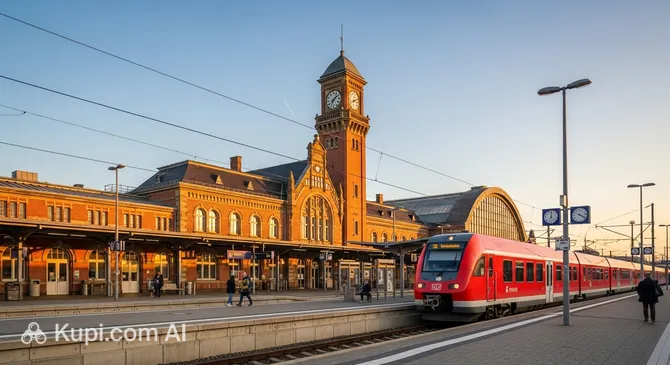
Krefeld Central Station (Krefeld Hauptbahnhof) is a key transport hub for the city and a significant point on the railway map of the state of North Rhine-Westphalia. Located just south of the historic city centre, the station welcomes travellers with a majestic building that combines historic architecture with modern functionality. From here, regional trains connecting the city with Düsseldorf and Cologne depart, as well as several long-distance routes. For tourists, this is the ideal starting point for exploring the "City of Velvet and Silk".
It is important for passengers to know that navigation within the station is simple and intuitive. The main entrance leads to the central hall, where the departure board is located. Access to the platforms (Gleise) is provided via an underground tunnel equipped with stairs and lifts. The main public transport stops (U-Bahn trams and buses) are located right on the station square, ensuring a quick and convenient transfer.
Contact Information
Official Website: bahnhof.de (Deutsche Bahn information)
Opening Hours: The station building is open 24 hours a day; the Ticket Centre (Reisezentrum) operates Mon-Fri from 07:00 to 19:00, Sat from 09:00 to 14:30, Sun — closed.
Luggage Storage Info: Automatic lockers (Schließfächer) are available within the station building.
Accessibility Information: The station is barrier-free, with lifts to all platforms and tactile guidance for the visually impaired; assistance from the Mobility Service is available.
How to Get There
Getting to Krefeld Station is effortless, as it serves as the heart of the city's transport system.
Public Transport: The Krefeld Hbf stop is located directly in front of the main entrance. Metro-tram (U-Bahn) lines U70 and U76 (from Düsseldorf) arrive here, as well as city trams (041, 042, 043, 044). A large bus terminal is situated on the southern side of the station.
On Foot: From the city centre, starting at the main shopping street Hochstraße, the walk takes about 10–15 minutes. Follow Ostwall or Rheinstraße in a southerly direction.
Taxi: The taxi rank is located directly on Willy-Brandt-Platz. A trip from central hotels will take about 5 minutes and cost on average 10–12 Euros.
Services and Amenities
Krefeld Station offers a necessary range of services for a comfortable journey.
The central hall houses the DB Reisezentrum (ticket sales and consultation centre) and numerous machines for purchasing travel documents independently. For waiting, there are benches in the hall and on the platforms, as well as covered areas. Free Wi-Fi (network WIFI@DB) is available throughout the station premises.
Passengers have access to automatic luggage lockers of various sizes, which is convenient for tourists wishing to explore the city light. There are also paid toilets, including cabins for people with reduced mobility, ATMs, and a Federal Police point to ensure safety.
Where to Eat
There are several options at the station and in its vicinity to satisfy your hunger before your journey.
Inside the building, there are popular chain bakeries (such as Kamps), where you can buy fresh coffee, pastries, and sandwiches. This is an excellent option for a quick snack with an average bill of 5–7 Euros. There is also a drugstore-style shop selling drinks and snacks.
If you have time for a full meal, it is worth stepping out onto the station square or walking a little further to Ostwall street. There, you will find fast-food establishments (including McDonald's and Döner kebab shops, which generally offer Halal options), as well as cafes serving Asian and Italian cuisine. Most of them operate from early morning until late in the evening.
Station History
The history of railway connections in Krefeld began in the mid-19th century, although the station acquired its modern appearance later. The current monumental building was grandly opened in 1907, replacing several scattered stations and consolidating railway tracks on a high embankment, which helped relieve street traffic.
During the Second World War, the station, like the rest of the city, suffered from bombings but was restored, preserving its historic features. In recent decades, extensive modernization was carried out (project Modernisierungsoffensive 2), during which platforms were renovated, lifts were installed, and lighting was improved, transforming the historic building into a modern transport hub.
Tips for Passengers
To ensure your trip is stress-free, we recommend arriving at the station 15–20 minutes before your train departs. This time is sufficient to orient yourself and reach the correct platform.
Tickets and Boarding: If you are travelling on regional trains or urban transport (VRR), do not forget to validate your paper ticket in the orange validators before entering the platform. Tickets for long-distance trains (IC/ICE) usually do not require validation.
Safety and Waiting: The station remains open at night, but we advise waiting for your train in well-lit areas or near other passengers. Keep an eye on your luggage, especially during peak hours. If you have a long layover, it is better to spend time in a cafe on the station square, where the atmosphere is more comfortable.