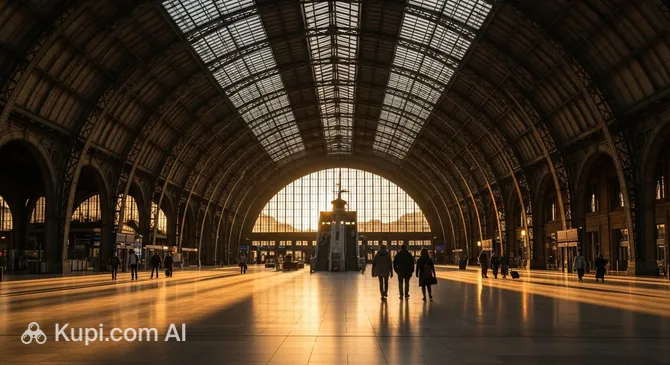
Leipzig Central Station (Leipzig Hauptbahnhof) is not just a transport hub, but a true architectural masterpiece and one of the city's most recognisable landmarks. It is considered one of the largest railway stations in Europe by floor area, impressing travellers with its sheer scale and historic façade. A vast shopping centre is located inside the station, making it a point of attraction not only for passengers but also for shopping enthusiasts.
Important for passengers: The station is a classic "terminus" (Kopfbahnhof) for long-distance trains, which ensures convenient access to platforms without the need to use underground passageways for the main tracks (platforms 6–24). However, the urban S-Bahn trains use the underground "City Tunnel" (platforms 1 and 2). The main hall is divided into eastern and western sections, with large information display boards helping you navigate.
Contact Information
Official website: The station's page on the bahnhof.de portal (Deutsche Bahn).
Information Service: DB Information counters located in the centre of the main hall (open 24/7).
Opening Hours: The station itself is open around the clock, though shops and ticket counters have their own schedules (usually from 06:00 to 22:00).
Luggage Storage: Automated lockers are available 24/7, located in the side wings of the station.
Accessibility: The station is fully equipped for passengers with reduced mobility (lifts to underground platforms, barrier-free access to main tracks, and the Mobility Service assistance team).
Getting There
Getting to Leipzig Central Station is very simple, as it is situated on the northern edge of the historic city centre.
Public Transport: Directly in front of the main entrance lies a major tram hub (stop Hauptbahnhof), through which most lines of the city tram network (LVB) pass. Underground, the S-Bahn Mitteldeutschland commuter trains stop, connecting the city with the wider region and the airport.
Taxis and Cars: Taxi ranks are located at the eastern and western exits. For private vehicles, multi-level car parks (Parkhäuser) are provided on the eastern and western sides.
On Foot: From the Market Square (Markt) and the Old Town Hall, you can reach the station in just 5–10 minutes at a leisurely pace, walking north through the shopping streets.
Services and Amenities
Leipzig Station offers an exceptional level of service, effectively operating as a "city within a city".
Key Services:
Tickets and Information: Travel Centre (DB Reisezentrum) and numerous ticket vending machines.
Waiting Areas: General seating zones and a specialised DB Lounge for First Class passengers and status customers.
Connectivity: Free Wi-Fi (WIFI@DB) is available throughout the premises.
Luggage and Hygiene: Spacious areas with automated luggage lockers of various sizes and clean paid restrooms (Sanifair), equipped with shower facilities.
Assistance: The "Bahnhofsmission" point provides aid to passengers in difficult situations.
Dining
Thanks to the integrated Promenaden Hauptbahnhof shopping centre, finding food here is never an issue. You will find over 100 shops and cafés spread across three levels.
Where to eat:
Quick Bites: The food court features all popular international fast-food chains, as well as outlets serving German sausages (Bratwurst) and Asian noodles.
Coffee and Pastries: A huge selection of bakeries (such as Lukas or Steinecke), where you can grab a fresh pretzel and coffee to go. The average bill for breakfast is 5–8 Euros.
Travel Supplies: An important feature is that the supermarkets (Rewe, Aldi) inside the station remain open on Sundays (from 12:00 to 18:00), which is a rarity in Germany.
Station History
The history of Leipzig Station began with its grand opening in 1915. It was built to replace several separate stations and symbolised the unification of the Saxon and Prussian railways, which is reflected in the symmetrical architecture of the building with its two domes and two entrance groups.
During the Second World War, the building suffered serious damage from bombing but was carefully restored in the 1950s. A large-scale reconstruction following the reunification of Germany in the 1990s transformed it into a modern transport and shopping complex. A crucial stage in its recent history was the opening of the City Tunnel in 2013, which allowed for the through-movement of trains across the city centre, significantly speeding up regional connections.
Passenger Tips
Arrival: Given the size of the station, arrive at least 20–30 minutes before your train's departure, especially if you need to locate your platform or buy provisions.
Tickets: If you plan to use public transport after arrival, the City-Ticket (often included in long-distance DB tickets) grants you one journey to your final destination within the city.
Safety: As with any major station, keep an eye on your belongings in crowds. The station is patrolled at night, but it is best to wait for your train in well-lit areas or the DB Lounge.
Transfers: Allow at least 10–15 minutes for transfers if you need to switch from the surface platforms (6–24) to the underground ones (1–2), as the descent takes time.