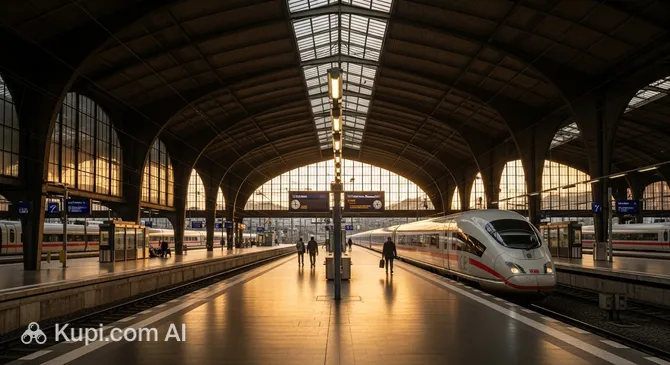
Munich Central Station (München Hauptbahnhof) is not just a major transport hub, but a true gateway to the Bavarian capital for thousands of travellers every day. It is one of the busiest stations in Germany, connecting Munich via high-speed ICE trains with major European cities, as well as serving a dense network of regional trains. The station building is located in the immediate vicinity of the historic centre, making it an ideal starting point for exploring the city.
It is important for passengers to know that the station is a terminus (Kopfbahnhof) for long-distance trains, which means that all tracks end in the main hall. However, the station has a complex structure: in addition to the Main Hall (tracks 11–26), there are two side wings — Starnberger (Starnberger Flügelbahnhof, tracks 27–36) and Holzkirchner (Holzkirchner Flügelbahnhof, tracks 5–10). Transferring between them can take up to 10–15 minutes, so it is worth studying the layout in advance for short connections. Underground, there are S-Bahn (suburban train) and U-Bahn (metro) stations, accessible via numerous escalators from the main hall.
Contact Information
To plan your journey and obtain the latest information, please use the following contacts:
Official website: www.bahnhof.de (München Hbf section)
Information desk phone (DB): +49 30 2970 (general Deutsche Bahn hotline)
Address: Bayerstraße 10a, 80335 München, Germany
Opening hours: The station is open 24 hours a day. Ticket offices and information desks are usually open from 06:00 to 22:30.
Luggage storage: Automatic lockers are available 24/7 in the main hall and side wings (cost from 4 to 6 EUR per day).
Accessibility: The Mobility Service assists passengers with reduced mobility (advance booking 24 hours prior is recommended).
How to Get There
Getting to Munich Central Station is very easy, as it is the heart of the city's transport system.
Public Transport:
S-Bahn (Suburban Train): Almost all main lines (S1–S8) pass through the station. This is the fastest way to arrive from outlying districts or the airport.
U-Bahn (Metro): The station is served by lines U1, U2, U4, U5. There are also connections to lines U7 and U8.
Tram: Stops for trams No. 16, 17, 19, 20, 29 are located right outside the main exits on Arnulfstraße and Bayerstraße.
From Munich Airport: The most convenient route is via the S1 or S8 train lines. Trains depart every 10–20 minutes, and the travel time is approximately 40–45 minutes.
On foot and taxi: From the central square Marienplatz, you can walk to the station in 15–20 minutes along the Kaufingerstraße shopping street. Taxi stands are located at the northern and southern exits; a trip within the city centre will take 5–10 minutes.
Services and Amenities
The station offers a wide range of services for a comfortable wait and to address daily needs while on the road.
Tickets and Information: A large Reisezentrum (Travel Centre) is located in the main hall. Red and blue self-service ticket machines are also placed throughout the station.
Waiting Areas: There are rest zones for all passengers on the first floor. 1st class passengers and status card holders can utilise the comfortable DB Lounge.
Connectivity and Power: Free WIFI@DB is available on the premises. Power outlets can be found in waiting areas and most cafes.
Luggage and Hygiene: Luggage lockers of various sizes operate around the clock. Rail & Fresh toilets (paid, approx. 1 EUR) are equipped with shower cabins.
For passengers with reduced mobility: The station is equipped with elevators and ramps, and there is a dedicated desk for assistance and escort to trains.
Where to Eat
It is impossible to stay hungry at Munich Station: there is a huge selection of gastronomy here for every taste and budget.
For a quick snack, the numerous bakeries (such as Rischart or Yorma's) are ideal, where you can buy a fresh pretzel, sandwich, and coffee for 3–5 EUR. In the main hall and on the underground level, there is a food court featuring popular fast-food chains, Asian noodles, and traditional Bavarian sausages.
Useful tip: If you arrive on a Sunday or late at night when city shops are closed, the Rewe and Edeka supermarkets inside the station (usually open until 23:00) will be your salvation. Here you can buy groceries and beverages at standard city prices.
Station History
The history of rail transport in this location began back in 1839, but the station occupied its modern location a little later. The first monumental building was erected in the second half of the 19th century and was severely damaged during the Second World War.
After the war, a decision was made not to restore the old facade, but to build a new functional complex, which opened in 1960. It was then that the recognisable look of the main facade with its clock and light canopies was formed. Currently, the station is undergoing another stage of massive reconstruction connected with the construction of the second suburban train line (2. Stammstrecke) and the renovation of the above-ground section, which will transform it into an ultra-modern transport hub in the coming years.
Passenger Tips
To ensure your trip goes smoothly, please pay attention to a few important points:
Arrival Time: Due to the large size of the station, arrive at least 20 minutes before departure. If your train departs from tracks 5–10 or 27–36, allow extra time for walking (up to 10 minutes from the main entrance).
Public Transport Tickets: Tickets for the metro and S-Bahn purchased from machines often require validation in the blue boxes before descending to the platform. Fines for travelling without validation are high.
Safety: As at any major station, watch your belongings, especially in crowds. At night, it is safer to wait for your train in designated zones or 24-hour cafes.
Navigation: Download the DB Navigator app — it shows up-to-date information on departure tracks and delays in real-time, which is often more reliable than the display boards.