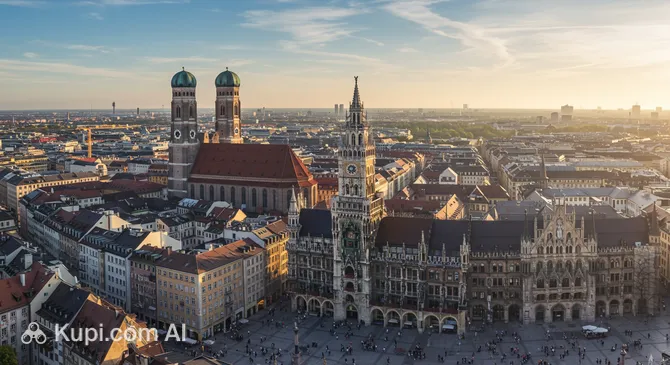
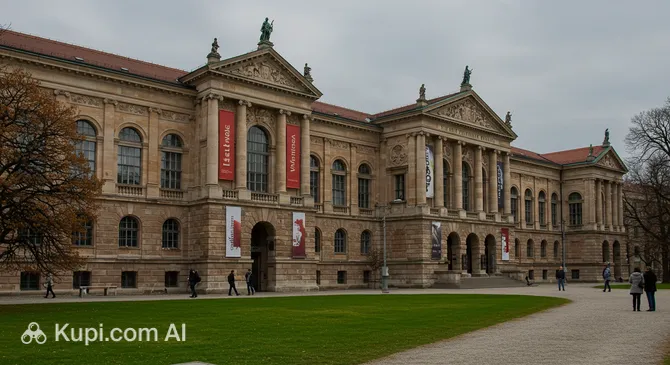
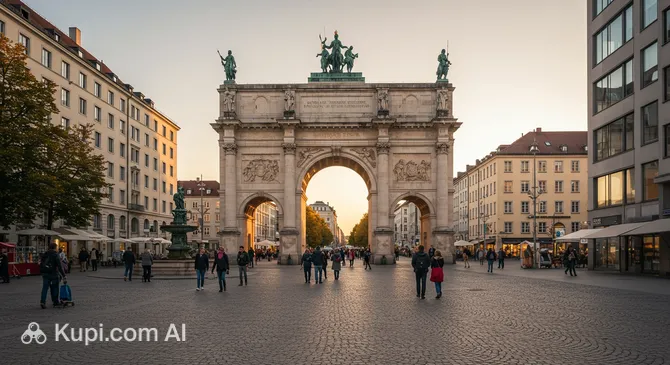
Munich, the capital of Bavaria, is a city where traditional Alpine culture seamlessly blends with modern innovation and a cosmopolitan lifestyle. Known for its warm hospitality and "Gemütlichkeit" (coziness), it stands as one of the most vibrant and prosperous destinations in Germany. With a population of over 2.6 million, Munich is a bustling metropolis that nevertheless manages to retain a charming, welcoming atmosphere.
Munich. Illustration.
Source: Kupi.com AI
Located on the banks of the Isar River north of the Bavarian Alps, the city enjoys a picturesque setting that serves as a gateway to stunning natural landscapes. The rich history of Munich is reflected in its magnificent architecture, from Gothic churches to baroque palaces. Visitors are often drawn to the heart of the city at Marienplatz, where the famous Glockenspiel chimes daily, and to the sprawling English Garden, which is even larger than New York's Central Park.
Whether you are visiting to experience the world-renowned Oktoberfest, explore the opulent Nymphenburg Palace, or simply enjoy a pretzel in a traditional beer garden, the city offers something for everyone. Munich invites travelers to immerse themselves in its unique culture, making it a must-visit location for anyone exploring Europe.
Weather Overview
Munich experiences a continental climate characterized by distinct seasons, offering a different atmosphere depending on when you visit. The summer months of June through August are generally pleasant and warm, with average temperatures hovering around 19°C and daytime highs reaching up to 24°C. In contrast, winters are cold; January is typically the chilliest month, with average temperatures around 1.4°C and lows frequently dipping below freezing.
Precipitation is fairly consistent throughout the year, so it is always a good idea to carry an umbrella. May tends to be the dampest month in terms of frequency, recording up to 18 wet days. Expect warm summers with occasional rain and cold winters that often bring a crisp chill to the air. For a more comprehensive look at what to expect during your trip, you can consult our detailed guide to the weather in Munich.
Average monthly temperature
Average monthly precipitation
Interesting Facts
Beyond the main attractions, Munich holds many fascinating secrets and quirky traditions that often escape the casual observer. From urban legends hidden in churches to unexpected sports scenes, the city is full of surprises.
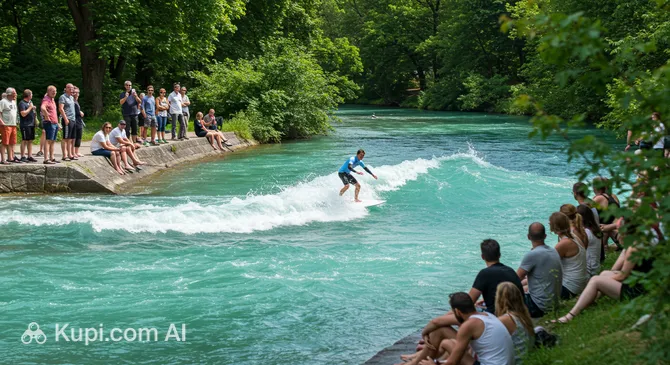
Eisbach Wave. Illustration.
Source: Kupi.com AI
Traveler photos:
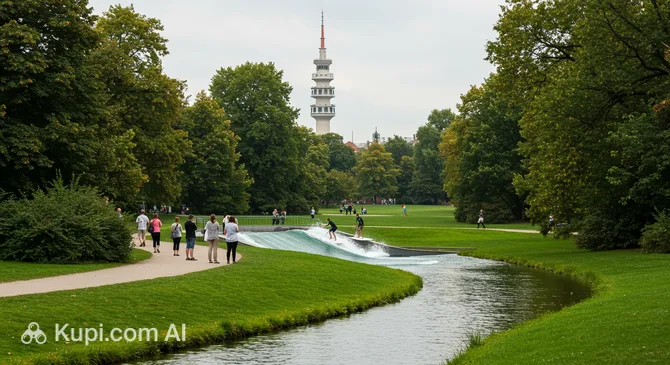
Surfing is likely the last sport you would expect in a landlocked city, but the Eisbach Wave has become a cult hotspot. Located at the entrance to the English Garden, this man-made river wave attracts surfers from around the globe who ride the icy water year-round, right in the city center.
A mysterious black mark known as the "Devil's Footprint" (Teufelstritt) can be found in the entrance hall of the Cathedral of Our Dear Lady. According to local legend, the devil stomped his foot there in delight, thinking the church had been built without windows, only to realize later that they were simply hidden by the massive columns.
At the world-famous Hofbräuhaus Munich, beer is a serious business involving personal security. Regular patrons, known as "Stammgäste," have access to private lockers where they keep their valuable stone beer mugs safe between visits, a tradition that highlights the locals' deep dedication to their brewing culture.
The city's skyline pays a unique architectural tribute to its automotive history. The headquarters of the car giant BMW was designed to resemble the four cylinders of a car engine, standing as a futuristic landmark next to the BMW Museum and BMW Welt.
How to Get There
Reaching the Bavarian capital is straightforward thanks to its excellent connectivity with the rest of Europe and the world. Whether you prefer flying or taking the train, the city is a major transportation hub. For those looking for detailed routes and tips, you can read more about how to get to Munich to plan your journey efficiently.
The primary gateway for air travelers is the Franz Josef Strauss Airport(IATA: MUC). As a large international hub, it handles millions of passengers annually and connects the region to destinations across the globe. Located approximately 29 km from the city center, the journey by road typically takes about an hour, depending on traffic. Travelers can easily access the city via taxi, bus, or the efficient S-Bahn suburban train lines that run directly from the terminal.
For budget-conscious travelers, Memmingen Allgäu Airport(IATA: FMM) is a popular alternative. Although it is often marketed as "Munich West," please note that this airport is located in the city of Memmingen, about 102 km away from Munich. The transfer time by taxi or bus is approximately 1 hour and 20 minutes. Another option is Nuremberg Airport(IATA: NUE) in Nuremberg, situated roughly 156 km to the north, which serves as a regional hub for Franconia and beyond.
For clarity, here is a summary of the main airports serving the region:
Traveling by train is another convenient way to arrive, offering scenic views of the German countryside. The city's central rail hub is Munich Hauptbahnhof. It is one of the busiest railway stations in Germany, handling a massive volume of passengers and situated right in the heart of the city, just about 1.9 km from the central landmarks. From here, you have immediate access to the subway (U-Bahn), trams, and buses.
Travelers coming from Austria might also consider connections through Salzburg Hauptbahnhof. Located in the city of Salzburg, approximately 115 km from Munich, it is a significant station for cross-border trains. A journey from Salzburg by road typically takes 1.5 to 2 hours, though direct train services are generally much faster and more direct.
Below is an overview of key railway stations in the vicinity:
Munich offers a wealth of sights that range from royal heritage to modern architectural marvels. The city center is compact and walkable, allowing visitors to easily explore its most iconic landmarks. Whether you are interested in history, science, or simply soaking up the local atmosphere, the Bavarian capital has plenty to offer.
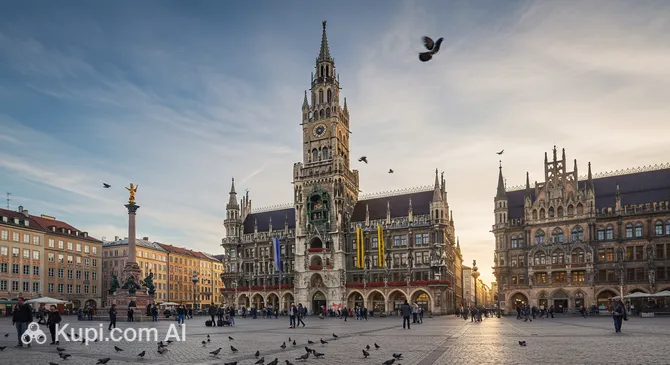
At the very heart of the city lies Marienplatz, the central square that has been Munich's main gathering point since 1158. It is dominated by the New Town Hall (Neues Rathaus), a stunning neo-Gothic building famous for its Glockenspiel. Every day, crowds gather to watch the mechanical figures reenact historical Bavarian stories to the sound of chimes. The square is the perfect starting point for any tour, bustling with activity and surrounded by shops and cafes.
Marienplatz. Illustration.
Source: Kupi.com AI
Traveler photos:
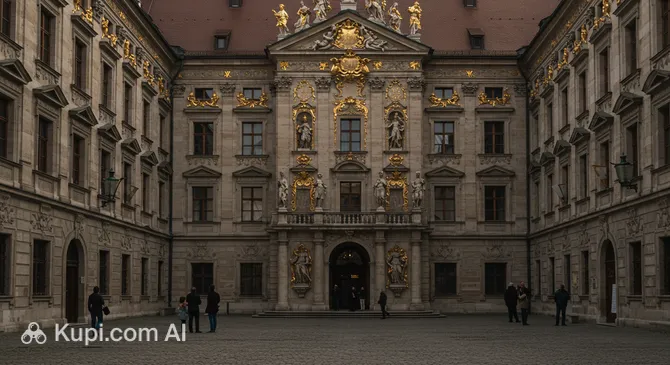
Just a short walk from the center, you will find the Munich Residenz. This vast palace complex served as the seat of government and residence of the Bavarian dukes, electors, and kings from 1508 to 1918. Today, it is one of the largest museum complexes in Bavaria. Visitors can wander through the lavishly decorated rooms, admire the Renaissance Antiquarium, and explore the Treasury, which houses the crown jewels. It is a breathtaking testament to the opulence of the Wittelsbach dynasty.
Munich Residenz. Illustration.
Source: Kupi.com AI
Traveler photos:
For those fascinated by science and technology, the Deutsches Museum is an absolute must-visit. Located on an island in the Isar River, it is one of the world's largest and oldest museums of science and technology. The exhibits cover everything from astronomy and aviation to mining and physics, often featuring interactive displays that appeal to visitors of all ages. It is a place where you can easily spend an entire day discovering the wonders of human innovation.
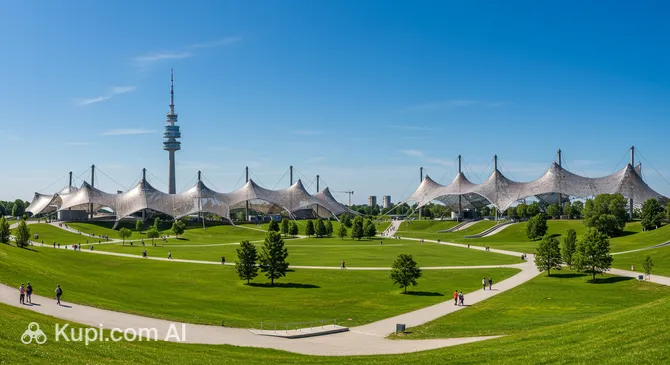
To experience a different side of the city's history, head to the Olympic Park Munich. Built for the 1972 Summer Olympics, this sprawling area is renowned for its bold, tent-like roof architecture that covers the main stadium and halls. Beyond its architectural significance, the park is a popular leisure destination offering panoramic views from the Olympic Tower, serene lakes, and green hills that are perfect for a relaxing afternoon walk.
Olympic Park Munich. Illustration.
Source: Kupi.com AI
Traveler photos:
Local Cuisine
Munich is a paradise for food lovers, particularly those with a hearty appetite. Bavarian cuisine is famous for its comforting, rustic dishes that perfectly complement the region's world-class beer. A culinary journey here typically begins with a traditional breakfast of Weisswurst—white veal sausages served with sweet mustard and a fresh soft pretzel. By tradition, these sausages are strictly a morning affair and should not be eaten after the church bells ring at noon.
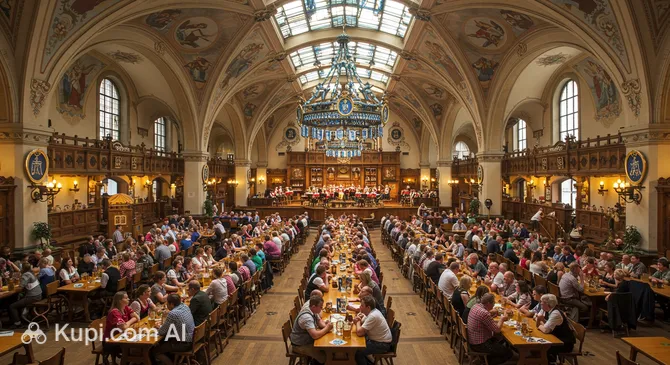
For a substantial meal, locals and visitors alike flock to the city's taverns for Schweinshaxe, a roasted pork knuckle with crispy skin, usually served with potato dumplings and sauerkraut. To experience the quintessence of this food culture, a visit to the Hofbräuhaus Munich is essential. Founded in 1589, this legendary beer hall offers an energetic atmosphere where you can enjoy liter-sized mugs of beer alongside classic Bavarian platters.
Hofbräuhaus Munich. Illustration.
Source: Kupi.com AI
Traveler photos:
Dining in Munich is not just about the food but also the setting. The Ratskeller Munich provides a unique ambiance located directly beneath the New Town Hall. With its vaulted ceilings and historic murals, it serves authentic regional specialties in a space that feels like a step back in time, making it a favorite for those seeking a traditional Bavarian experience.
If you are looking for something more unconventional, Gans Woanders offers a whimsical escape from the traditional beer halls. This cafe, built from reclaimed wood and resembling a treehouse, is perfect for enjoying wood-fired pizzas, cakes, and organic drinks in a cozy, fairytale-like environment. Whether you prefer a noisy historic hall or a quirky modern spot, the city's culinary scene has something to satisfy every taste.
Travel Tips
To help you make the most of your Bavarian adventure, we have compiled a list of essential travel advice. A little preparation goes a long way in Munich, ensuring that your trip is as smooth and enjoyable as the local lager.
Clothing and Gear: Munich's weather can be changeable, so the key is layering. Bring a waterproof jacket and a warm sweater, even in summer, as evenings can get cool. Comfortable walking shoes are a must for navigating the cobblestone streets of the Old Town. While there is no strict dress code for most places, modest attire covering shoulders and knees is respectful when visiting churches.
Transportation: The public transport system (MVV), consisting of the U-Bahn (subway), S-Bahn (suburban trains), trams, and buses, is efficient and covers the entire city. Renting a car is generally unnecessary and can be a hassle due to traffic and parking costs. Important: Always validate your ticket (stamp it in the blue machines) before boarding trains or rarely on the bus, as plainclothes inspectors check frequently and fines are steep.
Finances: Germany uses the Euro (€). While credit cards are increasingly accepted, Munich is still very much a cash-based society ("Bargeld lacht"). Many traditional beer gardens, small bakeries, and cafes may strictly accept cash only. ATMs are widespread, but it is wise to always carry some physical money. Tipping is modest; rounding up the bill or leaving 5-10% is standard practice.
Health and Safety: Munich is one of the safest cities in Europe. Pharmacies, marked by a red "A" (Apotheke), are easy to find; for after-hours service, look for the posted "Notdienst" (emergency service) schedule on any pharmacy door. The biggest safety tip for pedestrians is to stay off the bike lanes. Cyclists ride fast and expect their path to be clear; walking in the bike lane is a guaranteed way to upset locals.
Communication: The official language is German, but English is widely spoken, especially in the service industry and among younger people. However, learning a few local phrases goes a long way. Use the Bavarian greeting "Servus" for both hello and goodbye to charm the locals. Free Wi-Fi (M-WLAN) is available in many public squares like Marienplatz.
Local Etiquette: Politeness and order are valued. When entering a shop, a simple "Grüß Gott" (formal hello) is polite. In beer gardens, it is customary to clink glasses at the bottom (not the rim) and, most importantly, maintain eye contact while saying "Prost!"—failure to do so is considered bad luck. Also, remember that Sunday is a strict rest day; almost all shops and supermarkets will be closed.
What to Avoid: Do not jaywalk. Germans take traffic rules seriously, and crossing a red light—even if the street is empty—is frowned upon, especially if children are nearby. Wait for the green "Ampelmännchen" signal. Additionally, avoid sitting at a table marked "Stammtisch" in a pub; these are reserved for regulars.
Additional Tip: Don't throw away your plastic bottles or soda cans! Germany has a deposit system called Pfand. You pay a small deposit (usually €0.25) when buying a drink, which you get back by returning the empty bottle to reverse vending machines found in almost every supermarket.
With these practical tips in hand, you are ready to navigate Munich like a local. Embrace the city's unique blend of tradition and modernity, and enjoy every moment of your stay in the heart of Bavaria.
Entertainment & Nightlife
Munich's nightlife is as diverse as its beer culture, offering everything from traditional Bavarian pubs to high-energy techno clubs and chic cocktail lounges. As the sun sets, the city transitions from a relaxed cultural hub into a vibrant playground for night owls. While the traditional beer halls may close relatively early, the party continues well into the morning in the city's dedicated entertainment districts, catering to every musical taste and style.
One of the most popular areas for an evening out is the Glockenbachviertel. Once the center of the LGBTQ+ scene, it is now a trendy district packed with stylish bars and overflowing street cafes. For a more bohemian and student-friendly vibe, head to Schwabing. The area around Münchner Freiheit is legendary for its mix of cabaret theaters, jazz clubs, and late-night eateries, making it a perfect starting point for bar-hopping.
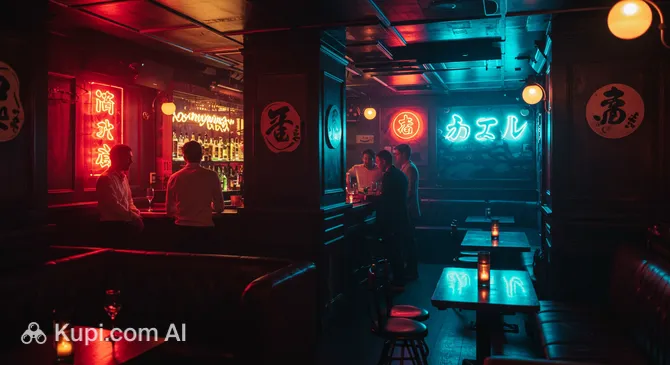
For those seeking a unique modern experience, the Werksviertel-Mitte near Ostbahnhof is the place to be. This converted industrial area is a hub for art, music, and entertainment. Here, you can sing your heart out at the Yokocho Karaoke Box & Bar, a venue designed like a Japanese alleyway that transports you straight to Tokyo. If you prefer something truly unconventional, look for the Boazn – Public Restroom Bar. As the name suggests, this cozy spot is housed in a converted public toilet facility, offering a quirky yet intimate setting for drinks that is sure to be a conversation starter.
Yokocho Karaoke Box & Bar. Illustration.
Source: Kupi.com AI
Traveler photos:
Before diving into the club scene, the city offers excellent options for lighter evening entertainment. You might catch a show at one of the many theaters or enjoy a playful start to the night at 3D Blacklight Minigolf Munich, where fluorescent art meets competitive fun. For a breathtaking view of the illuminated skyline before hitting the town, a ride on the Umadum Ferris Wheel provides a spectacular perspective of the city lights.
When planning your night out, keep in mind that the dress code in Munich is generally smart casual. While bouncers at exclusive techno clubs can be selective, most bars are welcoming and relaxed. Prices are moderate to high, typical for a major European city. Getting around is safe and easy; the subway (U-Bahn) usually runs until about 1:00 AM on weekdays and 2:00 AM on weekends, while an extensive network of night trams and buses (N-lines) keeps the city moving all night. Cream-colored taxis are reliable and can be easily hailed or booked via apps.
Parks & Museums
Munich is a city that breathes, offering a perfect balance between urban sophistication and lush, green escapism. With its vast public gardens and a museum district that rivals the best in Europe, the Bavarian capital provides endless opportunities for relaxation and cultural enrichment. Whether you want to stroll beneath ancient chestnut trees or admire masterpieces by the Old Masters, the city's parks and galleries are an essential part of the local lifestyle.
The crown jewel of the city's green spaces is undoubtedly the English Garden. Stretching from the city center to the northeastern limits, it is one of the largest urban parks in the world, surpassing even New York's Central Park in size. Locals flock here to sunbathe on the Schönfeldwiese, watch the surfers on the Eisbach, or enjoy a liter of beer at the famous Chinese Tower. It is a sprawling oasis where winding paths, open meadows, and serene streams create a peaceful retreat from the bustling streets.
English Garden. Illustration.
Source: Kupi.com AI
Traveler photos:
For a slightly different atmosphere, the Hirschgarten offers a unique mix of nature and conviviality. Located in the Nymphenburg district, this park was originally a royal deer preserve, and fallow deer still roam in an enclosure today, much to the delight of visitors. It is also home to the city's largest beer garden, where thousands of people gather under the shade of massive trees to enjoy traditional Bavarian hospitality in a relaxed, family-friendly setting.
Culture enthusiasts will find themselves at home in the Kunstareal, Munich's dedicated art district. A standout institution here is the Alte Pinakothek, one of the oldest galleries in the world. Its imposing brick facade houses a treasure trove of European painting from the Middle Ages to the Rococo period. Visitors can stand before monumental works by Rubens, Dürer, and Rembrandt, making it a pilgrimage site for anyone with a passion for art history.
Alte Pinakothek. Illustration.
Source: Kupi.com AI
Traveler photos:
Just a short walk away lies the Lenbachhaus, a stunning villa that offers a more intimate artistic experience. Famous for its collection of works by "The Blue Rider" (Der Blaue Reiter) group, including Kandinsky and Marc, the museum showcases the revolutionary expressionist movement that took root in Munich. The building itself, with its golden extension and historic Florentine-style villa, is an architectural highlight that beautifully bridges the gap between the past and the present.
Families and nature lovers should not miss the Hellabrunn Zoo. Founded in 1911 as the world's first "geo-zoo," it organizes animals by continent rather than species, allowing them to live in spacious, naturalistic enclosures. Set along the banks of the Isar River, it feels more like a nature reserve than a traditional zoo, offering a wonderful day out for visitors of all ages.
For a truly authentic experience away from the city center, consider a trip to the Poing Wildlife Park. Located just outside the city, this expansive park allows native wildlife like deer and mouflon to roam freely among the visitors. It is a favorite weekend spot for locals, offering a rare chance to hand-feed gentle forest animals and walk through pristine woodland trails.
Getting Around
Munich boasts one of the most comprehensive and efficient public transport systems in Europe, managed by the Munich Transport and Tariff Association (MVV). The network seamlessly integrates the U-Bahn (underground metro), S-Bahn (suburban trains), trams, and buses, allowing travelers to reach almost any corner of the city and its surrounding areas with a single ticket. The U-Bahn is recognizable by its blue "U" signs and primarily serves the inner city, while the S-Bahn, marked by green "S" signs, connects the city center with the suburbs and the airport. Trams and buses complement these rail networks, filling the gaps and offering scenic routes through the city's neighborhoods.
Navigating the ticket system is straightforward once you understand the zones. For most tourists exploring the main attractions, a ticket for Zone M (Munich City) is sufficient. Visitors can choose from a variety of options, including single tickets, the cost-effective Stripe Ticket (Streifenkarte) which allows for multiple flexible journeys, and Day Tickets (Tageskarte) available for individuals or groups. For those planning extensive sightseeing, the Munich Card or CityTourCard offers unlimited travel within selected zones along with discounts at various museums and attractions. Tickets can be purchased at multilingual vending machines at stations, via the MVV or MVGO apps, and sometimes from bus drivers.
A critical detail for first-time visitors is the validation process. If you buy a physical ticket from a vending machine that is not pre-stamped, you must validate it before boarding trains or immediately upon entering a bus or tram. Look for the small blue stamping machines located at station entrances or on board surface transport. Insert your ticket to receive a time stamp; failing to do so is considered fare evasion and can result in a hefty fine during ticket inspections, which are frequent and conducted by plainclothes officers.
The system operates extensively, typically running from around 4:30 AM until approximately 1:30 AM on weekdays, with extended service on weekends. In the gap between the last regular train and the first morning service, an extensive network of night buses and trams (marked with an "N") keeps the city moving, ensuring you can always get back to your hotel safely. The frequency is high, with U-Bahn trains arriving every few minutes during peak times, making timetables almost unnecessary for short trips within the center.
While public transport is the primary way to get around, the city is also incredibly bike-friendly. Bicycles are a popular alternative, with dedicated lanes on almost every street and rental systems like MVG Rad available throughout the city. For those who prefer a car, car-sharing services and electric scooters are widely available via mobile apps. Cream-colored taxis can be hailed on the street or found at designated stands, though they are significantly more expensive than the transit system.
Finally, transit in Munich offers more than just utility; it can be an aesthetic experience. The city is famous for the architecture of its U-Bahn stations, which are often described as underground art galleries. Stations like Westfriedhof, with its massive industrial lamps bathing the platform in blue and yellow light, or the vibrant orange of Marienplatz, turn a mundane commute into a visual delight. Riding the U-Bahn is not just a means of transport, but a chance to see some of the city's impressive modern design.
Accommodation
Where to Stay:
Finding the perfect place to stay in Munich is relatively easy, as the city offers a diverse range of accommodation options to suit every budget and travel style. Visitors can choose from traditional Bavarian guesthouses (Gasthöfe) that offer a cozy, authentic atmosphere, to sleek, modern business hotels and international luxury chains. For budget-conscious travelers, there are numerous well-maintained hostels and budget motels, while those seeking more independence can find a wide selection of furnished apartments and vacation rentals throughout the city.
The location you choose depends largely on your itinerary. The most popular area for first-time visitors is the Altstadt (Old Town), which places you within walking distance of major sights like Marienplatz and the Viktualienmarkt. However, this convenience often comes with a higher price tag. For a more practical and often more affordable base, the area around the Hauptbahnhof (Central Station) is ideal due to its unbeatable transport links, though it is a bustling and busy district. Travelers looking for a livelier, more bohemian vibe might prefer Schwabing, known for its student culture, cafes, and proximity to the English Garden.
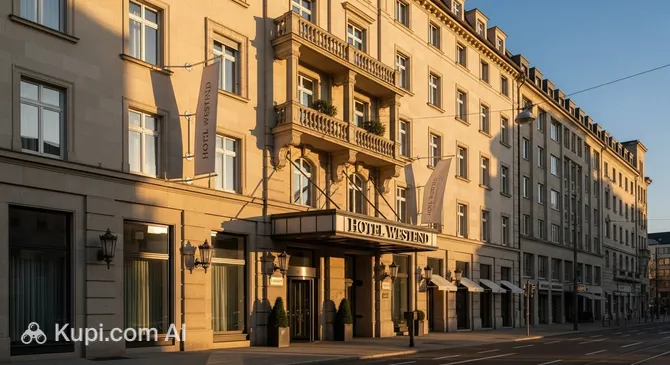
If you are looking for specific examples of local hospitality, the city has several notable establishments. You might consider the Hotel Westend, which is located in a district favored for its proximity to the Theresienwiese, the home of Oktoberfest. For those seeking a stay with potentially more extensive amenities, the Munich Resort provides another option for travelers. These establishments are just a glimpse of the varied hospitality landscape available in the Bavarian capital.
Hotel Westend. Illustration.
Source: Kupi.com AI
Traveler photos:
A crucial tip for booking accommodation in Munich is timing. While finding a room is generally straightforward throughout the year, the city transforms completely during major trade fairs and, most notably, during Oktoberfest (late September to early October). During these peak times, prices can triple, and rooms are often booked out months—sometimes a year—in advance. It is highly recommended to secure your reservation as early as possible if your trip coincides with these events.
In terms of pricing, Munich is one of Germany's more expensive cities. Budget options typically start around €60–€90 per night, while mid-range hotels usually fall between €100 and €200. Luxury stays can easily exceed €300 per night. Booking is most commonly done through major online travel platforms, but checking a hotel's direct website can sometimes yield better rates or special package deals.
Nearby Cities
For those looking to explore the surroundings, Munich serves as an excellent base for day trips to several interesting nearby locations. Just a short distance from the city limits, Karlsfeld is a favorite destination for outdoor enthusiasts. It is best known for the Karlsfelder See, a large recreational lake that offers swimming, hiking trails, and a lively atmosphere in the warmer months. Another notable spot is Unterhaching, located to the south. This town attracts visitors with the Landscape Park Hachinger Tal, a sprawling green space created on a former airfield that now serves as a haven for nature lovers and sports fans alike.
City
Population
Distance
Unterhaching
25 379
8 km
Unterfoehring
11 296
8 km
Neubiberg
14 538
9 km
Taufkirchen
18 035
10 km
Pullach im Isartal
8 983
10 km
These nearby destinations offer a glimpse into the diverse culture and landscapes of the region.
Shopping & Souvenirs
Munich is a diverse shopping destination that effortlessly combines traditional Bavarian charm with high-end luxury and modern retail trends. The city's main shopping artery is the lively pedestrian zone that stretches between Marienplatz and Karlsplatz (Stachus). This bustling mile, comprising Kaufingerstraße and Neuhauser Straße, is lined with large department stores, international fashion chains, and historic buildings, making it the perfect starting point for any shopping spree.
Karlsplatz. Illustration.
Source: Kupi.com AI
Traveler photos:
For those seeking luxury and exclusivity, Maximilianstraße is the address to visit. Here, world-renowned designer boutiques sit alongside five-star hotels in a sophisticated setting. Just a stone's throw away, you will find the elegant Fünf Höfe (Five Courts). This architectural masterpiece is more than just a shopping passage; it is a blend of art, culture, and commerce where visitors can stroll through stylish courtyards, admire the famous "Hanging Gardens," and explore a curated selection of upscale shops and cafes.
Fünf Höfe. Illustration.
Source: Kupi.com AI
Traveler photos:
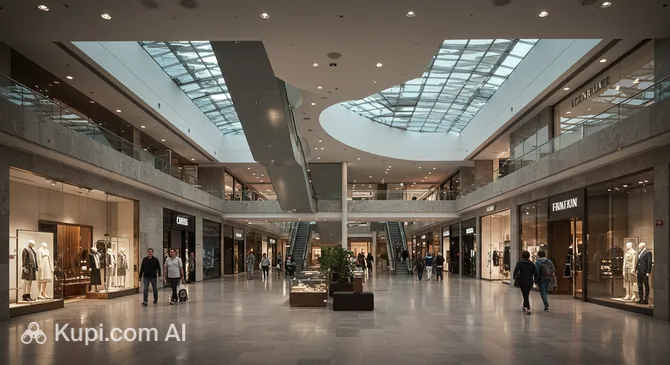
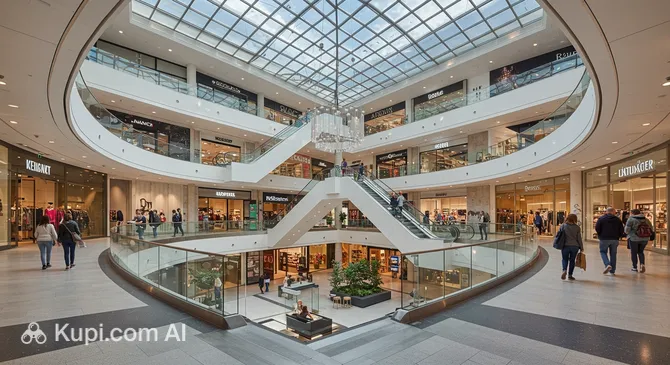
If you prefer a comprehensive shopping experience under one roof, the city offers several modern malls. The largest of these is the Riem Arcaden, located in the Messestadt Riem district. With over 120 shops, numerous restaurants, and a relaxed atmosphere, it provides everything from fashion and electronics to groceries, making it a favorite destination for locals and families alike.
Riem Arcaden. Illustration.
Source: Kupi.com AI
Traveler photos:
No shopping trip to Munich would be complete without exploring its traditional side. The Viktualienmarkt, located just steps from the central square, is a sensory delight where you can buy fresh regional produce, exotic spices, and local delicacies. For authentic souvenirs, look for traditional Bavarian crafts such as hand-painted beer steins, Nymphenburg porcelain, or a classic "Tracht" (Lederhosen or Dirndl), which are worn with pride during festivals and special occasions.
Travelers should be aware of the local opening hours, known as "Ladenschluss". Most shops in the city center are open from Monday to Saturday, typically closing by 8:00 PM. It is important to note that, in accordance with German tradition, almost all shops—including supermarkets and pharmacies—are closed on Sundays. The only exceptions are generally found at the main train station (Hauptbahnhof) and the airport, where you can find basic necessities seven days a week.