Support

Franz Josef Strauss Airport

Airports in the city

About the Airport

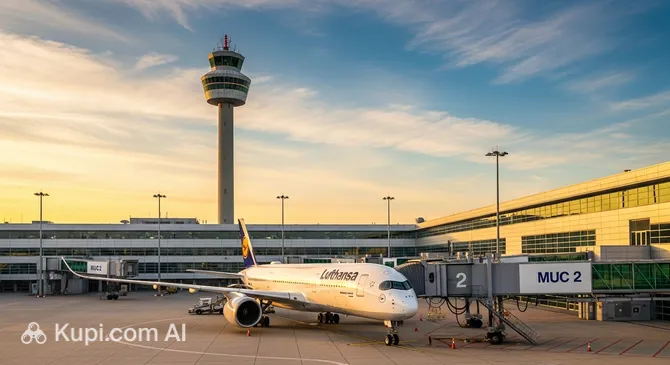
Franz Josef Strauss Airport. Source: Kupi.com Binoculars

Franz Josef Strauss Airport Munich is not merely a transport hub, but a true gateway to a Bavarian fairytale, where your journey begins with world-class comfort. It is the only airport in Europe featuring its own brewery and a cosy traditional garden, allowing you to experience the local atmosphere immediately upon landing. Thanks to intuitive navigation, futuristic architecture, and impeccable service, even a short layover here transforms into a pleasant part of your holiday.

IATA Code MUC
ICAO Code EDDM
City Munich
Distance to Centre 28.5 km
Status International
Passengers per Year ~41.6 million (2024)
Popular Airlines Lufthansa, Air Dolomiti, Eurowings
Schedule View online

Airport Features and Highlights:

Five-Star Status. Munich Airport was the first in Europe to be awarded the prestigious "5-Star" rating by Skytrax. This confirms the highest standards of cleanliness, ease of navigation, and passenger service quality.

Unique Gastronomy. A main highlight is the Airbräu brewery restaurant with an open-air garden, located right in the central area between the terminals. They brew their own beverages here and serve traditional Bavarian dishes at reasonable prices.

Visitors Park (Besucherpark). For aviation enthusiasts, there is a specially equipped hill with a viewing platform offering breathtaking views of the runways. There is also an exhibition of historic aircraft, including the legendary "Super Constellation".

Seasonal Events. In winter, the covered area between the terminals transforms into a magical festive market with a large ice rink and dozens of stalls offering souvenirs and warm treats, creating a holiday mood right before departure.

Contact Information

For your convenience, we have compiled the current contact details for Munich Airport to help you promptly resolve any issues related to flights, luggage, or services within the terminals:

  • Official Airport Website: www.munich-airport.de (available in German and English)
  • Information Service Phone: +49 89 975-00 (24-hour support)
  • Postal Address: Nordallee 25, 85356 München-Flughafen, Germany
  • Email: info@munich-airport.de
  • Lost & Found: Phone +49 89 975-214-70. The Lost & Found office is located in the Service Center in the central area of the airport (Munich Airport Center), Level 03.
  • Social Media: Official airport pages can be found on Facebook, Instagram, X (Twitter), and YouTube under the name Munich Airport.
  • Passenger Support Service: Information counters are located in Terminal 1, Terminal 2, and the central area (MAC). Special assistance is available for passengers with reduced mobility, which can be requested through your airline or on the airport website.

How to Get to the Airport

Bavaria's transport infrastructure is renowned for its efficiency, so getting from Franz Josef Strauss Airport to Munich city centre (and back) is effortless. The airport is located approximately 28.5 km northeast of the city, and travellers have several convenient transfer options to choose from.

Suburban Train (S-Bahn)

The most popular and predictable way to reach the centre is via the S1 and S8 suburban train lines. The station is located directly beneath the airport's central area (follow the signs with the green "S"). Trains depart every 10 minutes.

  • Route: The S1 line travels through the western part of the city, while the S8 goes through the east. Both lines will take you to the Central Station (Hauptbahnhof) and the central square, Marienplatz.
  • Travel Time: Approximately 35–45 minutes.
  • Cost and Tips: A single ticket costs around 13–14 Euros. If you are travelling as a couple or a group, it is more economical to buy a group ticket, the Airport-City-Day-Ticket (Partner), which is valid on all Munich public transport until 6 AM the following day.

Lufthansa Express Bus

Comfortable buses run between the airport and Munich Central Station every 20 minutes. This is an excellent alternative to the train, especially if you have a lot of luggage, as the buses are equipped with spacious luggage compartments.

  • Stops: Terminals 1 and 2, Schwabing district (München Nord / Schwabing), and Central Station.
  • Travel Time: About 45 minutes (depending on traffic).
  • Cost: A ticket purchased online is usually slightly cheaper than buying from the driver, costing around 11–12 Euros one way.

Taxi and Private Transfer

Taxi ranks are located at the exits of both terminals. A trip to the city centre in an official taxi (cream-coloured) will take about 30–45 minutes, depending on traffic. The fare is not strictly fixed but usually ranges from 85 to 100 Euros. Popular ride-hailing apps like Uber or FreeNow also operate in Munich.

Car Rental and Parking

For those planning to explore Bavaria by car, counters for all major rental companies are available at the airport. The exit from the airport leads directly onto the A92 autobahn, which connects to the A99 ring road.

The airport parking system is meticulously planned:

  • Short-term parking: Located directly at the terminals (for drop-offs and pick-ups).
  • Long-term parking: Economical zones (e.g., P41, P80) are located slightly further away but are connected to the terminals by free buses or the train. Booking a spot online in advance can help save up to 50% of the cost.

Nearest Alternative Airports

If you are planning a complex route across Europe or looking for better fares, it is worth considering neighbouring aviation hubs. Some of them are within a 1.5 to 2-hour drive from Munich and are actively used by tourists for trips to the Alps.

  • Salzburg Airport W. A. Mozart (SZG) — located in Austria, just 110 km from Munich. Popular among skiers and classical music lovers.
  • Memmingen Allgäu Airport (FMM) — often referred to as "Munich West" by low-cost carriers. Located 122 km away and offers budget flights.
  • Innsbruck Airport (INN) — an Austrian airport in the heart of the Alps, 126 km away. Ideal for winter tourism.
  • Nuremberg Airport (NUE) — located north of Munich at a distance of 137 km. A convenient hub for trips around Franconia.
  • Linz Airport (LNZ) — located in Austria, 178 km from the Bavarian capital.

Terminals and Map

Munich Airport is distinguished by a logical and clear structure, often referred to as a "campus". Despite its impressive size, it is designed so that passengers can orient themselves easily. The complex consists of two main passenger terminals (Terminal 1 and Terminal 2), connected by the Munich Airport Center (MAC) shopping and entertainment area.

Terminal 1: Decentralised Classic

This terminal serves airlines not part of the Star Alliance (e.g., Oneworld and SkyTeam alliances, as well as Emirates, Qatar Airways, Air France, British Airways, and others). Its main feature is its modular system.

  • Structure: The building is divided into five modules: A, B, C, D, and E. Modules A-D serve arrivals and departures, while Module E is used only for arrivals. There is also a separate Hall F, located closer to Terminal 2. It is used for flights with increased security requirements (e.g., to Israel).
  • Navigation Features: Terminal 1 is built on the concept of "short distances". Check-in counters, security checkpoints, and boarding gates are located within the same module. This means that upon entering the correct door from the street, you will be very close to your gate.
  • Zones: Level 04 is the main level for check-in and departure. Level 03 is the baggage claim area.

Terminal 2 and Satellite Terminal: Lufthansa Hub

This modern, bright building is used by Lufthansa and its Star Alliance partners. Terminal 2 operates on the principle of a centralised hub.

  • Structure: Unlike T1, here all passengers pass through a huge central departure hall (Plaza).
  • Satellite Terminal: Terminal 2 has an extension — a satellite building located directly on the apron. It has no direct street access or vehicle approach. Passengers check in and pass through security in the main T2 building, and then take a free automated underground train to the satellite in just one minute.
  • Zoning: Level 03 — Arrivals, Level 04 — Check-in and Departures (Schengen area), Level 05 — Departures (Non-Schengen area).

Munich Airport Center (MAC) and Connections

The central area (MAC) is the heart of the airport, linking both terminals. It is here, under a giant roof, that events take place and the famous garden restaurant operates.

Transfer between Terminal 1 and Terminal 2 is done on foot through the MAC area. The walk takes about 10–15 minutes. If you are in the transit area (airside) and need to change terminals, shuttle buses are available, but a repeat security check is often required.

Recommendations on Time and Navigation

Munich Airport operates efficiently, but due to its size and thorough security checks, it is important to calculate time correctly.

  • Arrival: It is recommended to arrive 2–2.5 hours before international flights and 1.5 hours for flights within Europe.
  • Security Check: In Terminal 2, the security area is centralised and can gather queues during peak hours, although it moves quickly. In Terminal 1, security checks take place directly before entering the "clean zone" of a specific module, which is often faster.
  • Apps and Maps: Interactive InfoGate kiosks are installed at the airport, where you can speak with a staff member via video link. It is also very convenient to use the airport's mobile app, which builds a route to your gate in real-time.

Airport History

Airport History:

The history of Munich's modern air harbour began relatively recently, but with an event that entered global logistics textbooks. Until the early 1990s, the city's main airport was Munich-Riem, located close to the centre. However, due to increasing passenger traffic and the impossibility of expansion, a decision was made to build a new complex on the Erdinger Moos marshes, away from urban development.

The Great Move of 1992
The official birthday of the airport is considered to be 17 May 1992. The transition from the old airport to the new one became a true legend. The relocation operation took just one night — from 16 to 17 May. About 5,000 people and hundreds of trucks participated in an unprecedented logistical mission. Exactly at midnight, the lights of the old airport went out, and work began at the new location. In the morning, the first Lufthansa flight landed on the new runway, and operations proceeded without a hitch. This achievement is still considered one of the most successful launches of major infrastructure projects in the world.

Name and Development
The airport was named after Franz Josef Strauss, the long-serving Prime Minister of Bavaria, who was a passionate aviation enthusiast and the initiator of the airport relocation project. Since its opening, the hub has developed rapidly, transforming from a regional node into a global transit centre.

The Era of Terminal 2
A major milestone in history was the opening of Terminal 2 in June 2003. This was a unique project in global practice: the terminal was built and is operated jointly by the airport management company and Lufthansa. This partnership allowed for the creation of ideal conditions for transit passengers and strengthened Munich's position as Germany's second hub after Frankfurt.

Expansion and Modernisation
In 2016, the airport expanded again by opening the Satellite Terminal. This is the first terminal building in Germany located in the middle of the apron with no car access — passengers reach it via an underground train. This allowed capacity to increase by another 11 million passengers per year while maintaining the highest standards of comfort.

Records and Recognition
Munich Airport has repeatedly inscribed its name in aviation history not only through construction but also through service quality. In 2015, it became the first airport in Europe to receive the "5-Star" status from the authoritative agency Skytrax. Munich holds this title, usually awarded to Asian hubs, thanks to constant innovation and attention to detail.

Interesting Facts:

  • An exhibition centre and residential area are now located on the site of the old Munich-Riem airport, but part of the old control tower and the entrance portal have been preserved as architectural monuments.
  • Initially, it was planned that the airport would have four runways, but due to protests from local residents and environmental restrictions, only two were built. Discussions about building a third runway have been ongoing for many years.
  • In 1999, just 7 years after opening, the airport had already served its 100 millionth passenger, significantly exceeding the boldest forecasts of analysts.

Services and Amenities

Munich Airport is often called a "city within a city", and this is no exaggeration. The range of services here is so wide that many locals come here specifically to shop or dine, even without a plane ticket. The hub's infrastructure is designed to satisfy the needs of diverse categories of travellers — from business people valuing every minute to families setting off on a long holiday.

Gastronomy and Shopping

For gourmets and shopping enthusiasts, Munich Airport is a true paradise. More than 150 shops and about 60 restaurants and cafes operate here.

  • Bavarian Flair: Even if you are only in Munich for a transit, you can taste the local cuisine. Besides the famous Airbräu brewery, there are restaurants in the style of Alpine chalets serving white sausages (Weisswurst), pretzels, and schnitzels.
  • Global Brands: Shopping galleries offer a wide selection of goods — from FC Bayern souvenirs to boutiques of luxury clothing brands, jewellery, and electronics. Most shops are open from early morning until 21:00–22:00.
  • Supermarkets: In the central area (MAC) and Terminal 2, there are full-service grocery supermarkets (e.g., EDEKA), where you can buy products at regular city prices, which is rare for airports.

Lounges and VIP Service

The airport offers excellent conditions for waiting for a flight comfortably, away from the bustle of the general halls.

  • Lufthansa Lounges: Since Terminal 2 is a Lufthansa hub, a whole network of premium lounges is located here: Business, Senator, and the exclusive First Class Lounge.
  • For All Passengers: Regardless of airline and ticket class, you can use paid lounges such as Airport Lounge World (Terminal 1) or Airport Lounge Europe. They offer hot snacks, beverages, work zones, and showers.
  • VIPWing: For those who value maximum privacy, a separate VIP terminal is available with personal limousine transfer to the aircraft, individual security screening, and exquisite cuisine.

Connectivity and Work

Staying connected at MUC is easy and convenient. Free unlimited Wi-Fi from Deutsche Telekom is available throughout the terminals. The connection procedure is simple and does not require complex registration.

For charging gadgets, numerous sockets and USB ports are built into seats in waiting areas. Business travellers can use specially equipped Workbenches with sockets and comfortable tables. If a meeting needs to be held, conference rooms with panoramic views are available in the Municon centre (above the MAC area).

Hotels and Rest Zones

If you have a long layover or an early flight, the question of accommodation is solved with maximum comfort.

  • Napcabs (Sleeping Pods): A unique feature of Munich. Automated sleeping cabins are located inside the terminals. Inside is a full bed, workspace, internet access, and the ability to set an alarm. Payment is hourly, by card right at the entrance.
  • Hilton Munich Airport: A five-star hotel located directly between Terminals 1 and 2. You can reach the lobby on foot without going outside. The hotel is famous for its huge glass atrium and spa area.
  • Nearby Hotels: Within a 5–10 minute drive by shuttle or bus are hotels such as Novotel, MOXY, and NH München Airport, offering more affordable rates.

Services for Passengers with Children

Munich Airport is deservedly considered one of the most family-friendly in Europe.

  • Kinderland: A large play centre in the Munich Airport Center (MAC Forum), where children can climb a "plane", draw, and play under the supervision of animators while parents relax in the nearby lounge.
  • Free Strollers: After passing security control in Terminal 1, you can take a free stroller and use it right up to boarding the plane.
  • Play Corners: Small areas with toys are distributed throughout all departure zones to brighten up the wait at the gate.

Medical and Pharmacy

In emergency situations, passengers can rely on qualified assistance. The airport has a modern medical centre, MediCare, providing a wide range of services — from first aid to dentistry. Pharmacies (Apotheke) are also available in each terminal and the central area, where you can purchase necessary medicines and hygiene products.

Financial Services

Bank branches (e.g., Sparkasse) and currency exchange points (Reisebank) are located in both public and departure zones. ATMs for withdrawing cash (Euros) are installed everywhere. Passengers also have access to Tax Refund services — customs offices and refund counters are located nearby, speeding up the tax-free processing.

Passengers with Disabilities

The airport is completely barrier-free: all levels are connected by spacious lifts, toilets are adapted, and special equipment is used for boarding the aircraft. The escort service provides assistance free of charge, but a request for such service must be submitted through your airline no later than 48 hours before departure.

Where to Eat

The gastronomic map of Munich Airport can surprise even sophisticated travellers. They adhere to the principle of "city prices" here, so in many establishments, especially in general areas, the cost of lunch does not differ from central Munich. Passengers have access to more than 60 restaurants, cafes, and bars offering everything from Bavarian classics to exquisite Asian cuisine.

Bavarian Flair and Local Specialities

If you want to start your acquaintance with Bavaria (or bid it farewell) with delicious food, be sure to visit these iconic places:

  • Airbräu (Munich Airport Center, public area/landside). This is the airport's main gastronomic attraction — the world's first brewery inside an airport terminal. It is worth ordering pork knuckle (Schweinshaxe), cheese spaetzle, or traditional white sausages (Weisswurst), which are customarily eaten before noon.
  • Sportalm (Terminal 2, Level 05, "clean" zone/airside). The restaurant is designed in the style of an Alpine chalet with wooden furniture and ski decor. The menu features hearty mountain dishes, for example, the sweet shredded pancake "Kaiserschmarrn".

Restaurants and Cafes by Terminal

Terminal 2 is famous for its high level of service and variety:

  • Dallmayr Bistro (Level 04 and 05). A branch of the famous Munich delicatessen house. An ideal place for a cup of premium coffee with a cake or a light, exquisite breakfast.
  • Vittorio Vanini. Italian classics with excellent pasta and pizza, available at several points in the terminal.
  • Bubbles Seafood & Wine Bar. For those who prefer seafood and a glass of white beverage before a flight.

In Terminal 1 and the central MAC area, the choice is also vast:

  • Mountain Hub Social. A modern restaurant at the Hilton Hotel (next to Terminal 1), offering reimagined Bavarian cuisine in a stylish interior.
  • Numerous bakeries (e.g., Müller), where you can always find fresh pastries.

Dietary Options (Vegetarian, Vegan, Halal)

Munich Airport is well-adapted to various dietary needs:

  • For Vegetarians and Vegans: Look for the Dean & David chain (T2, landside and airside). They prepare fresh salads, bowls, and curries marked with vegan/vegetarian icons. Excellent porridge and vegan sandwiches are also offered by Haferkater (T2, satellite).
  • Gluten-Free: Most large restaurants (including Airbräu) mark allergens on the menu. Dallmayr and Dean & David always have gluten-free options.
  • Halal: While specialised certificates may not be prominently displayed at many establishments, Turkish restaurants (e.g., Oliva in T1) traditionally offer Halal dishes. In other places, a wide selection of fish and vegetarian options is always available.

Quick Snack vs Full Meal

If time is short, look for signs saying Quick Coffee or street food stalls. A classic quick snack in Munich is a pretzel with butter (Butterbreze) or currywurst (sausage with curry sauce). You can buy them in almost any departure zone in 5–10 minutes.

For a full lunch, allocate at least 45–60 minutes. Service restaurants (Airbräu, Sportalm, Mountain Hub) imply a more measured pace, especially during peak hours.

Prices and Opening Hours

Average Bill:
A hearty lunch with a drink will cost 15–25 Euros per person. Coffee and a sandwich/pastry will cost around 6–10 Euros. Water in vending machines after security costs less than in cafes.

Opening Hours:
Most establishments in public areas (landside) open around 05:00–06:00 AM and operate until 21:00–22:00. In the "clean" zone (airside), cafes usually adjust to the flight schedule, but after 22:00, the choice of hot food may be limited. Vending machines with snacks and drinks are available around the clock.

Tips for Travellers

Munich Airport is famous for its efficiency and Bavarian hospitality, but even in such an organised place, knowing the nuances will help make your trip much more pleasant. Here is a list of practical tips that will be useful before departure and during your stay in the terminal.

Optimal Arrival Time

German punctuality extends to airport operations, so arriving late is not recommended. Queues for security can arise suddenly, especially during morning peak hours and before holidays.

  • Intra-Schengen Flights: Arrive 2 hours before departure. This is enough time to calmly drop off luggage and pass security control.
  • International Flights (Non-Schengen): It is better to arrive 3 hours in advance. Passport control upon leaving Germany may take additional time, especially if several long-haul flights depart simultaneously.

Check-in and Security Control

To speed up the process, use Self-Service Kiosks, which are plentiful in Munich, especially in Terminal 2 (Lufthansa). Self Bag Drop counters are also often available there.

At security, be prepared for German precision:

  • Liquids must be strictly in containers up to 100 ml and packed in one transparent 1-litre bag in advance. The bag must be placed in the tray separately.
  • In some new security lines (with CT scanners), electronics and liquids may not need to be removed, but follow the staff's instructions: if they ask you to take out a laptop, do so without argument.
  • Boots with thick soles or shoes covering the ankle will likely need to be removed.

Choosing a Seat on the Plane: View of the Alps

If you are flying from Munich to the south (towards Italy, Greece, Spain) or arriving from the south, try to book a Window Seat. In clear weather, a fantastic view of the snow-capped Alpine peaks opens up. Usually, when departing to the south, the best views are from the left side of the aircraft, and when approaching for landing from the south, often from the right, but the route depends on the wind direction.

Hand Luggage: What is Allowed and Prohibited

Besides standard international rules, Germany is very strict regarding the transport of power banks (external batteries) and lithium batteries. They must be in your hand luggage. If you accidentally leave a power bank in your checked suitcase, it will likely be removed during baggage scanning, and you may be paged via the public address system.

Also, pay attention to food products: soft cheeses (like Camembert), honey, chocolate spread, and Bavarian mustard are considered liquids/gels. If the jar is larger than 100 ml, it will not be allowed in hand luggage.

Tips for Transit Passengers

Munich is one of the best hubs for transfers in the world. It operates on a Minimum Connection Time concept, which for flights within the same terminal can be as little as 30–40 minutes.

  • If you have a short connection, immediately look for the status of your next flight and gate number on the screens.
  • When flying from a non-Schengen country to a Schengen country (or vice versa), you will pass passport control. Allow at least 45 minutes for this.
  • An automated train runs between Terminal 2 and its Satellite (travel time — 1 minute); there is no need to leave the "clean zone".

Customs Control

German Customs (Zoll) works thoroughly. When arriving from non-EU countries, remember the limits:

  • Importing goods for personal use duty-free is allowed up to a value of 430 Euros (for air passengers). Keep receipts for new expensive purchases (gadgets, jewellery) to prove their value.
  • Cash funds equivalent to 10,000 Euros or more must be declared.
  • The import of meat and dairy products from non-EU countries is strictly prohibited (you may even be asked to discard a sandwich with sausage).

How to Save Time and Money

  • Free Water: Tap water in Germany is of excellent quality. Bring an empty reusable bottle, take it through security, and fill it at drinking fountains (look for taps marked Trinkwasser) or special dispensers near the toilets. This will save you 3–5 Euros.
  • Cheaper than Duty Free: If you want to buy sweets (Ritter Sport chocolate, Mozartkugel) or souvenirs, do so at the EDEKA or Müller supermarket in the airport's central area (before security). Prices there are regular city prices, whereas in the departure zone, they are 1.5–2 times higher.
  • Tax Refund: If you plan to claim a tax refund for purchases, arrive at the airport early. First, get a customs stamp (you need to show the goods), and only then go to the Global Blue counter or other operators for the money.

What to Do in Case of Flight Delay

If your flight is delayed, do not panic. Munich Airport is comfortable for waiting.

  • In case of a long delay (more than 2 hours), ask the airline representative for a voucher for drinks and food.
  • If the wait drags on, use the Napcabs sleeping pods (in Terminal 2) to rest in silence.
  • Remember your rights under EU Regulation No 261/2004: for significant delays or flight cancellations, you may be entitled to monetary compensation. Keep boarding passes and receipts for expenses.
Reached the end of the page?

That means the route is fully explored