Support

Zurich Airport

About the Airport

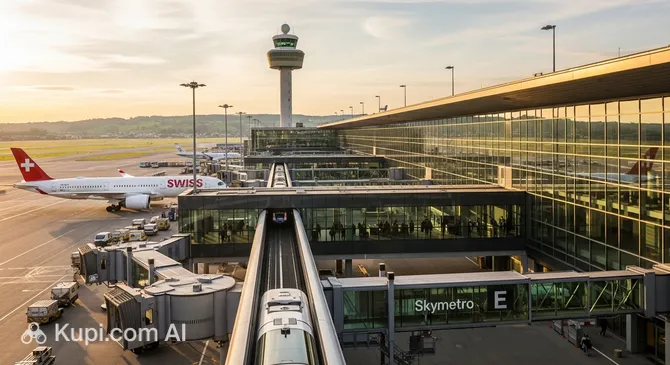
Zurich Airport. Source: Kupi.com Binoculars

Zurich Airport is not merely a transit hub, but a true showcase of Swiss quality, where impeccable organization meets Alpine comfort. This air gateway has repeatedly been recognized as the best in Europe thanks to its intuitive navigation, cleanliness, and unique atmosphere, allowing you to feel the spirit of Switzerland immediately upon landing. Here, just a few minutes from the country's financial center, travelers are treated to panoramic views of the runways and mountains, as well as service that turns waiting for a flight into part of the vacation.

IATA Code ZRH
ICAO Code LSZH
City Zurich
Distance to center ~12 km
Status International
Passengers per year ~28.9 million (2023)
Schedule Online Board

Features and Advantages of the Airport

One of the most memorable details for transit passengers is the Skymetro — an underground air-cushioned train connecting the main terminal with Dock E. The journey is accompanied by the sounds of alphorns, cowbells, and yodeling, while images of the famous character Heidi are projected onto the tunnel walls, creating an unexpected and cheerful mood even during a short transfer.

For aviation enthusiasts, the airport offers magnificent observation decks. Terrace B allows you to watch aircraft preparing for departure from a close distance, while Terrace E offers a breathtaking view of the runways against the backdrop of the Alps. This is an ideal place for plane spotting and beautiful photography.

The modern complex The Circle has turned the airport into a full-fledged urban space. It features a huge park with walking trails, futuristic shops, restaurants, and conference halls. This allows travelers to spend time in nature and breathe fresh air without leaving the airport territory.

Contact Information

Below is the main contact information for Zurich Airport, which will help you plan your trip and resolve any potential issues.

  • Official Website: You will always find the most complete and up-to-date information on the official airport website: www.flughafen-zuerich.ch. The site is available in several languages, including English and German.
  • Information Service Phone: For general information, flight schedules, and other inquiries, you can call: +41 43 816 22 11.
  • Airport Address: Flughafen Zürich AG, P.O. Box, CH-8058 Zürich-Flughafen, Switzerland.
  • Email: A direct email address for general inquiries is not provided. It is recommended to use the contact forms available on the official website in the relevant section for communication.
  • Social Media: Follow airport news and updates on official accounts: Facebook, X (formerly Twitter), Instagram, YouTube.
  • Lost Luggage Information: If you have lost items in the airport terminal, contact the Lost & Found office, the details of which are on the website. In case of lost checked baggage, you must immediately contact your airline's representative.
  • Passenger Support Service: Assistance can be obtained at Information Desks located in the arrival and departure zones, as well as via the general information service phone number.

How to Get to the Airport

Getting to Zurich Airport (ZRH), the main aviation hub of Switzerland, is possible via several convenient methods. Thanks to the excellently developed transport system, the journey from the city center or other regions of the country will not take much time and will be hassle-free.

The fastest and most popular method is the train. The Zürich Flughafen railway station is located directly beneath the main airport terminal. Both S-Bahn commuter trains (lines S2, S16, and S24) and numerous long-distance trains (InterCity and InterRegio) arrive here. The trip from Zurich Main Station (Zürich HB) takes just 10–15 minutes. To travel, you need a ticket covering the city zone (110) and the airport zone (121). This is an efficient and punctual option, ideally suited for most travelers.

Public transport is also represented by trams and buses. Tram line No. 10 (Glattalbahn) offers a more scenic, albeit slower, route from the main station to the airport, passing through the Irchel and Oerlikon districts. Travel time is approximately 35-40 minutes. Next to the terminal is a large bus station, from where 16 regional bus routes depart, connecting the airport with surrounding settlements. This is an excellent choice if you are not staying in the city center.

Taxis, transfers, and car sharing are comfortable but also the most premium options. A taxi ride from the center of Zurich to the airport will cost approximately 60–80 Swiss Francs and take 20–30 minutes depending on traffic conditions. You can order a car via apps like Uber or Bolt, which may be slightly cheaper. You can also pre-book a private transfer, which is especially convenient for large groups or families with bulky luggage.

If you are traveling by personal or rental car, convenient access roads via the A51 motorway are at your service. The airport has several parking complexes. Parking lots P1, P2, and P3 are closest to the terminals and are intended for short-term parking. For long-term parking, it is better to use more remote and budget-friendly options, such as P6, from which free shuttles run to the terminal. It is recommended to book a parking space online in advance to secure a more favorable rate.

Terminals and Map

Zurich Airport (ZRH) is renowned for its efficiency and clear structure, making it one of the most comfortable hubs in Switzerland and Europe. In fact, it consists of one main complex, including check-in zones and the Airside Center, from which three main piers (gate zones) extend, designated as Terminals A, B/D, and E.

Structure and Purpose of Terminals:

  • Check-in Zone (Check-in 1, 2, 3): Located in the main building before security control. Airline counters and self-service check-in kiosks are located here.
  • Terminal A: Used for flights within the Schengen Area, including domestic flights within Switzerland. It can be reached on foot immediately after the central security checkpoint.
  • Terminal B/D: This is a hybrid pier. Gates B serve Schengen flights, while gates D serve non-Schengen flights. Passengers departing from D gates undergo additional passport control inside the terminal.
  • Terminal E: A standalone terminal designed exclusively for intercontinental and other non-Schengen flights. It can only be reached via the automated underground Skymetro train from the Airside Center.

Navigation and Transfers Between Terminals

Movement through Zurich Airport is organized very logically. After passing centralized security control, you enter the Airside Center — a shopping and transit zone. From here, you can easily walk to gates A and B/D. Signs in German and English are extremely clear. The Skymetro train ride to Terminal E takes only about 3 minutes and is a small entertainment in itself thanks to the audio accompaniment with Alpine motifs.

Time and Recommendations

Although the airport runs like clockwork, it is worth allocating enough time to complete all formalities. It is recommended to arrive at the airport at least 2 hours before departure for Schengen flights and 3 hours for international (non-Schengen) destinations. This time is usually sufficient for check-in, baggage drop, security screening, and passport control (if necessary). To avoid rushing, always check the letter of your gate (A, B, D, or E) on your boarding pass and follow the signs — this will help you find the right path quickly.

Airport History

The history of Zurich Airport (ZRH), also known as Kloten Airport, is a story of rapid development and innovation, reflecting the growth of the aviation industry in Switzerland. The decision to build the country's main intercontinental airport was made immediately after World War II, and its official opening took place as early as 1948. The first runway was put into operation, marking the beginning of a new era for Swiss civil aviation.

From the very beginning, the airport constantly expanded to meet growing passenger traffic. In 1953, the first terminal was opened, becoming an architectural symbol of its time. The jet age required further modernization: in 1961, a second runway was built, and in 1971, Terminal B was opened. A crucial stage in the airport's history was the opening of its own underground railway station in 1980, which perfectly integrated it into the country's transport system and made it one of the most convenient in Europe.

The largest reconstruction in the history of Zurich Airport began under the "Airport 2000" project. The result of this massive project, completed in 2003-2004, was the appearance of the new central Airside Center building, a separate Terminal E (Midfield Terminal) for intercontinental flights, and the unique automated passenger transport system, Skymetro, which connects the main terminals with Terminal E. This modernization transformed the airport into a modern, multifunctional, and highly efficient transport hub.

Throughout its history, the airport has repeatedly received prestigious awards, including the title of "Europe's Leading Airport" by the World Travel Awards, confirming its high level of service and comfort for passengers. Today, Zurich Airport is not just a gateway to Switzerland, but also an important European hub that successfully combines rich history with advanced technologies.

Services and Amenities

Zurich Airport (ZRH) is rightfully considered one of the most comfortable in Europe, offering passengers a wide range of world-class services. Here you will find a vast number of shops for every taste: from luxury boutiques and famous Swiss watch stores to classic Duty Free and souvenir shops. Dining options are equally impressive — numerous restaurants, cafes, and lounges offer both local cuisine and popular international delicacies, allowing you to spend time pleasantly while waiting for your flight.

For those who value enhanced comfort, the airport features lounges operated by various airlines as well as paid VIP lounges. In these, you can rest in silence, use shower facilities, have a snack, and catch up on work. Free Wi-Fi is available throughout the airport, and numerous charging stations for electronic devices ensure your gadgets won't run out of power at an inconvenient moment.

Financial matters are easily resolved thanks to the presence of bank branches, ATMs, and currency exchange points. A 24-hour medical center is available to care for passengers' health, ready to provide assistance, along with several pharmacies. Travelers with children will appreciate the special family rooms and well-equipped play areas where young passengers can have fun before the flight.

The airport is fully adapted for passengers with reduced mobility: special assistance is provided for boarding and moving through the terminal, and there are elevators, ramps, and adapted restrooms. If you have a long layover or an early departure, you can stay at one of the hotels located directly on the airport grounds or a few minutes away by shuttle. For business travelers, modern conference halls and business centers are available, allowing you to hold meetings and work in a comfortable setting without leaving the airport.

Dining

Zurich Airport (ZRH) rightfully prides itself on its gastronomic infrastructure, offering travelers a wide selection of establishments for every taste and budget. Here you will find everything: from quick snacks and cozy coffee shops to fine dining restaurants. Regardless of how much time you have before departure, you certainly won't go hungry.

Dining options are conveniently divided between the public area (Landside) and the area after security control (Airside). In the Landside zone, accessible to all visitors, there is a large food court as well as many cafes and restaurants, including those in the modern complex The Circle. This is an ideal place to eat before checking in for a flight or to meet arriving passengers. In the Airside zone, the choice is even wider: lounges with views of the runway, themed restaurants, and corners of world-famous brands will help pass the time while waiting for boarding.

For those wishing to experience the cuisine of Switzerland, the airport offers several excellent options. Be sure to try traditional dishes such as Rösti (potato fritters) or Zürcher Geschnetzeltes (sliced veal in cream sauce). For an authentic atmosphere and classic Swiss dishes, you can visit a chalet-style restaurant. And for dessert, don't forget to visit the Confiserie Sprüngli to enjoy the famous Luxemburgerli macarons and Swiss chocolate.

If you are short on time, numerous bakeries, sandwich bars, and fast-food outlets are at your service. For a more substantial lunch or dinner, you can choose one of the à la carte restaurants. Various world cuisines are represented here: from Italian and Asian to American steaks. For connoisseurs of refined flavors and gourmet snacks, stylish lounges are available where you can relax before your flight.

Zurich Airport cares for passengers with special dietary needs. In many establishments, the menus mark vegetarian, vegan, and gluten-free items. One of the best places for vegetarians is the restaurant tibits, offering a rich buffet with fresh and diverse dishes. Halal options are also available in selected restaurants.

Food prices at the airport are generally higher than in the city. A quick snack will cost approximately 15–25 Swiss Francs, while a full lunch in a restaurant will cost from 40–50 Francs and up. Most establishments open early in the morning and work until late evening, adjusting to the flight schedule. Some cafes in the public zone may operate 24 hours a day.

Travel Tips

Traveling through Zurich Airport, one of the most convenient and organized aviation hubs in Europe, usually goes smoothly, but a few tips will help make it even more comfortable. Kloten Airport (ZRH) is famous for its efficiency, however, like any major hub, peak hours do occur. We recommend arriving at the airport 2-3 hours before international flights and 1.5-2 hours before flights within the Schengen Area. This time will be sufficient for calm check-in, baggage drop, and security screening.

To save time, always check in for your flight online. Screening procedures in Zurich are standard: be prepared to remove electronics and liquid containers up to 100 ml, packed in a transparent bag, from your hand luggage. Regarding seat selection on the plane, it is better to do this in advance during online check-in: a window seat will give you magnificent views of the Swiss Alps during takeoff or landing, while an aisle seat ensures more freedom of movement.

For passengers with connecting flights, Zurich Airport is one of the best places. Navigation is intuitively clear, and the automated Skymetro train runs between the main terminal (gates A, B/D) and the satellite terminal E. Customs control here has its own specificities: Switzerland is part of the Schengen Area but not the EU Customs Union. This means that even when flying from EU countries, you may need to pass customs, so follow the signs for the "Green" or "Red" channels depending on whether you have goods to declare.

To save money, use public transport. You can get directly from the airport to the center of Zurich (to the main station Zürich HB) by train in just 10-15 minutes — this is significantly cheaper and faster than a taxi. Also, do not forget that tap water in Switzerland is of excellent quality, so feel free to fill your reusable bottle at drinking water stations after passing security. In case of a flight delay, numerous shops, restaurants, and even the large shopping and entertainment complex The Circle, located right by the terminal, are at your service. Don't forget to check with your airline regarding your rights to compensation or care provided by passenger regulations.

Reached the end of the page?

That means the route is fully explored