Support

W. A. Mozart Salzburg Airport

About the Airport

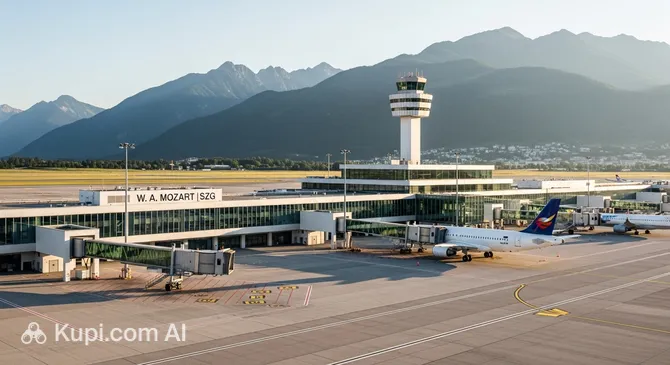
W. A. Mozart Salzburg Airport. Source: Kupi.com Binoculars

Salzburg Airport W. A. Mozart is not merely a transport hub, but a true overture to your Alpine journey. The air harbour is located so close to the historic centre that it feels as though planes are landing right amidst the scenery of a Baroque fairy tale. It is the second-largest airport in Austria, transforming in winter into a major hub for skiing enthusiasts, and in summer welcoming fans of classical music and lake landscapes. Thanks to its compactness and thoughtful navigation, the journey from the aircraft steps to the city exit takes just a few minutes.

IATA Code SZG
ICAO Code LOWS
City Salzburg
Distance to centre ~4 km
Status International
Passengers per year ~1.6 million (2023)
Schedule Regular and seasonal

Features and advantages of the airport:

Unique location. This is one of the most convenient airports in Europe: it is located just 4 kilometres from the city centre. A trip by trolleybus or taxi to the main attractions will take no more than 15–20 minutes, allowing you to start exploring Salzburg almost immediately after arrival.

Gateway to a ski paradise. During the winter season, the airport becomes a key transfer point to the famous resorts of the Salzburg province and the Ski Amadé region. Specifically to service ski charters, a second terminal operates here, equipped for the rapid processing of sports equipment.

Hangar-7 Museum. Located right on the airport grounds is the famous Red Bull Hangar-7. It is not just an aviation museum with a collection of historical "Flying Bulls" aircraft and Formula 1 cars, but also an architectural masterpiece of glass and steel featuring a haute cuisine restaurant.

Comfort and views. The terminal is distinguished by clear navigation and a lack of long queues. A panoramic terrace is open for well-wishers and passengers, offering a breathtaking view of the runway against the backdrop of majestic Alpine peaks.

Contact Information

  • Official website: www.salzburg-airport.com. The site provides the most up-to-date information on flights, services, and airport regulations.
  • Information desk phone: +43 662 8580 0. This is the main number for general enquiries.
  • Airport address: Innsbrucker Bundesstrasse 95, 5020 Salzburg, Austria.
  • Email: For general requests, you can use the address info@salzburg-airport.at.
  • Social media: Salzburg Airport actively maintains pages on popular social networks such as Facebook and Instagram, where it publishes news and useful information. Links to official accounts can be found on the main page of the website.
  • Lost & Found: If your luggage has been lost or damaged, you should contact the relevant airline service or the Lost & Found office at the airport. Detailed instructions and contacts are posted in the "Baggage" section on the official website.
  • Passenger support contacts: For general questions, you can call the information desk. If your question concerns tickets, flight check-in, or schedule changes, you must contact your airline's representative office directly.

How to get to the airport

Getting to Salzburg Airport W. A. Mozart from the centre of Salzburg is effortless thanks to its close proximity and excellent transport system. The most economical and popular method is public transport. Uninterrupted connection with the city is provided by trolleybuses: route No. 2 departs from the main railway station (Hauptbahnhof) and will take you to the terminal in approximately 20-25 minutes. Route No. 10 runs from the city centre through the Maxglan district. Trolleybuses run at short intervals, making this option incredibly convenient for travellers.

For those who value comfort and speed, the ideal choice would be a taxi or pre-booked transfer. A taxi ride from the city centre to the airport will take about 15-20 minutes, depending on traffic conditions. This is more expensive than public transport but ensures door-to-door service. You can find taxis at special ranks throughout the city or order one via an app. Pre-booking a transfer can guarantee a fixed price and is particularly convenient if you are travelling with a large amount of luggage or in a group.

If you are travelling around Austria by rental car, getting to the airport will be very simple. Roads are well-signposted, and the route from the city centre is intuitive. Offices of all major international rental companies are present at the airport, allowing you to conveniently return the car right before departure. This option gives maximum freedom of movement, especially if you plan to visit the surroundings of Salzburg.

For travellers with a personal vehicle, a convenient parking system is provided at the airport. Directly opposite the terminals is a multi-storey car park (P4), connected to them by a covered walkway. Both short-term and long-term parking spaces are available. To obtain more favourable rates for long-term parking, it is recommended to book a space online in advance on the airport's official website.

The choice of how to get to Salzburg Airport depends on your priorities: the trolleybus for budget and an authentic experience, a taxi for speed and comfort, or a car for independence. Due to its location, the airport also serves as a convenient point for travel to other cities, for example, to Munich or Linz, whose airports are within easy reach.

Terminals and Map

Salzburg Airport W. A. Mozart (SZG) is a compact and passenger-friendly aviation hub consisting of two terminals: Terminal 1 and Terminal 2. Thanks to the thoughtful layout, navigating the airport causes no difficulties even for those here for the first time.

Terminal 1 is the main facility and operates year-round. It is a two-storey building where the majority of scheduled and some charter flights are serviced. On the ground floor, you will find the arrivals area, check-in counters for certain airlines, car rental desks, and the baggage claim. The first floor houses the main check-in hall, security and passport control zones, as well as departure gates. Most shops, cafés, and dining outlets are also concentrated here.

Terminal 2 is a smaller, single-storey terminal used primarily during peak load periods, especially during the winter ski season (from December to March) and summer holidays. It is designed to service charter and budget airlines, helping to relieve the main terminal. The infrastructure here is simpler, with a focus on rapid completion of formalities: check-in, baggage drop, and boarding. Please note that on peak days it can be quite crowded here.

Both terminals are located in immediate proximity to each other, literally a few steps apart. No special transport is required to move between them—a short walk along a covered walkway is sufficient. The airport map is logical: departure and arrival zones are clearly demarcated, and signs in German and English help you orient yourself easily.

Check-in and security procedures at Salzburg airport generally proceed quite quickly. On ordinary days, it is recommended to arrive 1.5–2 hours before departure. However, at the height of the winter season, especially on Saturdays when a large number of ski charters arrive and depart, it is worth allowing extra time—up to 3 hours—to avoid rushing. Before travelling, always check which terminal your flight departs from so you can head straight to the correct hall.

Airport History

The history of Salzburg Airport W. A. Mozart (SZG) is closely intertwined with the development of aviation and tourism in Austria. Although the first aircraft landed on this field back in 1910, the official opening of the airport took place on 16 August 1926. From the very beginning, it played an important role in establishing air connections between Salzburg and other European cities, such as Munich and Vienna.

After the Second World War, the airport was restored, and in 1954 regular international flights resumed, which became the starting point for its modern development. A real breakthrough occurred in the 1960s with the beginning of the jet age. In 1966, a new terminal was opened, capable of handling the growing flow of passengers. This period coincided with the boom in ski tourism, and Salzburg Airport became the main aerial gateway to the Alps for thousands of winter sports enthusiasts.

One of the most significant events in the airport's history was its naming after Wolfgang Amadeus Mozart in 1984—a tribute to the great composer born in Salzburg. Further modernisation continued, and in 2003 a second terminal, Amadeus Terminal 2, was opened. It was specially designed to service the peak winter season and charter flights, which significantly increased throughput capacity.

Among interesting facts, it is worth noting that Salzburg Airport is the second largest in Austria. Its unique location—just a few kilometres from the city centre and in immediate proximity to the country's largest ski resorts—makes it incredibly convenient for travellers. Today, the airport continues to develop, maintaining its status as an important transport hub that welcomes and sees off millions of guests from all over the world annually.

Services and Amenities

Salzburg Airport W. A. Mozart (SZG) offers passengers all necessary amenities to make waiting for a flight as comfortable and productive as possible. The airport infrastructure is well thought out and meets the needs of various categories of travellers.

W. A. Mozart Salzburg Airport. Source: Kupi.com Binoculars

Within the terminal, you will find a variety of cafés and restaurants where you can have a quick snack, drink a cup of aromatic coffee, or have a full meal, enjoying both traditional Austrian dishes and international cuisine. For shopping enthusiasts, there are stores, including Duty Free, where you can purchase souvenirs, perfumes, confectionery, and other goods at attractive prices.

Stay connected thanks to free Wi-Fi available throughout the airport. Numerous sockets and USB ports are provided for charging electronic devices. If you are looking for quiet and enhanced comfort, the Salzburg Airport Business Lounge is at your service, where you can relax in a calm atmosphere, work, or enjoy light refreshments.

For financial matters, the airport has bank branches, ATMs, and currency exchange points. In case of need, a medical centre operates in the terminal to provide first aid.

Travellers with children can use the mother and child rooms equipped with changing tables. The airport is fully adapted for passengers with reduced mobility: there are ramps, lifts, and specially equipped restrooms. If necessary, assistance services can be booked in advance.

If you have an early departure or a long layover, several comfortable hotels are located in the immediate vicinity of the airport. For business travellers, modern conference rooms and business centres are provided, allowing meetings and negotiations to be held without leaving the airport territory.

Where to Eat

Salzburg Airport W. A. Mozart (SZG) offers passengers several cosy establishments where you can have a snack before departure or a full lunch. Although the selection is not as vast as in megacities, everyone will find something to their taste here, from traditional Austrian dishes to quick bites.

The majority of establishments are concentrated in Terminal 1. In the public area (landside, before security control) is the main spot for gourmets—the Markt-Restaurant. This is a spacious self-service establishment offering a large selection of hot and cold dishes, salads, soups, and desserts. Here you can leisurely enjoy a genuine Viennese schnitzel or try the famous apple strudel. This is the best option for a full lunch or dinner. Nearby is also Das Wolfgang café, ideal for a cup of coffee with pastries or a refreshing beverage.

After passing security control (airside) in the departure area of Terminal 1, Café-Bistro Jedermann awaits passengers. This is an excellent place for a quick snack if you have a little time left before boarding. Sandwiches, paninis, salads, desserts, and various drinks are served here. In Terminal 2 (Amadeus Terminal), which serves mainly seasonal and charter flights, the choice is more limited and usually represented by a small bar or café, such as Salzburger Lokal-Bier & Schmankerl, where you can try local beverages and have a snack.

Regarding special dietary needs, vegetarian dishes, such as salads or vegetable sides, are available in most establishments. However, options for vegans or people with gluten intolerance may be limited, so it is recommended to clarify the ingredients with the staff. The price range at the airport varies from moderate to high, which is typical for such places. Opening hours of establishments are usually tied to the flight schedule, starting from early morning until the departure of the last aircraft.

Tips for Travellers

Travelling through W. A. Mozart Airport in Salzburg is generally a comfortable and straightforward process. To make it even smoother, take advantage of our tips. We recommend arriving at the airport 2-2.5 hours before Schengen flights and 3 hours before international flights. During peak periods, such as Christmas holidays, the ski season, or during the famous Salzburg Festival, it is better to allow extra time.

To save time, complete online check-in for your flight in advance and save the boarding pass on your smartphone. If you are travelling with hand luggage only, this will allow you to head straight to security control. The screening procedure here is standard for EU airports. Remember the liquids rule: all containers must be no more than 100 ml in volume and packed in a single transparent bag. Be sure to check the weight and size limits for hand luggage on your airline's website to avoid extra charges.

When choosing a seat on the plane, note that Salzburg Airport is surrounded by the Alps. If you want to enjoy breathtaking views of the mountains during take-off or landing, choose a window seat. An aisle seat is suitable for those who value the ability to stand up freely and be among the first to exit the aircraft.

Passengers with transfers will find it useful to know that Salzburg Airport is quite compact, and moving between gates does not take much time. Ensure that your luggage is checked through to your final destination. Customs control for those arriving from non-EU countries follows the "green" and "red" channel system. If you have no goods to declare, proceed confidently through the "green" channel.

To save money, use public transport for the trip to or from the city—trolleybuses No. 2 and No. 10 are a fast and budget-friendly option. Bring an empty reusable water bottle with you, which can be filled after passing security control. This is a small but pleasant way to reduce expenses while travelling around Austria.

In case of a flight delay or cancellation, first contact your airline representative for information and assistance. According to EU legislation (Regulation 261/2004), during long delays, passengers are entitled to meals, drinks, and sometimes hotel accommodation. Remain calm; the airport has cafés, shops, and free Wi-Fi to help pass the waiting time.

Reached the end of the page?

That means the route is fully explored