Support

Frankfurt Airport

Airports in the city

About the Airport

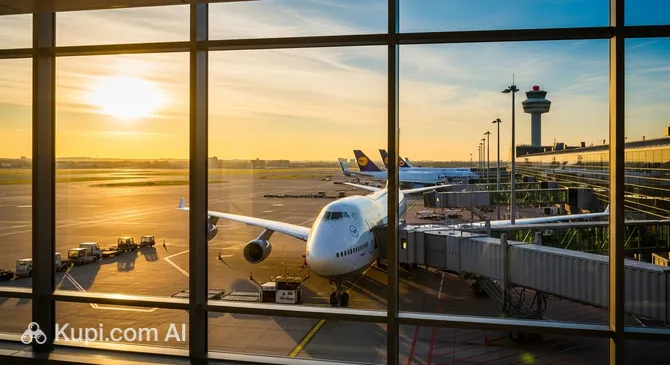
Frankfurt Airport. Source: Kupi.com Binoculars

Frankfurt am Main Airport (FRA), also known as Rhine-Main Airport, is not merely the aerial gateway to Germany, but an entire city within a city and one of Europe's largest transport hubs. Life buzzes here daily: thousands of travellers depart for various corners of the planet, meeting and parting ways. Thanks to its well-thought-out infrastructure and the highest level of service, Frankfurt Airport transforms the wait for a flight or a layover into a comfortable and engaging experience. This is the place where your journey around the world begins, setting the tone for the entire adventure.

IATA Code FRA
ICAO Code EDDF
City Frankfurt am Main
Distance to Centre approx. 12 km
Status International
Passengers per Year approx. 59.4 million (2023)
Popular Airlines Lufthansa, Condor, United Airlines
Schedule Online Board "Frankfurt Airport"

Frankfurt Airport is renowned for its outstanding organisation and passenger convenience. It consists of two main passenger terminals, connected by the free SkyLine train and shuttle buses, making movement between them quick and effortless. A distinctive feature is its excellent transport accessibility: the airport has two of its own railway stations, from where you can travel to the centre of Frankfurt as well as other cities in Germany and Europe. Furthermore, travellers can enjoy complimentary 24-hour Wi-Fi, numerous Duty Free shops, a variety of restaurants, play areas for children, quiet rooms for rest and prayer, and even a viewing terrace.

Contact Information

Official Website: www.frankfurt-airport.com. Here you will find the most up-to-date information on flights, services, and airport regulations.

Information Service Phone: +49 69 690-0. You can obtain general information about airport operations at this number.

Address: 60547 Frankfurt am Main, Germany.

Email: To contact the airport, it is recommended to use the contact forms on the official website, which allow you to direct your enquiry to the appropriate department.

Social Media: The airport maintains active pages on popular social networks such as Facebook, X (formerly Twitter), and Instagram, where news and important updates are published.

Lost Luggage Information: In case of lost luggage during a flight, you should immediately contact your airline's representative. If you have lost personal items within the airport premises, please contact the Lost and Found office (Fundbüro).

Passenger Support Service: Assistance and advice can be obtained at the information desks located in the terminals or via the general information service telephone.

How to Get to the Airport

Reaching Frankfurt am Main International Airport (FRA), one of Europe's largest aviation hubs, is possible via several convenient methods. The airport is located just 12 km from the city centre and boasts excellent transport links, allowing you to easily plan a route from any point in Germany.

Public Transport is the most popular and efficient method. The S-Bahn urban trains, lines S8 and S9, run from Frankfurt Central Station (Hauptbahnhof) to the airport's regional station (Regionalbahnhof), located directly beneath Terminal 1. The journey takes just 10-15 minutes, with trains departing every 15 minutes. The ticket cost is approximately 5-6 Euros. Additionally, high-speed ICE, IC, and EC trains arrive at the long-distance train station (Fernbahnhof) near Terminal 1, connecting the airport with other major cities in the country. You can also reach the airport via numerous buses, including city routes and intercity services (such as FlixBus).

A taxi ride from the city centre to the airport will take 20-30 minutes depending on traffic conditions and will cost approximately 35-45 Euros. This is a convenient option if you have a lot of luggage or are travelling with family. Official taxi ranks are located at the exits of both terminals. Alternatively, you can use ride-sharing apps or pre-book a private transfer, which often allows you to fix the price in advance.

If you prefer to travel by rental or private car, the airport is easily accessible from the major A3 and A5 motorways. There are numerous car parks on the premises — from short-term parking right by the terminals to more budget-friendly long-term car parks connected to the terminals by shuttle buses. To save money, it is recommended to book a parking space online in advance, especially if you plan to leave your car for several days.

Although Frankfurt Airport is the region's main hub, it is worth keeping other nearby airports in mind. Depending on your route and airline, Frankfurt-Hahn (HHN), which mainly serves low-cost carriers, or the large international Cologne/Bonn Airport (CGN), located approximately 140 km away, might be convenient for you.

Terminals and Map

Frankfurt am Main Airport (FRA) is one of the largest and busiest aviation hubs in Europe. Its passenger infrastructure consists of two main terminals — Terminal 1 and Terminal 2, as well as the new, partially operational Terminal 3. Most travellers interact specifically with the first two.

Movement between terminals is organised efficiently. The most popular and fastest method is the free automated SkyLine train, which runs every 2–3 minutes. The journey takes just a couple of minutes. SkyLine stations are located in Terminal 1 (in Concourse B) and in Terminal 2 (between Concourses D and E). Additionally, free shuttle buses run between the terminals around the clock, with stops located directly at the exits.

Terminal 1 is the older and larger complex, serving as the main hub for Lufthansa and its Star Alliance partners. It consists of several piers (concourses): A, B, C, and Z. Concourse Z is located above Zone A and serves flights to non-Schengen countries. Be prepared for potentially significant walking distances here, so it is worth allowing extra time to reach your boarding gate.

Terminal 2 is more modern and compact. It primarily serves airlines from the Oneworld and SkyTeam alliances, as well as numerous other carriers. This terminal is divided into two zones — D and E. Thanks to a simpler and more logical layout, navigation in Terminal 2 generally takes less time.

Departure and arrival zones in both terminals are standardly separated by floors: check-in and security control are usually on the upper levels, while baggage claim and arrival zones are on the lower ones. Due to the immense passenger flow, completing all pre-flight formalities can take considerable time. It is strongly recommended to arrive at the airport at least 3 hours before international flights and no less than 2 hours before flights within Germany and the Schengen area.

To avoid getting lost, always check your terminal and concourse number in advance on your ticket or the airport website. The signage system is very clear and is duplicated in English. If you have a connecting flight involving a transfer between terminals, allow at least 45–60 minutes for the transfer to calmly catch the SkyLine train and, if necessary, pass through security control again.

Airport History

The history of Frankfurt am Main Airport is a chronicle of aviation development in Germany and Europe. The official opening took place on 8 July 1936 under the name "Flug- und Luftschiffhafen Rhein-Main". Initially, it served as a base not only for aeroplanes but also for the famous Zeppelin airships, including the infamous "Hindenburg". It was one of the most modern aviation complexes of its time.

After the Second World War, the airport came under the control of American forces and played a key role in one of the most important humanitarian events of the 20th century — the Berlin Airlift (1948–1949). It was from here that the "Raisin Bombers" (Rosinenbomber) took off, delivering food and essential goods to blockaded West Berlin. This event forever inscribed the airport into world history.

With the advent of the jet age, an era of rapid growth began. In 1972, the new, spacious Terminal 1 (known today as Terminal 1 Mitte) was opened, which at the time was one of the largest in the world. This allowed the airport to become the country's main international hub. Further expansion followed in 1994 with the opening of Terminal 2, designed to service the growing passenger flow and airline alliances.

In the 21st century, modernisation continued: in 2011, a fourth runway was put into operation, significantly increasing the airport's capacity. Today, Frankfurt Airport is a true "city within a city", known as Fraport City. One interesting fact: the largest office building in Germany — The Squaire — is located here and is directly connected to Terminal 1. The airport consistently ranks among the busiest in Europe for both passenger and cargo traffic, confirming its status as a vital transport hub of global importance.

Services and Amenities

Frankfurt Airport is a veritable city within a city, offering passengers a vast selection of services and amenities for a comfortable wait. Everything here is thought out to the smallest detail so that your journey begins or ends as pleasantly as possible.

The airport's gastronomic and retail opportunities are impressive. At your disposal are hundreds of Duty Free shops, boutiques of world-famous brands, bookshops, and souvenir stalls. The choice of restaurants and cafes is also huge: from fast food outlets to fine dining restaurants where you can enjoy both German and international dishes. Regardless of the time of day, you will always find a place to have a snack or drink a cup of coffee.

For those who value enhanced comfort, numerous airline lounges operate at the airport, as well as paid VIP lounges available to all passengers regardless of ticket class. Here you can rest in silence, work, or enjoy complimentary snacks and beverages. Free Wi-Fi is available throughout the airport, and numerous charging stations for gadgets will ensure your devices stay powered.

Financial matters are easily resolved directly in the terminals. Bank branches, 24-hour currency exchange points, and many ATMs are located here. In case of necessity, passengers can visit the medical centre, open 24/7, or purchase necessary medicines at one of the pharmacies.

Travellers with children will appreciate the specially equipped mother and child rooms, as well as the bright play areas where little ones can have fun before the flight. For passengers with reduced mobility, a full range of services is provided: from special assistance when moving through the terminal to adapted restrooms and rest areas.

If you have a long layover or an early departure, you can stay at one of the hotels located directly on the airport grounds or in the immediate vicinity. For business travellers, modern conference rooms and business centres are equipped, where you can hold a meeting or work in a calm environment.

Where to Eat

Frankfurt am Main Airport (FRA) offers a huge selection of establishments for every taste and budget, so it is practically impossible to stay hungry here. Regardless of which terminal you are in and how much time you have before departure, you will easily find a suitable option — from a quick snack on the run to a leisurely dinner in a restaurant with table service.

Quick Snacks and German Specialities

For those short on time, numerous bakeries and cafes are scattered throughout the airport. Look out for chains such as Kamps or Heberer's Traditional Bakery, where you can buy fresh pastries, sandwiches, and, of course, the famous German pretzel — Brezel. This is an excellent and inexpensive way to experience local gastronomy. Also, kiosks selling sausages (Wurst) are frequently found in departure zones — another iconic German street food that is perfect for quickly satisfying hunger.

Restaurants for a Full Lunch or Dinner

If you have an hour or two to spare, it is worth visiting one of the full-service restaurants. In Terminal 1 (especially in departure zones A and B, after passport control), you can find establishments such as Hausmann's or Paulaner. They serve classic dishes of Germany: from Vienna schnitzel and hearty meat dishes to various sausages with braised cabbage. This is a wonderful opportunity to enjoy authentic cuisine and the local atmosphere before your flight. Besides German cuisine, international options are widely represented: Italian pizzerias, Asian bistros, and steakhouses.

Options for Special Dietary Needs

Frankfurt Airport also pays attention to passengers with special dietary requests. In many restaurants, vegetarian and vegan dishes are marked on the menu. The dean&david chain, for example, specialises in fresh salads, smoothies, and healthy bowls. It is best to clarify information regarding gluten-free or Halal options directly with the establishment's staff — in larger restaurants, they will most likely be able to assist you.

Practical Tips

  • Location: The greatest variety of cafes and restaurants is found in the zones after passport and security control (airside). In the public area (landside), there is also a selection, but it is more modest.
  • Opening Hours: Most establishments operate from early morning until late evening, adapting to the flight schedule. Some cafes in transit zones may operate around the clock.
  • Prices: Be prepared for prices at the airport to be on average 20-30% higher than in the city. A quick snack (coffee and pastry) will cost €7-€12, while a full hot meal in a restaurant starts from €20-€30 and upwards.

Tips for Travellers

To ensure your journey through one of Europe's largest aviation hubs goes as smoothly as possible, make use of our tips. Frankfurt am Main Airport is immense, so arrive early: for international flights, it is recommended to allow at least 3 hours before departure, and for flights within Germany and the Schengen area — about 2 hours. During peak seasons (summer, winter holidays), it is better to add another hour. Try to complete online check-in in advance — this will save you a lot of time. During check-in, you also have the opportunity to select a seat: by the window for beautiful views during take-off, or by the aisle if you value the ability to move freely during the flight.

Prepare for security control in advance to pass through quickly. All liquids (perfumes, gels, creams) must be in containers not exceeding 100 ml and packed in a single transparent bag. Laptops, tablets, and other large electronics will need to be removed from hand luggage and placed in a separate tray. Sharp objects, weapons, and flammable substances are prohibited in hand luggage. Be sure to check your airline's rules regarding the weight and dimensions of hand luggage, as they may differ.

If you have a transfer in Frankfurt, be especially attentive. This is a giant hub with two main terminals (Terminal 1 and Terminal 2). Immediately after disembarking from the plane, find an information screen and check the gate number and terminal for your next flight. The free SkyLine train and shuttle buses run between the terminals. Moving between distant gates, especially with a repeat passport control check, can take up to 60-90 minutes, so do not linger in shops if you have a short connection.

Standard EU rules apply when passing through customs control. If you have nothing to declare, proceed confidently through the "Green Channel". If you are carrying goods exceeding established limits (for example, restricted items), use the "Red Channel". To save money, travel to or from the airport by public transport — S-Bahn trains (lines S8 and S9) are the fastest and most budget-friendly method. Also, take an empty water bottle with you — after security, it can be filled for free at drinking fountains.

In the event of a flight delay or cancellation, first contact your airline's representative — their counters are usually located near boarding gates or in the transit zone. According to EU regulations, during long delays, passengers are entitled to drinks, meals, and sometimes hotel accommodation. Frankfurt Airport offers many ways to pass the time: from numerous shops and restaurants to special rest zones (Ruhezonen) and even a viewing terrace in Terminal 2.

Reached the end of the page?

That means the route is fully explored