Support

Dusseldorf International Airport

Airports in the city

About the Airport

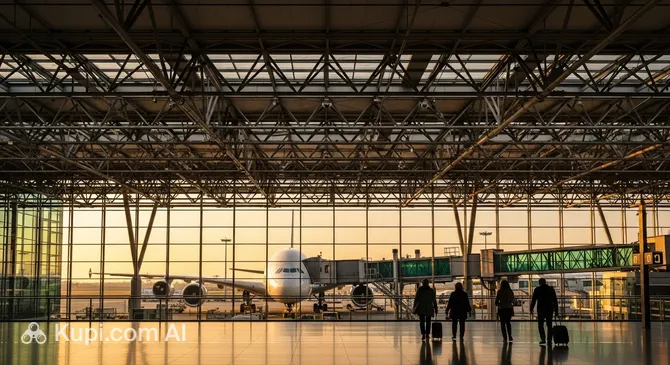
Dusseldorf International Airport. Source: Kupi.com Binoculars

Dusseldorf International Airport (DUS) is not merely the air gateway to one of Germany's key economic and fashion centres, but also the country's fourth-largest airport. Located in the heart of the densely populated Rhine-Ruhr region, it serves as a vital hub for both business travellers and tourists. Every year, millions of passengers begin their journey across Europe and the globe from here, enjoying first-class service and well-planned infrastructure. This modern and technologically advanced complex offers everything needed for a comfortable wait before your flight.

IATA Code DUS
ICAO Code EDDL
City Dusseldorf
Distance to Centre 7–9 km
Status International
Annual Passengers approx. 19.1 million (2023)
Popular Airlines Eurowings, Condor, TUI Fly
Schedule online schedule "Dusseldorf International Airport"

One of the airport's main features is its exceptional transport accessibility. With its own railway station handling over 300 trains daily, including high-speed ICE trains, it is easy to reach not only the centre of Dusseldorf but also other major cities in Germany and neighbouring countries. The automated SkyTrain connects the terminals with the railway station, significantly saving time for passengers. The airport is also renowned for its extensive shopping area and a variety of restaurants and cafes, some of which operate 24/7 to provide travellers with quality service at any hour.

Contact Information

To contact representatives of Dusseldorf Airport, obtain directory information, or resolve any issues, you can use the following contact details:

  • Official Website: You can find the most up-to-date information on flights, services, and airport regulations at www.dus.com.
  • Information Desk Phone: You can call the information centre at +49 211 421-0.
  • Address: Flughafenstraße 105, 40474 Dusseldorf, Germany.
  • Email: For general enquiries and feedback, please use the address customerservice@dus.com.
  • Social Media: Follow news and updates on the airport's official pages on Facebook, Instagram, and X (formerly Twitter).
  • Lost & Found: If you have left personal items in the terminal, contact the Lost & Found office via email: fundbuero@dus.com or by phone: +49 211 421-2515. For lost luggage issues, please contact your airline directly.
  • Passenger Support Service: For immediate assistance and consultations, use the main airport phone number listed above.

How to Get to the Airport

Dusseldorf International Airport boasts excellent transport links, offering travellers a multitude of convenient ways to reach the terminals from the city and vice versa. Choosing the best option depends on your budget, time, and amount of luggage.

Public Transport is the most popular and economical method. The airport has two railway stations. The Düsseldorf Flughafen Fernbahnhof station serves regional (RE) and high-speed trains (ICE, IC), connecting the airport with cities across Germany. From here, the automated SkyTrain will take you to the terminals in just a few minutes. Directly beneath Terminal C lies the Düsseldorf Flughafen Terminal station, served by the S-Bahn (line S11) suburban train. The journey from Dusseldorf Central Station (Düsseldorf Hauptbahnhof) on the S11 takes about 12 minutes and is the fastest route to the terminal. Additionally, several bus routes (e.g., 721, 760, SB51) connect the airport to various districts of the city.

Taxis and Transfers offer maximum comfort, especially if you are travelling with family or bulky luggage. Official taxi ranks are located directly outside the arrivals area. A trip to the centre of Dusseldorf usually takes 15-25 minutes depending on traffic and costs approximately 25-35 Euros. You can also book a private transfer in advance, which can sometimes be more cost-effective and helps avoid waiting times.

If you plan to travel around the North Rhine-Westphalia region, renting a car is a convenient solution. Offices of all leading international and local rental companies are located in the arrivals area. The airport is easily accessible by private car via the A44 motorway. The airport offers a wide range of parking spaces: from premium covered car parks directly at the terminals (P1, P2, P3) to more budget-friendly long-term car parks (P4, P5, P23), connected to the terminals by shuttles or the SkyTrain. It is highly recommended to book parking online in advance, as this allows for significant savings, especially for long-term parking.

Although Dusseldorf Airport is one of the largest in the country, it is useful to consider neighbouring airports when planning your trip. Depending on the destination and airline, Cologne Bonn Airport or Dortmund Airport may be good alternatives. For certain budget flights, Weeze Airport or Maastricht Aachen Airport located in the Netherlands might be convenient.

Terminals and Map

Dusseldorf Airport (DUS) is a well-organised complex consisting of three passenger terminals: A, B, and C. An important feature is that they are all located within a single building and are interconnected, which significantly simplifies passenger movement. You do not need to go outside to move from one terminal to another — simply follow the signs inside the building.

The structure of the terminals is as follows:

  • Terminal A primarily serves Lufthansa and its Star Alliance partners, as well as its subsidiary Eurowings. Flights from here are predominantly to Schengen zone countries.
  • Terminal B is used by various airlines, including members of the Oneworld and SkyTeam alliances. It serves both European and some intercontinental destinations, including flights to North Africa.
  • Terminal C specialises in long-haul flights outside the Schengen zone. Major carriers such as Emirates, Etihad Airways, and Delta Air Lines operate from here. This is the most modern of the three terminals.

Navigation in the airport is intuitive thanks to clear signage in German and English. Departure areas with check-in counters and security checkpoints are located on the upper level, while arrival areas and baggage claim are on the lower level. To move conveniently between the terminals and the long-distance railway station (Bahnhof Düsseldorf Flughafen), as well as car parks P4, P5, and P6, the automated SkyTrain operates regularly. This is particularly convenient for those arriving at the airport by train.

The time required to complete formalities depends on the flight destination and airport traffic. For flights within the Schengen zone, it is recommended to arrive approximately 2 hours before departure. If you are flying to a non-Schengen country or on an intercontinental flight, it is best to allow at least 3 hours. During peak times, such as the start of holidays or early in the morning, waiting times at security may increase, so always check current information on the airport website and arrive with time to spare.

Airport History

The history of Dusseldorf International Airport (DUS) is a chronicle of constant development, overcoming challenges, and technological progress. Officially opened in 1927 in the Lohausen district, the airport initially served small airships and propeller aircraft, linking the city with other centres in Germany. The early years were dedicated to establishing regular domestic flights and gradually building infrastructure.

After the Second World War, the airport, like many facilities in the country, required restoration. Under the management of British authorities, it was reconstructed, and civil aviation resumed as early as 1949. This moment marked the starting point of its transformation into a major international hub. In 1973, a new terminal building, modern for its time, was opened, capable of handling jet aircraft and coping with the growing passenger traffic of the mass tourism era.

One of the most tragic and pivotal moments in the airport's history occurred on 11 April 1996. A fire broke out as a result of welding work on the roof of Terminal A, spreading quickly and leading to loss of life and colossal damage. This tragedy forced a complete revision of fire safety standards in airports across Europe and served as a catalyst for large-scale modernisation.

The recovery became a project of rebirth. The airport was not just rebuilt, but radically reimagined. In 2001, a new central terminal opened, constructed using large amounts of glass and steel, making it brighter, more spacious, and safer. In 2002, the SkyTrain automated passenger transport system was launched, connecting the terminals with the long-distance railway station. This significantly improved convenience for travellers. The finishing touch was the opening of Terminal C in 2003, specifically designed to handle long-haul flights and non-Schengen passengers.

Today, Dusseldorf Airport is one of the largest in the country, capable of handling the world's largest passenger aircraft, including the Airbus A380. Its history is a vivid example of how an ultra-modern and efficient transport hub can rise from the ashes of tragedy, becoming a symbol of resilience and innovation.

Services and Amenities

Dusseldorf International Airport (DUS) offers passengers a wide range of services, making their stay here comfortable and productive. For those wishing to have a meal or do some shopping, the terminals feature a huge variety of restaurants, cafes, and dining spots to suit every taste and budget — from fast food outlets to fine dining restaurants. The retail area includes numerous Duty Free shops, boutiques of famous clothing and accessory brands, as well as souvenir shops where you can buy gifts from Germany.

For a comfortable wait before a flight, passengers can utilise the services of business lounges and VIP lounges. Access is available to business class passengers, airline loyalty programme members, or for a separate fee. Inside, you will find comfortable seating, complimentary snacks and beverages, press, and a quiet atmosphere suitable for relaxation or prayer. Free Wi-Fi is available throughout the airport, and numerous charging stations for gadgets ensure you always stay connected.

Financial matters can be resolved at bank branches, currency exchange points, or by using ATMs located in various parts of the terminals. In case of unforeseen health issues, a medical centre and several pharmacies are available at the airport, where you can receive consultation and purchase necessary medicines.

Dusseldorf Airport is well-prepared for travellers with children. Play areas are equipped for young passengers, and baby care rooms provide everything necessary for looking after infants. Passengers with reduced mobility can count on full support: the airport is equipped with ramps, lifts, special restrooms, and offers an escort service, which is recommended to be booked in advance through your airline.

For those who need to work or hold a business meeting, conference rooms and business centres equipped with modern technology operate within the airport grounds. If you have an early flight or a long layover, you can stay at one of the hotels located directly at the airport or in the immediate vicinity, such as the Maritim Hotel or Sheraton Dusseldorf Airport Hotel, which are easily accessible on foot or by shuttle.

Where to Eat

At Dusseldorf International Airport (DUS), travellers will find a wide selection of establishments to suit any taste and wallet. Whether you are looking for a quick snack before departure or wish to relax with a full meal, you will easily find a suitable option both in the public area and after passing security control.

For those in a hurry, numerous cafes, bakeries, and fast-food outlets are ideal. Coffee shops are located in the arrival and departure zones (landside) and after passport control (airside), where you can grab an energising drink and fresh pastries. This is an excellent opportunity to try a traditional German pretzel — the Brezel. Global fast-food chains are also available here, offering familiar burgers and sandwiches.

If you have time to eat at a leisurely pace, consider the restaurants. The airport features establishments serving Italian, Asian, and, of course, traditional German cuisine. This is a great chance to enjoy dishes such as sausages (Wurst) with potato salad or try the famous local dark beer, Altbier, for which Dusseldorf is renowned. The majority of restaurants are concentrated in the departure zones (Piers A, B, and C) after passing control.

Passengers with special dietary requirements will also be well catered for. Many establishments offer Halal, vegetarian, vegan, and gluten-free dishes, which are usually marked on the menu with special icons. It is recommended to check the ingredients with the staff. The price range at the airport varies from moderate at fast-food points to higher at full-service restaurants. Most establishments open early in the morning and operate until late in the evening, aligning with flight schedules.

Tips for Travellers

To ensure your journey through Dusseldorf International Airport (DUS) goes as smoothly as possible, make use of our tips. We recommend arriving at the airport well in advance: 2.5–3 hours before international flights and 1.5–2 hours before flights within the Schengen zone. This will give you sufficient time to complete all procedures without rushing, especially during peak holiday seasons.

To save time, check in for your flight online and, if travelling with hand luggage only, proceed immediately to the security checkpoint. Prepare in advance: liquids in containers up to 100 ml must be packed in a transparent bag, and laptops and other large electronics must be removed from your bag. Dusseldorf Airport is a large and busy hub, so be prepared for potential queues.

When choosing a seat on the plane, consider your priorities. A window seat (A, F) offers beautiful views during take-off and landing. An aisle seat (C, D) allows you to stand up freely without disturbing neighbours. Emergency exit seats offer more legroom, but usually cannot be occupied by passengers with children and may incur an extra charge.

In hand luggage, besides restrictions on liquids, it is prohibited to carry sharp objects (scissors, knives), flammable substances, and weapons. Always check your airline's regulations, as weight and size requirements for hand luggage may vary. Power banks and other batteries are permitted only in hand luggage.

If you have a layover in Dusseldorf, follow the "Flight Connections" or "Transit" signs. The airport has convenient navigation. Check in advance if you need to pass passport control and security screening again — this depends on where you are flying from and to (for example, transferring from a non-Schengen flight to a Schengen flight requires mandatory control).

Customs control upon arrival in Germany from non-EU countries operates on the "Green" and "Red" channel system. If you have no goods to declare, proceed through the "Green" channel. If you are carrying goods exceeding established limits (e.g., large amounts of cash, expensive purchases, or tobacco products), you must go through the "Red" channel and declare them.

To save money, bring an empty water bottle and fill it at drinking fountains after passing security control. Prices for food and drinks at the airport can be high, so bringing a light snack with you is also a good idea. To save time, use online services: from flight check-in to pre-booking taxis or parking.

In the event of a flight delay or cancellation, first contact your airline representative. Under EU regulations, for long delays, you may be provided with vouchers for food and drinks, and if necessary, hotel accommodation. Keep all receipts and boarding passes. Dusseldorf Airport has many shops, cafes, and rest areas where you can comfortably spend time while waiting for your flight.
Reached the end of the page?

That means the route is fully explored